
Arthropod stings and bites: different reactions in humans
Arthropods constitute the most diverse animal group on the planet and include insects, mites, arachnids and myriapods, among others.
Technical summary
- Focus
- Arthropods constitute the most diverse animal group on the planet and include insects, mites, arachnids and myriapods, among others.
- Approach
- It brings together technical criteria linked to Edición 18, artrópodos and latam plagas.
- Use
- Useful for professionals who need context, diagnosis and operational decisions in edición 18.
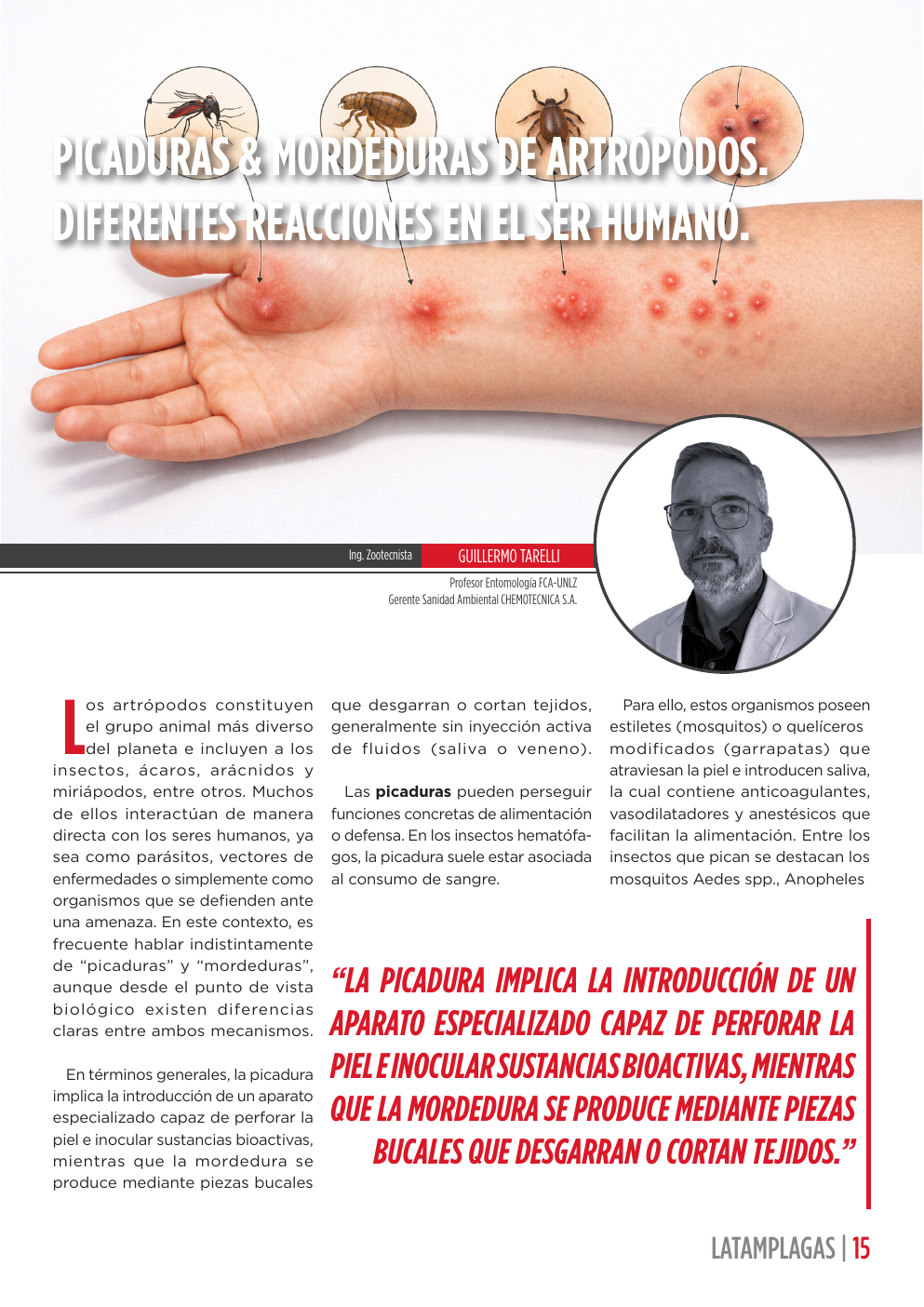
Arthropods constitute the most diverse animal group on the planet and include insects, mites, arachnids and myriapods, among others. Many of them interact directly with human beings, either as parasites, disease vectors or simply as organisms that defend themselves against a threat. In this context, it is common to speak interchangeably of “stings” and “bites”, although from a biological point of view there are clear differences between both mechanisms.
Broadly speaking, stinging involves the introduction of a specialized apparatus capable of piercing the skin and inoculating bioactive substances, while biting is produced by mouthparts that tear or cut tissues, usually without active injection of fluids. The bites can pursue specific feeding or defense functions. In hematophagous insects, the bite is usually associated with blood consumption.
To do this, these organisms have stylets (mosquitoes) or modified chelicerae (ticks) that pierce the skin and introduce saliva, which contains anticoagulants, vasodilators and anesthetics that facilitate feeding. Among the biting insects, the mosquitoes Aedes spp., Anopheles spp., Culex spp., etc., the bed bug Cimex lectularius, fleas and their different species, lice of the order Pthiraptera, suborder Anoplura, vinchucas (Triatominae) and many others stand out. In these cases, the mouthpart acts as a sharp structure that directly accesses the blood vessels, which is why they are classic examples of solenophagous insects, since they insert their stylets directly into the capillaries. Ticks do not gnaw or bite the skin; They have structures called chelicerae adapted to puncture and fix the mite to the epithelial tissue.
“THE MOUTAL APPARATUS ACTS AS A SHARP STRUCTURE THAT DIRECTLY ACCESSES THE BLOOD VESSELS.”
These specialized pieces are called hypostomes, and they turn out to be like an Indian arrow with its center hollowed out for suction. For this reason, it is very difficult to detach a tick when it is attached and feeding. The anchor is so robust that when pulled, the tick can detach, leaving these structures in the skin and giving rise to the entry of pathogenic microorganisms. The mite of the genus Trombicula or Neotrombicula, also known as the red bug or crop mite, feeds on previously liquefied tissue tissues from the inoculation of saliva with high enzymatic content that they perform with their chelicerae. This tiny arthropod usually attacks mainly in spring, closely associated with activities on grass; It lodges in areas of thin skin and is where it usually triggers complicated skin reactions due to the scratching associated with the itching or itching that it generates. Other hematophagous insects, such as horseflies, simulids (black flies or gnats) or sandflies, are classified within the telmophagous group. Their bites are what allow blood to flow and, once accumulated in small “pools”, they can absorb it. They do not bite vessels directly, but bite the skin, generating a small wound. During this process, the insect releases saliva rich in anticoagulant and immunogenic proteins. This type of feeding makes it a much more painful process for the host and can produce more obvious injuries and even infectious processes.
“THIS TYPE OF FEEDING MAKES IT A MUCH MORE PAINFUL PROCESS FOR THE HOST AND CAN PRODUCE MORE EVIDENT INJURIES AND EVEN INFECTIOUS PROCESSES.”
In the case of arachnids, such as spiders and scorpions, the sting mostly serves a defensive or predatory function. These species inoculate poisons through chelicerae or stingers, designed to immobilize prey or deter potential aggressors. In this case, the bite of any organism that is not a prey can be as a defense mechanism and even accidental. The latter is usually the most common interaction between spiders and scorpions with humans. There are insects that also sting, in this case as a purely defensive mechanism, such as bees, wasps, bumblebees and some ants. The stinger, the active part that inoculates the venom, may or may not be retractable. The stinger in bees is not retractable, it allows the insect to sting only once and, losing part of the digestive tract along with the stinger and poison glands, it will then die. If the stinger is retractable, as in the case of wasps, bumblebees, and some ants, the insects can sting repeatedly. In relation to ants, Solenopsis spp. The fire ant is the most common species associated with skin reactions in people who have spent time lying or sitting on the grass. They are extremely aggressive ants when their movement paths are interfered with or their nests are disturbed. Scolopendras, within the centipede group, have structures such as forcipules behind the jaws that allow them to inoculate poison. Like other arthropods, these are substances that can rarely trigger serious processes, but they are very painful stings.
Allergic reactions and the body's response to these stings or bites vary significantly between people. These clinical manifestations do not depend solely on the arthropod, but mainly on the immunological response of the human being. The reactions are due, in most cases, to hypersensitivity to proteins present in the saliva or the inoculated venom. These substances can trigger mild local reactions, such as redness, edema and pruritus, to severe epithelial lesions, blisters, necrosis or systemic reactions. In sensitized individuals, a generalized allergic reaction, and even anaphylaxis, a life-threatening condition, may occur. It is important to note that each organism reacts differently. There are people in whom bites can go practically unnoticed, while others develop intense responses to minimal exposures. Even the same individual can react differently to a bite from the same insect on different days, depending on their immune status, previous exposure and other physiological factors. It should be taken into account that small children or the elderly are usually the highest risk groups. In the first case, due to the lack of specialization of the immune system, while, in the second, the defensive barriers could be deteriorated. Understanding the differences between arthropod stings and bites is essential not only from a biological point of view, but also from a health point of view. These interactions can have consequences ranging from simple skin discomfort to serious epithelial diseases or fatal anaphylactic reactions. Recognition of the type of injury and the organism involved allows for better prevention, diagnosis and treatment of associated effects. It is very important to keep in mind that these are not “pathognomonic” lesions, characteristic and always the same. The images, infographics and posters that exist associating a type of injury with a type of arthropod often trigger confusion, in many cases wrong diagnoses, delays in decision-making and negative results. Yes, there are distribution patterns of stings or bites that could have a greater correlation with a particular organism, but not the type of injury.