
The use of UV-A lamps to control flies and flying insects in the food industry
The control of the Asian tiger mosquito (Aedes albopictus) as well as the monitoring of other invasive species observed in Europe with increasing frequency (Ae.
Technical summary
- Focus
- The control of the Asian tiger mosquito (Aedes albopictus) as well as the monitoring of other invasive species observed in Europe with increasing frequency (Ae.
- Approach
- It brings together technical criteria linked to Edición 17, industria alimentaria and lámparas UVA.
- Use
- Useful for professionals who need context, diagnosis and operational decisions in food safety and industry.
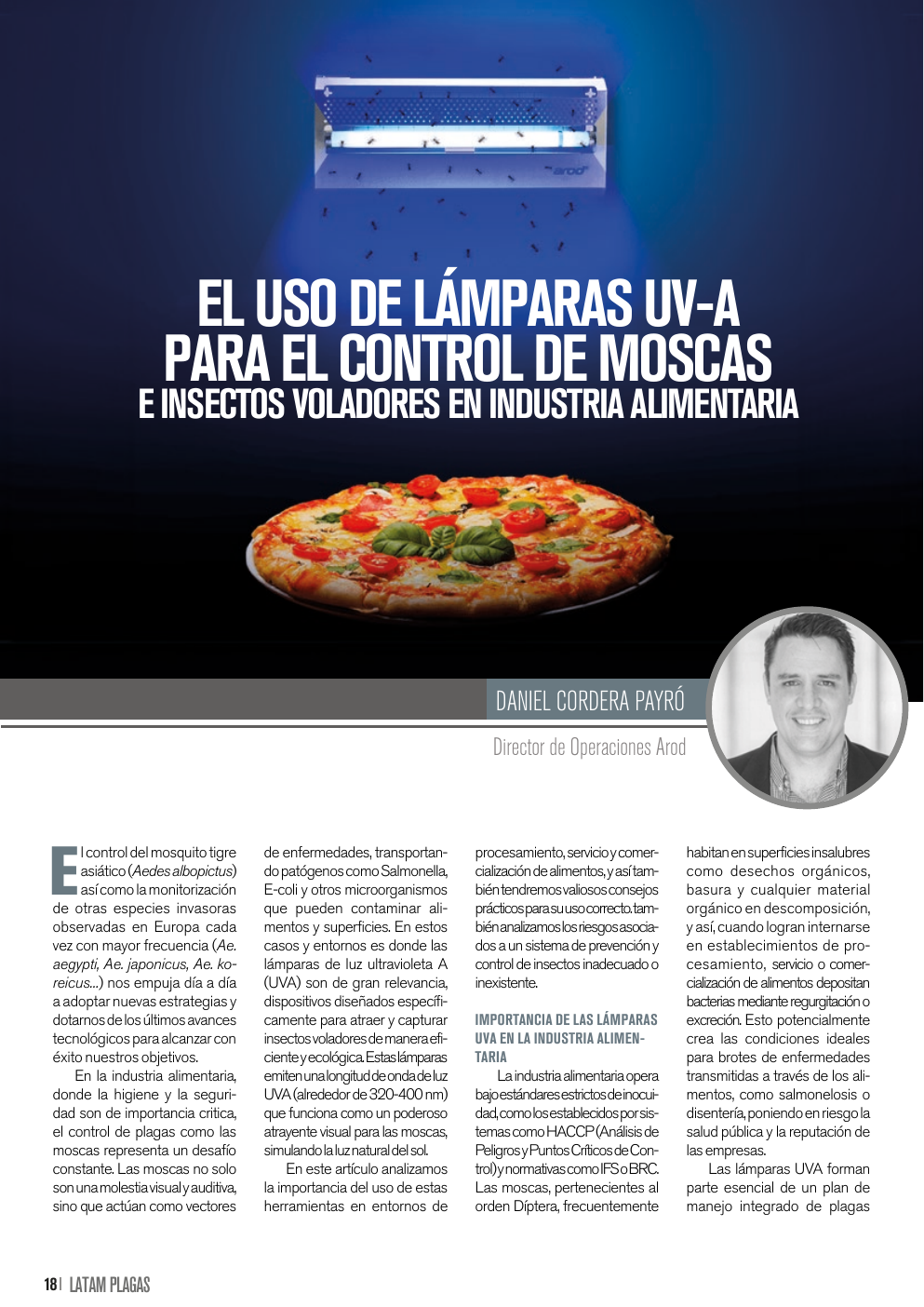
The control of the Asian tiger mosquito (Aedes albopictus) as well as the monitoring of other invasive species observed in Europe with increasing frequency (Ae. aegypti, Ae. japonicus, Ae. koreicus...) pushes us every day to adopt new strategies and equip ourselves with the latest technological advances to successfully achieve our objectives. In the food industry, where hygiene and safety are of critical importance, controlling pests such as flies represents a constant challenge. Flies are not only a visual and auditory nuisance, but they act as disease vectors, carrying pathogens such as Salmonella, E-coli and other microorganisms that can contaminate food and surfaces. In these cases and environments is where ultraviolet A (UVA) light lamps are of great relevance, devices specifically designed to attract and capture flying insects in an efficient and ecological way. These lamps emit a wavelength of UVA light (around 320-400 nm) that works as a powerful visual attractant for flies, simulating natural sunlight. In this article we analyze the importance of using these tools in security environments.
food processing, serving and marketing, and we will also have valuable practical advice for its correct use. We also analyze the risks associated with an inadequate or non-existent insect prevention and control system. IMPORTANCE OF UVA LAMPS IN THE FOOD INDUSTRY The food industry operates under strict safety standards, such as those established by systems such as HACCP (Hazard Analysis and Critical Control Points) and regulations such as IFS or BRC. Flies, belonging to the order Diptera, frequently
They live on unhealthy surfaces such as organic waste, garbage and any decomposing organic material, and thus, when they manage to enter food processing, service or marketing establishments, they deposit bacteria through regurgitation or excretion. This potentially creates ideal conditions for outbreaks of foodborne illnesses, such as salmonellosis or dysentery, putting public health and business reputations at risk. UVA lamps are an essential part of a
(IPM), minimizing the use of toxic chemicals and promoting effective and hygienic control. We have detected over many years of use and development that these devices capture more than 90% of flying pests within an establishment as long as they are located correctly and have the correct quality and components, contributing to “zero tolerance” environments for pests. In this way, it allows us to detect potential infestation problems and prevent or correct other measures before having problems that put public health at risk. Let us remember that they are a tool that is part of a set of techniques and solutions for comprehensive pest management. Also, the new BugsterLED technology allows us not only a longer life of the product but also significant savings in energy consumption. In the food service sector known as HORECA (hotels, restaurants and cafes), these lamps allow us to have active and uninterrupted insect control while businesses are active and with customers inside, going unnoticed by the public since there are aesthetic and discreet designs such as the Bugster Lite and the Bugster Cenith, which do not negatively affect the appearance inside the establishments. It is considered an ecological tool, since it avoids or reduces the use of pesticides and due to its general characteristics it aligns with sustainability trends. HOW UVA LAMPS WORK Flies and other species of flying insects are vulnerable to UVA light due to their phototactic vision, which when exposed to specific wavelengths generates strong light stimuli. The lamps emit UVA rays that attract insects into the interior of the
device, where they are trapped thanks to the glue traps strategically located inside. Models such as the Bugster 30 from Arod, with two 15W lamps with anti-burst protection and rust-resistant aluminum design, offer discreet and effective capture, attracting flies without electrocuting them and containing any risk agent inside the equipment, ensuring that there is no spread of organic particles in the environment or inconvenience to customers and business personnel. TIPS FOR THE CORRECT USE OF UVA LAMPS To maximize effectiveness, it is crucial to follow recommended practices based on research and regulations: Strategic location: Place the lamps at the ideal height at which flying insects find the most attractive areas, generally this is no more than 2 meters high and no less than 50 cm from the floor. It is important to locate insect passage areas such as doors, windows or near garbage areas, cleaning utensils, bathrooms, taking care that they are not located too close to exposed food to avoid attracting flies directly to them. Avoid areas with direct air currents such as air conditioners, air curtains or, conversely, ovens or very hot areas (ideal: 25-30°C), as they may affect the attraction. In large establishment plants, the use of multiple units spaced more than 5 meters apart is recommended to effectively cover and ensure the safety of the establishments. MAINTENANCE: it is recommended to ensure the change of UVA tubes maximum every 12 months, ensuring the change at the beginning of seasons with a high insect population such as the warmest or rainiest seasons, since they progressively lose their useful life, in this way we ensure that the most problematic time of the
year we will have the highest efficiency of the lamps. In the same way, it is recommended to change the adhesive traps weekly. Changing UVA tubes is recommended to be carried out with companies specialized in pest control, ensuring that they are of the correct specification and with the quality that allows adequate attraction. INTEGRATION WITH IPM: without fear of being repetitive, these are ideal tools in IPM (comprehensive pest management) that is, their use is most effective when combined with additional preventive measures such as ensuring that doors and windows are in good condition and with their mosquito net or mesh protections, the correct sanitation and confinement of all organic elements such as garbage containers with lids and regularly sanitized, drains and drains correctly treated and sealed, Hawaiian curtains in areas that require it and any other element that allows flying insects to enter the establishment. Monitoring with these tools allows species to be identified and thus implement other control methods specific to the problems detected with UVA lamps for flying insects. EQUIPMENT SELECTION: There are designs and specifications for all types of environments and conditions, from decorative equipment such as the Bugster Cenith and Lite for diner areas in restaurants, to industrial and high capture equipment such as Bugster 60 and 30 for food processing, storage or treatment areas. There are also ideal equipment and designs to place on walls and columns or designs such as the Bugster Up to hang from ceilings if there are no ideal walls.
and in safe conditions for users. Hire professional services for installation and audits. Following these recommendations, efficient control is achieved, reducing the existence of pests by up to 90%.
SAFETY AND COMPLIANCE: Make sure devices comply with international electrical standards to ensure your investment lasts a long time
RISKS OF NOT HAVING UV LAMPS OR OTHER CONTROL TOOLS The lack of effective control of flies and flying insects in the food industry can
cause serious consequences. Flies are considered powerful transmitters of pathogenic elements, acting as vectors of more than 100 diseases, including typhoid fever, hepatitis and cholera. In food processing companies, inadequate management of the prevention of flying insects can cause serious consequences in the rest of the commercial chain such as detentions and destruction in customs when exporting products, recovery of processed foods and even lawsuits for contamination and non-compliance with international standards, with many real cases of serious problems related to inefficient control of flying insects. Without tools like UVA lamps, pests reproduce quickly and many times before staff are aware of potential problems, a house fly lays up to 150 eggs, evolving in days under the right conditions. In addition to this, failure to comply with audits in the food industry can result in the loss of certifications, affecting exports and contracts.
UVA lamps are an indispensable tool in comprehensive pest management (IPM) in the food industry for effective and sustainable control of flies, protecting food safety and meeting international standards. Its importance lies in preventing contamination and diseases. Following recommendations such as optimal location and correct maintenance ensure optimal results. Ignoring or dispensing with the use of these devices puts any establishment that handles food at latent risk of health problems and financial losses. We recommend the use of brands such as Arod's Bugster that offer reliable and high-quality solutions in international standards, integrating perfectly into IPM plans. Implementing these lamps not only protects public health, but also boosts business efficiency and sustainability. For personalized advice, consult our experts or your pest control professional.