
Effects of insecticides on scorpions
Scorpions are easily recognizable arachnids related to spiders, mites and ticks.
Technical summary
- Focus
- Scorpions are easily recognizable arachnids related to spiders, mites and ticks.
- Approach
- It brings together technical criteria linked to Edición 13, arácnidos and escorpiones.
- Use
- Useful for professionals who need context, diagnosis and operational decisions in products and technologies.
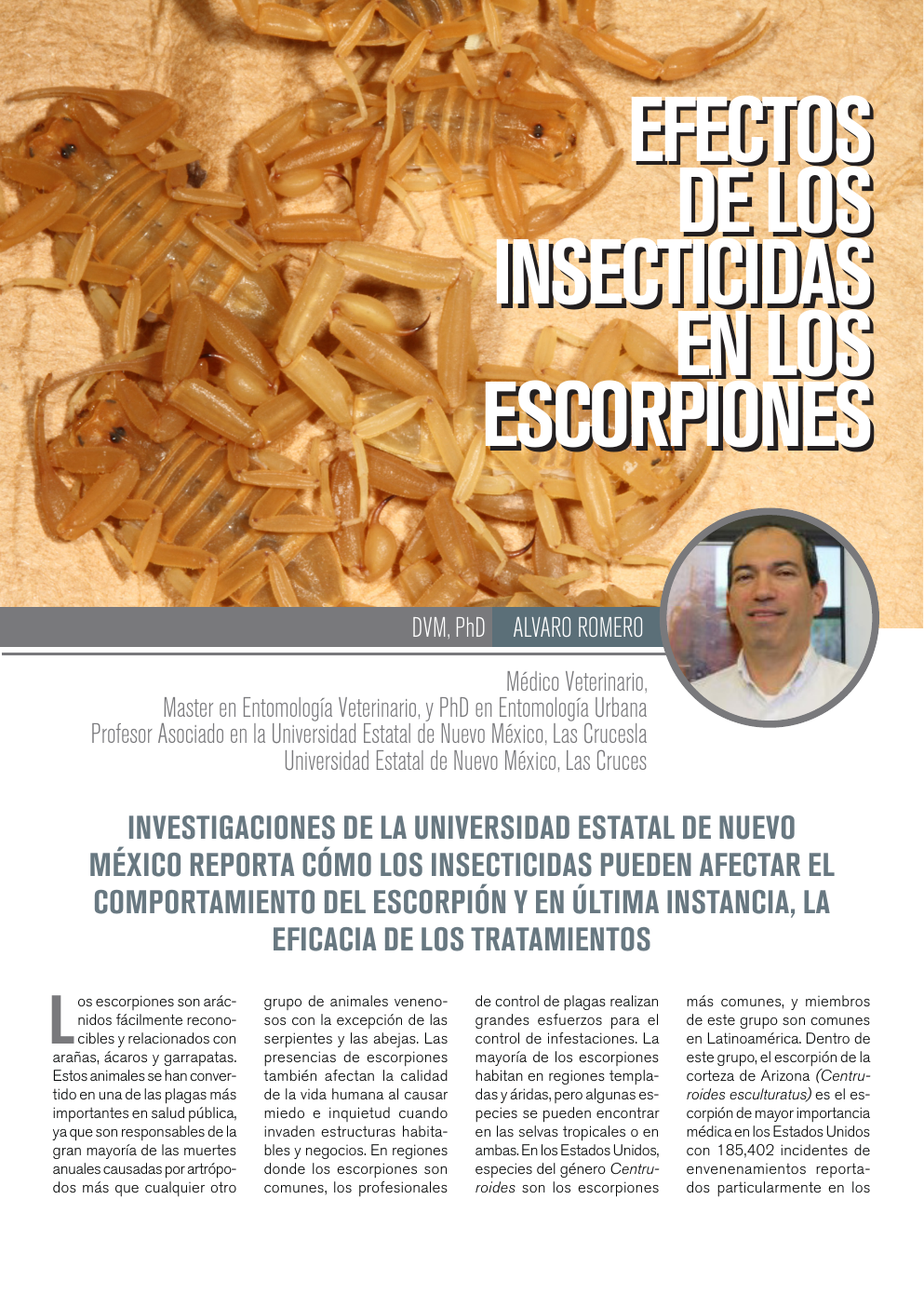
Scorpions are easily recognizable arachnids related to spiders, mites and ticks. These animals have become one of the most important public health pests, as they are responsible for the vast majority of annual deaths caused by arthropods more than any other group of venomous animals with the exception of snakes and bees. Scorpion presences also affect the quality of human life by causing fear and concern when they invade habitable structures and businesses. In regions where scorpions are common, pest control professionals make extensive efforts to control infestations. Most scorpions live in temperate and arid regions, but some species can be found in tropical rainforests or both. In the United States, species of the genus Centruroides are the most common scorpions, and members of this group are common in Latin America. Within this group, the Arizona bark scorpion (Centruroides sculpturetus) is the most medically important scorpion in the United States with 185,402 incidents of envenomations reported particularly in the experimental ones where half had been treated with insecticides, while, in a second study, the scorpions were studied when they interacted with an insecticide-treated shelter. These findings improve our understanding of the responses of scorpions to insecticides and provide information that is useful for better management in control plans for these arthropods. figure 01 states of Arizona, Texas and Nevada. Despite the medical importance of scorpions in these areas, there is no information on how these scorpions interact with or are affected by pesticide residues, information that is useful for better managing infestations. SCORPION HABITATS Arizona bark scorpions are poor burrowers and can be found under rocks, hiding in cracks in the ground, and also on trees (Fig. 1). In urban areas, scorpions invade habitable structures, found mainly under dishwashers, bathtubs, shoes, drawers, closets or clothing cabinets. Scorpions are nocturnal animals that come out at night to hunt insects, which they ambush. Figure 1. Scorpion on the bark of a tree in an urban area of Phoenix, Arizona It is during these moments of hunting, or when they are returning to their shelters, when scorpions can make contact with deposits of previously applied insecticides. To understand a little more about the effect of insecticides on scorpions, a series of experiments were conducted in the New Mexico laboratory simulating possible practical field scenarios where these scorpion-insecticide deposit interactions occur. In a first study, scorpions were studied in areas EXPERIMENT #1: RESPONSE TO TREATED AREAS The objective of this experiment was to evaluate the responses of scorpions when encountering areas treated with insecticide. This scenario is very common when insecticide treatments are applied to areas where scorpions are presumed to be hiding or potential infested areas. This experiment was carried out on concrete tablets (30 x 30 cm) to whose halves one of the three liquid insecticides that were evaluated in this study was applied (Fig. 2). Once the insecticide dried (approximately 2 hours), individual scorpions were placed on the untreated half. (Fig. 2). To prevent scorpions from escaping from the experimental area, segments of PVC pipes (25 cm diameter x 5 cm height) were used (Fig. 2). Three insecticidal formulations were evaluated: Demon® Max (25.3% cypermethrin; AI concentration used: 0.02%), Demand® CS (9.7% lambda-cyhalothrin; AI concentration used: 0.03%) and the mixture “Demand CS (0.03%) and Demon Max (0.02%). The experiment was carried out in the dark for 20 minutes, using an infrared camera. and two infrared light illuminators located on the sand to study the response of the scorpions. For tracking and quantitative analysis of scorpion activity, EthoVision Once the 20-min evaluation period was over, the scorpions were transferred to containers to determine daily mortality for 10 days, in order to correlate exposure to the insecticide and mortality. Figure 2. Experimental arenas used to evaluate scorpion responses to insecticides. Top left: scorpion approaching an insecticide-treated area; Figure 02 top right: activity of a scorpion recorded during 20 minutes of bioassay; Below: an arena containing a shelter that had been treated with insecticide. EXPERIMENT 2: RESPONSES TO INSECTICIDE-TREATED SHELTERS The objective of this study was to determine whether scorpions would hide in an insecticide-treated shelter. This experiment would simulate crack and crevice insecticide treatments commonly recommended in integrated scorpion management (ISM) programs. The arena was similar in size to that described in Experiment 1. However, the only treated area in the arena was a shelter made of 7.5 cm x 12.5 cm construction paper, which was placed in the center of the area (Fig. 2). Four fluorescent tube lights were placed on the sands that illuminated the sands for 12 hours in order to simulate daylight and stimulate the scorpions to hide figure 04 figure 03 the shelter treated with insecticides. After 12 hours, the location where the scorpions were found was recorded, whether hidden in the shelter or outside, wandering in the experimental arena. The scorpions used in this experiment were transferred to containers once the test was completed to determine mortality for 10 days. RESULTS In specific experiments, scorpions spent similar amounts of time in areas treated with Demon Max, Demand CS or Demand CS + Demon Max +, compared to untreated arenas (control) (Fig. 2). The mortality of scorpions after the concrete test was 0% mortality with Demon Max, 70% with Demand CS and 40% with Demand CS + Demon Max (Fig. 3). In experiments on ceramic tiles, scorpions tended to avoid walking on the insecticide-treated halves (Fig. 3) and often adopted a “stilt-like” posture when they came into contact with the insecticide (Fig. 4). Scorpions that interacted with halves treated with Demon Max did not die. Contrary to this, a high mortality (90%) of scorpions was recorded in arenas whose halves had been treated with Demand CS. However, this mortality was reduced to 70% in the halves that were treated with the Demand CS + Demon Max mixture (Fig. 3). Figure 3. Location of scorpions in sand (concrete or tile) whose halves were treated with insecticides. Mortality was recorded after the test on day 10. Figure 4. Typical posture of scorpions when coming into contact with surfaces treated with insecticide. 3A, normal posture of a scorpion that is not exposed to insecticides, where it lies completely flat on the surface, dragging its body when walking or raising its body slightly above the surface. 3B shows a scorpion beginning to walk “on its toes.” Scorpions during this phase often maintain this posture to reduce exposure to insecticides. 3C, extreme response of scorpions to insecticides where exposure to insecticide residues is minimized as much as possible. EXPERIMENT 2: RESPONSES TO INSECTICIDE-TREATED CASHES After 12 hours in the sand, all scorpions in the control group (untreated caches) were found in the shelter, while most scorpions avoided sheltering in insecticide-treated caches (Fig. 5). However, a low proportion of scorpions hiding in caches treated with Demon Max (20%) or Demand CS + Demon Max (30%) was observed, and none of the scorpions sought refuge in caches treated with Demand CS. Despite the low refuge rate of scorpions in arenas with Demand CS or Demand CS + Demon Max, these scorpions had significant mortality (≥80%) 10 days after exposure. This indicates that most of these scorpions spent sufficient time in the cache making contact with the insecticide deposits to cause mortality during the 12 hours. Scorpion mortality was minimal (10%) in Demon Max assessments (Fig. 5). Figure 5. Proportion of scorpions found hiding in insecticide-treated shelters and proportion of dead scorpions 10 days after the experiment. The gray bars indicate the percentage found in the refuge and the line indicates the scorpion mortality after 10 days. IMPLICATIONS OF THE STUDY Under natural conditions, scorpions spend most of their time in hiding places, which they leave at night to catch and feed on insects. It is during this time that scorpions may come into contact with deposits of previously applied insecticides. While it is generally assumed that insecticides are highly effective against scorpions, very little is known about how these residues affect the behavior of these animals, which ultimately determines the effectiveness of treatments. Scorpions, like many arthropods, avoid prolonged exposure to insecticides by moving away from treated areas or adopting “tiptoe” postures (see below). If scorpions avoid insecticides and relocate to other areas, the effectiveness of scorpion control programs may be reduced. In evaluations on concrete, scorpions spent more time in areas treated with insecticides than when these evaluations were carried out on tile. In this scenario, it would then be deduced that scorpions would be more exposed to insecticides when it is deposited on concrete, which would produce a more rapid death. However, it is well known that insecticides tend to be absorbed more on porous surfaces than on smooth surfaces, thus reducing the insecticidal effect of the deposits. This clearly occurred with Demand CS and the Demand CS + Demon Max mixture, which caused greater mortality in tile. Regardless of the type of surface tested, however, Demand CS caused the highest mortality in scorpions and this is possibly due to the micro-encapsulation technology used in the production of this formulation which protects the active ingredient from being rapidly absorbed into the surface. Another aspect we evaluated was whether scorpions would choose to hide in insecticide-treated shelters. This is a typical scenario in scorpion control, where the insecticide application is directed at their potential shelters. In all trials, the majority of scorpions were found outside the shelter that had been treated with insecticides. Scorpions were frequently found wandering around the experimental arena, some with obvious signs of poisoning, which are consistent with pyrethroid toxicity. This is a clear indication that the scorpions at some point during the 12 hour trial were in contact with the insecticide that had been applied in the shelter. We conclude then that crack and crevice treatments in areas where scorpions are presumed to be present are effective, and areas similar to these (foundation bases and wall voids) should be treated with insecticides for better scorpion management. Scorpions exhibit cryptic and nocturnal behavior with the ability to reduce contact with insecticide deposits through behaviors that include evasion movements and “tiptoe positioning.” The results of this research then show that the use of effective pesticide formulations, knowledge of the habitat, behavior of scorpions and specific application to shelters can improve infestation control. Alvaro Romero is a Veterinarian, Master in Veterinary Entomology, and PhD in Urban Entomology; Associate Professor at New Mexico State University, Las Cruces, NM. John Agnew and Brittny Blakely are graduate students at the same institution. Dr. Eric Paysen is Technical Service Manager at Syngenta. This study was funded by Syngenta. Products reviewed may not be available for purchase outside of the United States. This article was translated by Alvaro Romero into Spanish with authorization from Pest Control Technology from the original title “Arizona Bark Scorpions And Their Responses to Insecticides”. figure 05