
Pesticide toxicology
The use of pesticides within the chemical control strategy in Integrated Pest Management implies not only knowing the spectrum of action on the pests to be controlled, but also toxicological aspects for their...
Technical summary
- Focus
- The use of pesticides within the chemical control strategy in Integrated Pest Management implies not only knowing the spectrum of action on the pests to be controlled, but also toxicological aspects for their rational and...
- Approach
- It brings together technical criteria linked to Edición 15, latam plagas and plaguicidas.
- Use
- Useful for professionals who need context, diagnosis and operational decisions in edición 15.
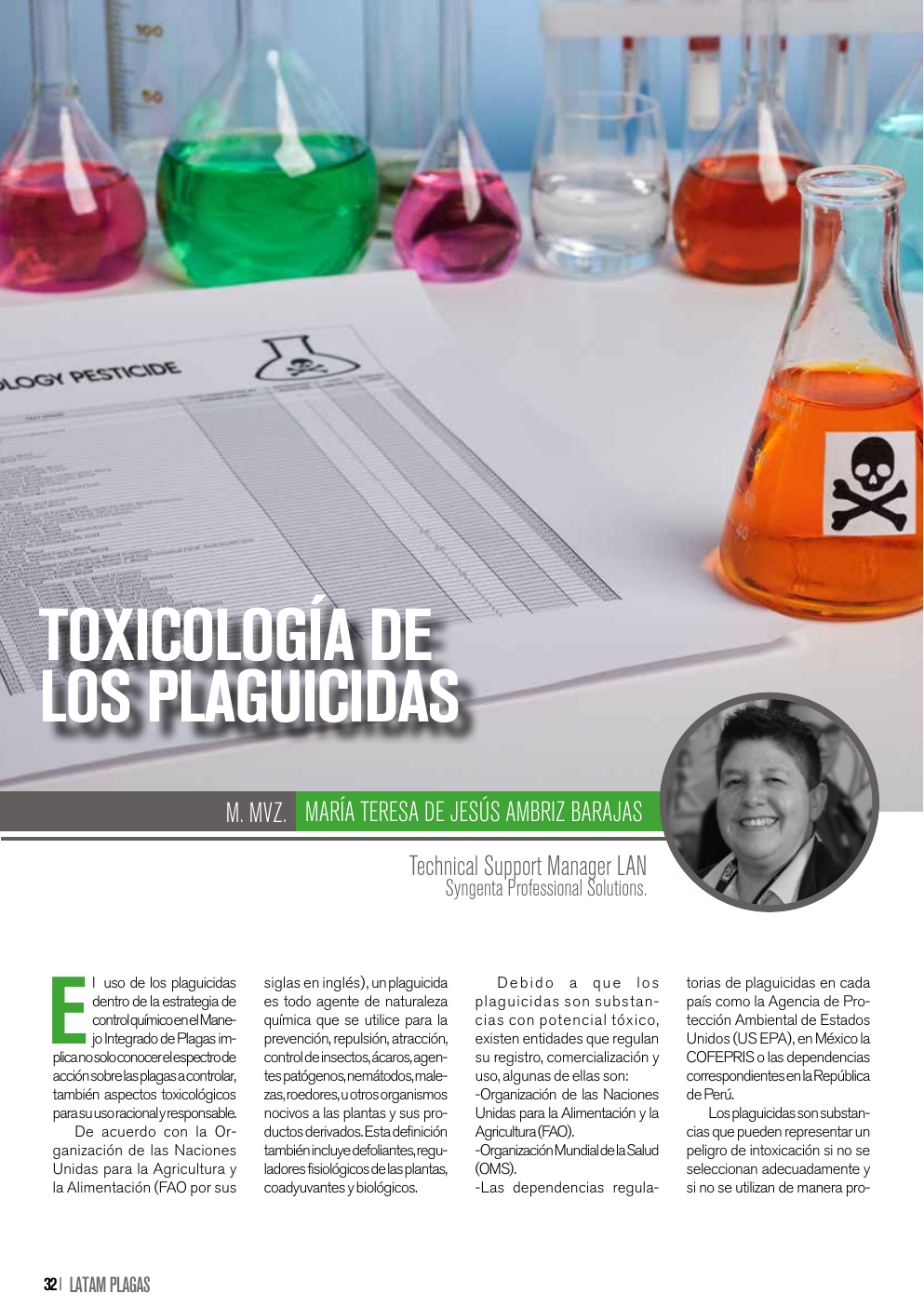
The use of pesticides within the chemical control strategy in Integrated Pest Management implies not only knowing the spectrum of action on the pests to be controlled, but also toxicological aspects for their rational and responsible use. According to the Food and Agriculture Organization of the United Nations (FAO), a pesticide is any agent of a chemical nature that is used for the prevention, repulsion, attraction, control of insects, mites, pathogens, nematodes, weeds, rodents, or other organisms harmful to plants and their derived products. This definition also includes defoliants, plant physiological regulators, adjuvants and biologicals. Because pesticides are substances with toxic potential, there are entities that regulate their registration, marketing and use, some of them are: -Food and Agriculture Organization of the United Nations (FAO). -World Health Organization (WHO). -The pesticide regulatory agencies in each country such as the United States Environmental Protection Agency (US EPA), in Mexico the COFEPRIS or the corresponding agencies in the Republic of Peru. Pesticides are substances that can represent a danger of poisoning if they are not selected appropriately and if they are not used in a professional and responsible manner. Paracelsus (1493-1541), the father of toxicology, coined this phrase: “Nothing is poison, everything is poison, the difference is in the dose.” The toxicity of a substance or pesticide is the amount that causes damage to the body. The factors inherent to the individual that can modify the toxicity of a pesticide are weight, age, sex, pre-existing diseases and other factors may be the type of substance, frequency of exposure to it. Some pesticide active ingredients are less toxic than such common substances as table salt, which has an acute oral LD50 of 3000 mg/kg, equivalent to 3 g of salt per kg of body weight, and in excessive amounts is a greater risk than most pesticides used by a Pest Management Professional. Or for example, acetylsalicylic acid (antipyretic and analgesic) has an acute oral LD50 of 200 mg/kg. CLASSIFICATION OF PESTICIDES Since the 1970s, there have been various versions of classification of the degree of toxicity of pesticides based on the main routes of exposure to them, such as oral, dermal and inhalation routes, since the class or toxicological category of a pesticide is determined with doses in milligrams of active ingredient per kilogram of weight in rats (mg i. a. / kg). In some countries, the classification is also determined for the commercial formulation, since some inerts could be a greater risk than the active ingredient or because it is absurd to classify some pesticides, such as rodenticides, based only on the active ingredient, given that the concentration ranges from 0.001 to 0.005% in commercial rodenticides. Acute toxicology parameters to determine the toxicity of an active ingredient or formulation are as follows: (LC50): Concentration of a substance in the air that is fatal for 50% of a group of test animals, in a given time, where the route of exposure is always inhalation. It is expressed in the case of gases in ppm and for vapors, dusts and mists in mg/l. Since 2009, the World Health Organization determined to align the classification of pesticides by their risk with the Globally Harmonized System or GSH (“The Globally Harmonized System of Classification and Labeling of Chemicals”, for which this classification has been adopted in several countries, as well as the color of the toxicological band and distinctive phrases for the labeling of commercial products: (1)
- Lethal Dose50 (LD50): Dose of a substance that is lethal to 50% of a group of test animals, where the route of administration can be oral or dermal. It is expressed in milligrams of active ingredient per kilogram of weight (mg i.a./kg). To understand the implications and risks of pesticide use, whatever their classification, it is relevant to know some basic concepts:
- Lethal Concentration 50 Danger: always present... Always latent, but the danger can be managed. The danger in handling pesticides increases with greater exposure. Exposure is the result of concentration X time… how many times you are exposed to a hazard and what concentrations. The greater the exposure to a given danger, the greater the Risk. The risk is also manageable. Risk: probability that a substance will cause us some harm in a specific condition.
- Stay calm and act quickly, rationally and coordinatedly,
- Remove the poisoned person from the source of contamination to avoid further contact.
- In case of inhalation, remove the patient to fresh air.
- Call the poison control center in your country and have the product label on hand.
- Get medical attention immediately and show the label. Do not induce vomiting; if the patient is unconscious, there may be aspiration. Make sure you can breathe without difficulty. Do not try to put anything in your mouth at all. The doctor must assess whether the patient is susceptible to gastric lavage.
- Keep the patient warm and at rest.
- In case of contact with skin, immediately remove all contaminated clothing and wash thoroughly with soap and water.
- If ingested, rinse mouth with water.
- In case of contact with the eyes: irrigate immediately with eyewash solution or clear water for at least 15 minutes, keeping the eyelids open. Rinse with a 4% sodium bicarbonate solution or, failing that, with clean water.
- If the product is ingested by domestic animals, consult a Veterinarian. For Syngenta, your health is important and we are always aware of the safety of the users of our products and their customers. Read the DL 50 ACUTE ORAL DL 50 ACUTE DERMAL pesticide label before using the product and identify the potential risks of handling, use the appropriate personal protective equipment and/or indicated on the label and respect the dosage and application instructions. Insecticide products with Syngenta's patented iCap® microencapsulation technology such as Actellic® 300CS (Pirimiphos methyl) and Demand® 10CS/ Icon® 10CS (Lambda cyhalothrin) are formulations approved in different countries and whose toxicological classifications correspond to a wide margin of safety, since they have been evaluated and approved with the new Prequalification procedure of the World Health Organization for vector control (PQT-VC) and are very important chemical control tools for controlling mosquitoes, among other pests for which they have a spectrum of action in the countries where they are marketed. Below are the toxicological parameters of the two formulations expressed in mg of i. a/kg weight: (3) These two products are approved by the DIGESA of the Republic of Peru and are commercially available. LITERATURE. Ministry of Health. 2010. Official Mexican STANDARD NOM232-SSA1-2009, Pesticides: which establishes the requirements for packaging, packaging and labeling of technical grade products for agricultural, forestry, livestock, gardening, urban, industrial and domestic use. DOF April 13, 2010. World Health Organization. 2010. The WHO Recommended Classification of Pesticides by Hazard and Guidelines to Classification. 2009.
ESTIMATION OF THE RISK OF INTOXICATION: Risk = danger The degree of toxicity always depends on the exposure, that is, the effective contact of the toxicant, such as a pesticide, with the organism. The routes of entry of the substance into the body can be oral, by dermal absorption through the skin, mucous membranes and eyes, and inhalation through the respiratory system. Regarding dermal exposure, the percentage of penetration capacity of pesticides is (1) Source: Mexican Official Standard NOM-232-SSA1-2009 (2) Source: contribution to Syngenta from Dr. Piedad Calle. different depending on the area of the body that was exposed: (2) To measure the degree of exposure to a pesticide there are 3 parameters: -Exposure dose: amount of active ingredient per kg of body weight. -Exposure frequency: number of times. -Exposure time: hours, days or months. HOW TO ACT ACCORDING TO EXPOSURE TO PESTICIDES. Pesticides have a certain composition, that is, they have an active ingredient, which is the main component of a formulation, and additive or inert ingredients, that is, any other substance, outside of active ingredients, added to the formula. The active ingredients are classified into different chemical groups and these groups, depending on their composition, have ACTELLIC PRODUCT 300 CS DEMAND 10CS (3) mechanisms of action through various processes in pests, but they can also affect people and animals not subject to control, if they are not used rationally and appropriately. What to do in case of emergency due to pesticide poisoning is the following: