
On the social territories of dengue and other reflections
On the social territories of dengue and other reflections: Since Kimura and Hotta isolated its causal agent in 1943, the research and study of dengue have been developed under the mechanical perspective of the...
Technical summary
- Focus
- Since Kimura and Hotta isolated its causal agent in 1943, the research and study of dengue have been developed under the mechanical perspective of the positivist and neopositivist paradigms, which privilege the biomedical...
- Approach
- It brings together technical criteria linked to Edición 9, dengue and latam plagas.
- Use
- Useful for professionals who need context, diagnosis and operational decisions in public health and vectors.
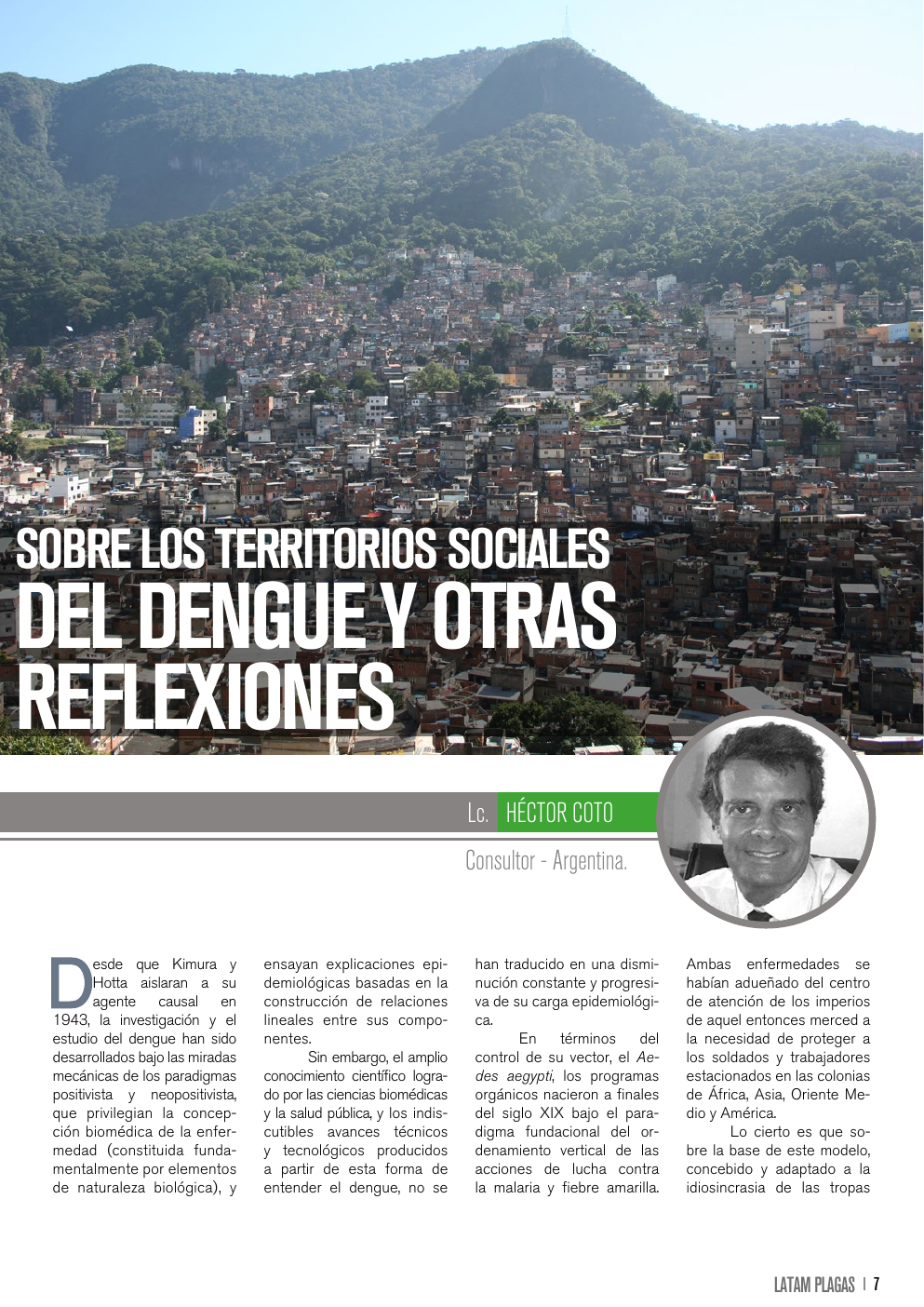
Since Kimura and Hotta isolated its causal agent in 1943, the research and study of dengue have been developed under the mechanical perspective of the positivist and neopositivist paradigms, which privilege the biomedical conception of the disease (mainly constituted by elements of a biological nature), and
They test epidemiological explanations based on the construction of linear relationships between its components. However, the extensive scientific knowledge achieved by biomedical sciences and public health, and the indisputable technical and technological advances produced from this way of understanding dengue, are not
have translated into a constant and progressive decrease in its epidemiological burden. In terms of the control of its vector, Aedes aegypti, organic programs were born at the end of the 19th century under the founding paradigm of the vertical organization of actions to combat malaria and yellow fever.
Both diseases had taken over the center of attention of the empires of that time thanks to the need to protect soldiers and workers stationed in the colonies of Africa, Asia, the Middle East and America. The truth is that on the basis of this model, conceived and adapted to the idiosyncrasies of the occupation troops (and here its military roots are understood), programmatic constructions for vector control, dominated by rigid organizations headed by central commands, burst onto the health scene at the beginning of the 20th century. Their actions were based on the conviction that eradication technology was available and that success depended on the meticulous application of established procedures. Thus, from their beginnings, the operating costs and investment expenses for the maintenance of these programs were unsustainably high, due to the use of control methods that privileged high coverage, mainly with insecticides. Along these same lines, decades later, the subsequent incorporation of other actions such as the physical elimination of breeding sites and the application of larvicides followed the same logic. This partly explains why everything attempted to date has only had a limited and temporary impact on dengue prevention, either because it was ineffective or because its coverage was limited. But, in addition, currently, from various sectors, there is a growing recognition of the multidimensional nature of the surveillance and control of Aedes aegypti, which contemplates in its characterization a complex network of sociocultural, political, biological, environmental and health aspects in permanent interaction. This allows us to understand the differential patterns of exposure and vulnerability between groups and social subjects. Thus, the appearance of dengue is not a fact due to random factors, but the result of an intricate process in which the contexts of poverty, as limits of the structural and functional logic of the population that suffers from them, play a substantial role in the pattern of occurrence of the infection. An anticipatory view in this sense was developed, decades ago, by the Brazilian intellectual Milton Santos, who maintained that the heterogeneity of the social, economic, political and cultural structures of a human population modulates the paths and emphases with which the disease is distributed. In Latin America, populations with urban and peri-urban expressions associated with precarious housing conditions, poor network water supply, overcrowding, low educational levels, poor sanitary conditions and unstable insertion in the productive system, combine determinants of vulnerability to dengue that should not be ignored. For these and other reasons, many historical paradigms have been shattered in the last five years. The requirement to overcome classical approaches is evident, and it is
The need to structure actions on concepts that abandon easy or stereotyped formulas, which provided satisfactory explanations about the occurrence of diseases vectored by Aedes aegypti, and dogmatically guided the course of actions, but, of course, did not solve the problem, becomes increasingly compelling. The new models have initiated a deep and praiseworthy reflection, not stripped of a veiled and self-critical retrospective, on the ways of weighing the tensions generated by dimensions and forces that interact and define the formation of the scenarios in which dengue takes place. Finding links between the mosaic of variables that define transmission patterns in each local circumstance is the next challenge. This will allow identifying the territorial portions with the highest epidemiological-entomological risk to concentrate comprehensive prevention and control interventions on them. Human attempts to successfully confront dengue are about to enter a new stage. Only the future knows its results.