
Are geckos real pests?
The “Gecko”, “gecko” or “wall lizard” is what we normally call the species of the genus Hemidactylus.
Technical summary
- Focus
- The “Gecko”, “gecko” or “wall lizard” is what we normally call the species of the genus Hemidactylus.
- Approach
- It brings together technical criteria linked to Edición 13, geckos and latam plagas.
- Use
- Useful for professionals who need context, diagnosis and operational decisions in urban pests.
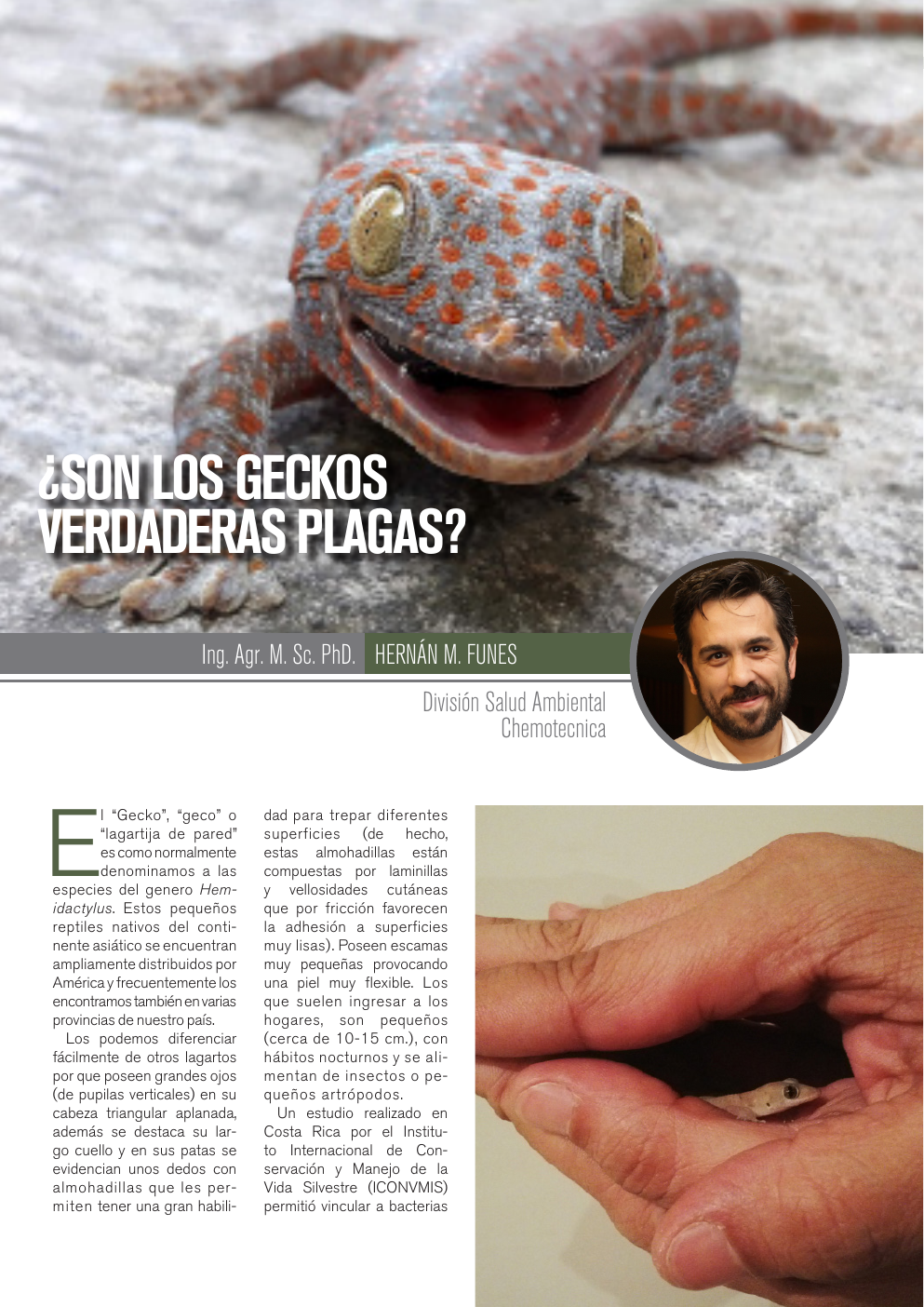
The “Gecko”, “gecko” or “wall lizard” is what we normally call the species of the genus Hemidactylus. These small reptiles native to the Asian continent are widely distributed throughout America and we frequently find them in various provinces of our country as well. We can easily differentiate them from other lizards because they have large eyes (with vertical pupils) on their flattened triangular head, in addition their long neck stands out and on their legs there are fingers with pads that allow them to have a great ability to climb different surfaces (in fact, these pads are composed of skin lamellae and villi that by friction favor adhesion to very smooth surfaces). They have very small scales causing very flexible skin. Those that usually enter homes are small (about 10-15 cm), with nocturnal habits and feed on insects or small arthropods. A study carried out in Costa Rica by the International Institute of Wildlife Conservation and Management (ICONVMIS) made it possible to link Salmonella bacteria present in their droppings, which causes diseases such as salmonellosis, gastroenteritis or meningitis. But according to this research, the presence of Salmonella was only recorded in 4.3% of the cases evaluated in the total gecko excreta examined (more than 100 species). Actually having this type of invaders in a home does not represent a problem, in fact, they can play an important role in reducing populations of other pest insects. However, it is true that the concept of a “problem” being an “invasive species” varies depending on the client and many times we have to act based on the demand that is generated in the market. There are no products for the control of these animals, management lies mainly in enclosure strategies, mainly locating the entry routes to homes. As complementary information, we can add that, as happens with snakes, pyrethroids have an irritating action on them and can in some cases act as a chemical barrier. In this sense, perimeter applications in homes with pyrethroids whose formulations promote residuality (Floables or microencapsulated, for example), are usually an appropriate complement to the aforementioned enclosure. Let us remember that it is a harmless and non-aggressive animal. In our country there is a belief that “geckos” are poisonous, which is an urban myth. No Gecko is poisonous and no poisonous Saurians (lizards and lizards) have been recorded in our country. CMY CM MY CY CMY K