Situation of IPM companies in the context of the pandemic
At the beginning of the year, SARS-CoV-2 made its entry into Argentina, despite the history we had of its passage through Europe and the USA, the measures taken caused a very strong blow to the entire economy.
Technical summary
- Focus
- At the beginning of the year, SARS-CoV-2 made its entry into Argentina, despite the history we had of its passage through Europe and the USA, the measures taken caused a very strong blow to the entire economy.
- Approach
- The article structures the analysis around NEGATIVE EFFECTS IN PANDEMIC and POSITIVE EFFECTS IN PANDEMIC.
- Use
- Useful for professionals who need context, diagnosis and operational decisions in business and training.
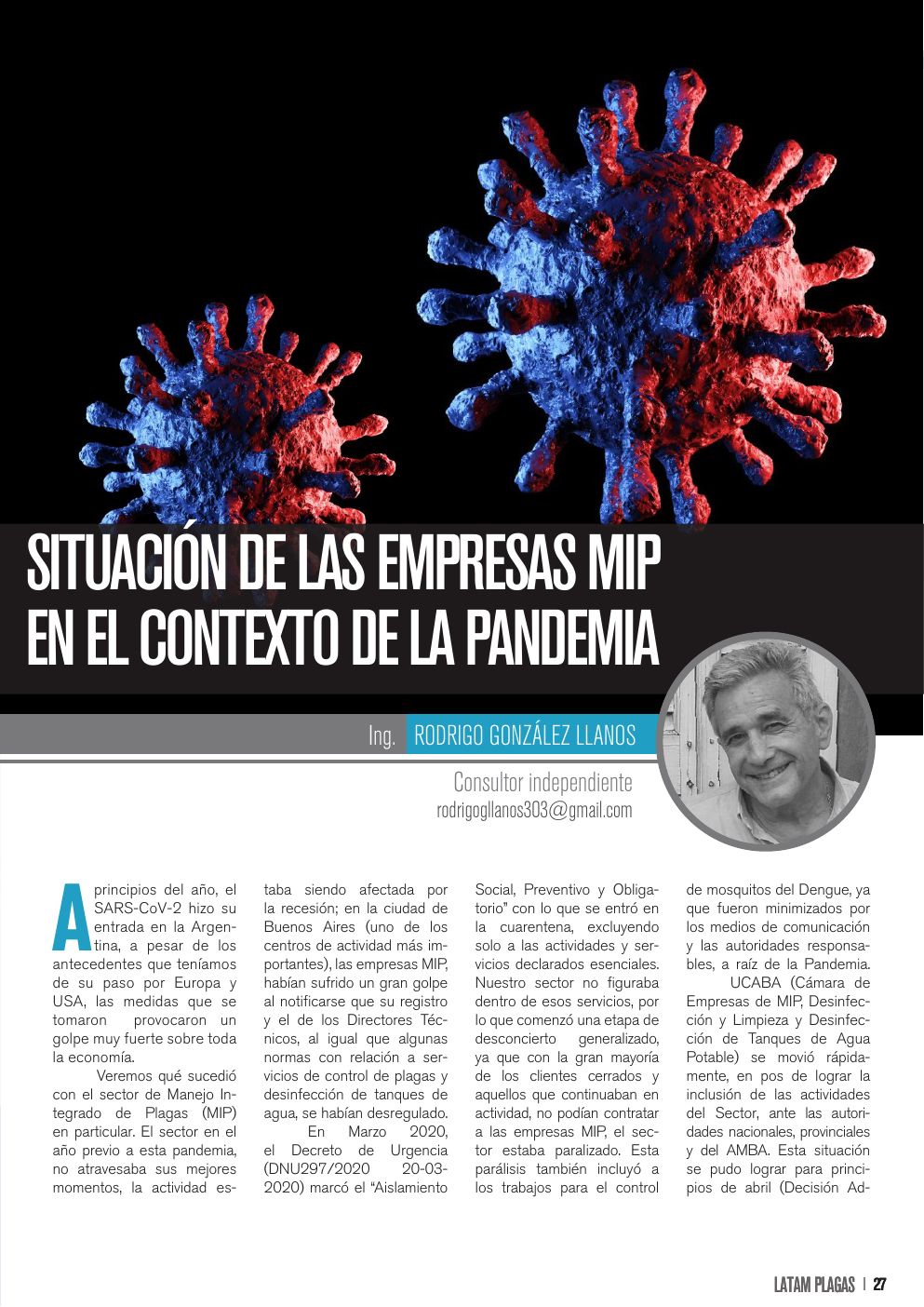
At the beginning of the year, SARS-CoV-2 made its entry into Argentina, despite the history we had of its passage through Europe and the USA, the measures taken caused a very strong blow to the entire economy. We will see what happened with the Integrated Pest Management (IPM) sector in particular. The sector in the year before this pandemic was not going through its best moments, activity was being affected by the recession; In the city of Buenos Aires (one of the most important centers of activity), the IPM companies had suffered a great blow when it was notified that their registration and that of the Technical Directors, as well as some regulations in relation to pest control services and disinfection of water tanks, had been deregulated. In March 2020, the Emergency Decree (DNU297/2020 03-202020) marked the “Isolation
Social, Preventive and Mandatory" with which the quarantine was entered, excluding only the activities and services declared essential. Our sector was not included within those services, so a stage of general confusion began, since with the vast majority of clients closed and those that continued in activity, could not hire the IPM companies, the sector was paralyzed. This paralysis also included the work to control Dengue mosquitoes, since they were minimized by the media and The responsible authorities, as a result of the Pandemic, UCABA (Chamber of IPM Companies, Disinfection and Cleaning and Disinfection of Drinking Water Tanks) moved quickly, in order to achieve the inclusion of the Sector's activities, before the national, provincial and AMBA authorities. This situation could be achieved by the beginning of April (administrative AdMIP Decision 450/2020 and new DNU 576/2020), the Government expanded the list of essential activities and services including the category of maintenance and fumigation. This categorization is a primary factor in the consolidation of our sector as Health Agents, as responsible for the protection of Public Health, food and private property, and not only for the authorities but also for the community. Parallel to this consolidation in Pest Management, everything related to disinfections reemerged with great force, which, for years, was relegated to a secondary service within IPM companies. We have no doubt that pest control companies are provenly trained in the use of restricted use products, such as professional disinfectants, they are also trained in the use of application machinery and personal protective equipment (eyes, gloves, protective clothing, etc.) and also in
the use of work protocols and safety requirements established by National and International organizations.
NEGATIVE EFFECTS IN PANDEMIC
Closure of businesses, industries, establishments, mandatory social isolation, it was in this commercial sector where the greatest drop in services was generated. There was also a very significant drop in services in the Residential market, both for apartments/consortia and houses. There were very significant drops in sales of services and products (laboratories, distributors), logistics problems also became a bottleneck. The Sales force had to work from home, without having experience in this modality. In addition to these sharp drops in billing, there was also a negative impact on the services provided to essential industries (food, laboratories, etc.). There was a cut in the payment chain and an increase in operating costs due to the increase in the price of inputs and also in service operators (PPE, transfers, protocol times). The growth of new opportunities (Disinfection Services) did not compensate (on the sector average) for the loss of services they had in the Pest Management sector, even with the important presence of Dengue. There was a greater movement in machinery sales, which moderately compensated distributors, but the increase in the sale of disinfectants was much lower than the usual sales of insecticides.
POSITIVE EFFECTS IN PANDEMIC
In my opinion, we must highlight the nomination of the Sector as Essential Services and the reinforcement of its image of professionalism. There also emerged, as we have mentioned, an enormous opportunity, professional disinfection, a sector that we can access due to its affinity and complementarity but that we must take very seriously in the same way as was done, years ago, with Integrated Pest Management. It is a unique opportunity and cannot be missed; it will represent a very important market, with innovative technologies in terms of products, systems, and application machinery. We must quickly adapt to this new scenario.
tor working together to obtain achievements in its operation. It is important to understand that this unity must be consolidated by associating ourselves with a chamber and then working for the joint work of these chambers. This unit, within the sector, is also absolutely important for the management of vectors (Dengue) and disinfections, there is no point in having negotiations or individual management, but rather working together between the sector and the State.
HOW WE WILL LOOK LIKE / POST-PANDEMIC The pandemic accelerated and precipitated some trends, which were already occurring more slowly, in the commercial field: the digital transformation process for teleworking (home office, total or partial), for purchases / sales / production / services / advertising / dissemination / logistics / deliveries, etc. , both in suppliers, distributors and in IPM companies. This acceleration in the use of digital channels made customer service tasks and the search for specific solutions more efficient. This also happened in the field of technical and commercial training. Today, thanks to the wide range of conferences, webinars, online courses, and technical conferences, training can be covered in a general, fast, and good manner. Another transcendent positive effect was the visualization of the importance of acting together, not massively, but in an orderly manner, each one fulfilling their responsibilities and the sector. It is one of the few sectors of the Market that is sure that growth will occur, through the conjunction Disinfection + Pest Management. For this, changes will need to be made in companies; several market sectors will require more competitive companies. We will have to produce services that we had not performed, develop different skills in our staff, these changes in habits will involve a lot of discipline, vigilance, and digitalization. Adapt the structures to the total or partial 'home office', to remote sales, with more elastic work models. Professionalization and specialization will be essential since there will be new disinfection systems, new standards to meet, various protocols to be developed, and technological innovations. As a sector we have to ensure that all this knowledge is also protected, we need regulations that protect it and we need to be able to decide on them. Distance training will grow in terms of efficiency and improvement, but face-to-face activities (Fairs, Conferences, conferences) will not disappear and will continue to have a prominent place in the annual agendas, although with greater selectivity. Society in general has become very sensitized to contacts and contamination, so the already existing trend of limiting the use of chemical products, using more environmentally friendly formulations, using specific applications, using baits and, especially, carrying out preventive exclusion work, continues to grow. In customer surveys, they have shown fear of being infected by workers. Actions that allow a lower presence of our technicians with customers will be highly appreciated by them. For this reason, there will be a greater dissemination of digital elements for remote monitoring of pests and captures, which allow the reception of data, their sending and the simultaneous generation of graphs, plans or reports. Also the use of management software, drones, sensors, etc. Some other trends that were formulated prior to the pandemic will continue their course in the medium term, such as global warming influencing the increase in VTEs (vector-borne diseases) and also the continuity in the growth of urban centers, especially in Latin America. Although in an intangible form, an increase in the collaborative spirit among members of the sector has been noted, which could indicate greater respect for others, a greater degree of humility, a better relationship in competition, all factors that consolidate professionalism. All these transformations are happening; and they will be as positive as our ability and speed to adapt. Professionalism, sector unity and a collaborative attitude are the most powerful values to face this enormous opportunity.
The situation described corresponds to what happened in Argentina. It can be considered that in most Latin American countries the scenario was similar, with small variations. Perhaps the country where there were the greatest objections to IPM companies dedicating themselves fully to disinfections was Mexico, due to the high value of insurance for these services (this was a major factor in the US). Also in other countries, a takeover of this market by cleaning companies may have greatly influenced, which also acted quickly to take possession of it. It would be very interesting if IPM entrepreneurs or consultants from different countries could give a brief account of the situation in their country. Also in this case, joint action by everyone (both at the country level and at the continental level) will give us better results.