
Indoor residual spraying for the control of Aedes aegypti
From the perspective of vector-borne disease risk management, focusing on the control of transmitting insects is an effective preventive approach.
Technical summary
- Focus
- From the perspective of vector-borne disease risk management, focusing on the control of transmitting insects is an effective preventive approach.
- Approach
- It brings together technical criteria linked to Edición 9, aedes aegypti and dengue.
- Use
- Useful for professionals who need context, diagnosis and operational decisions in public health and vectors.
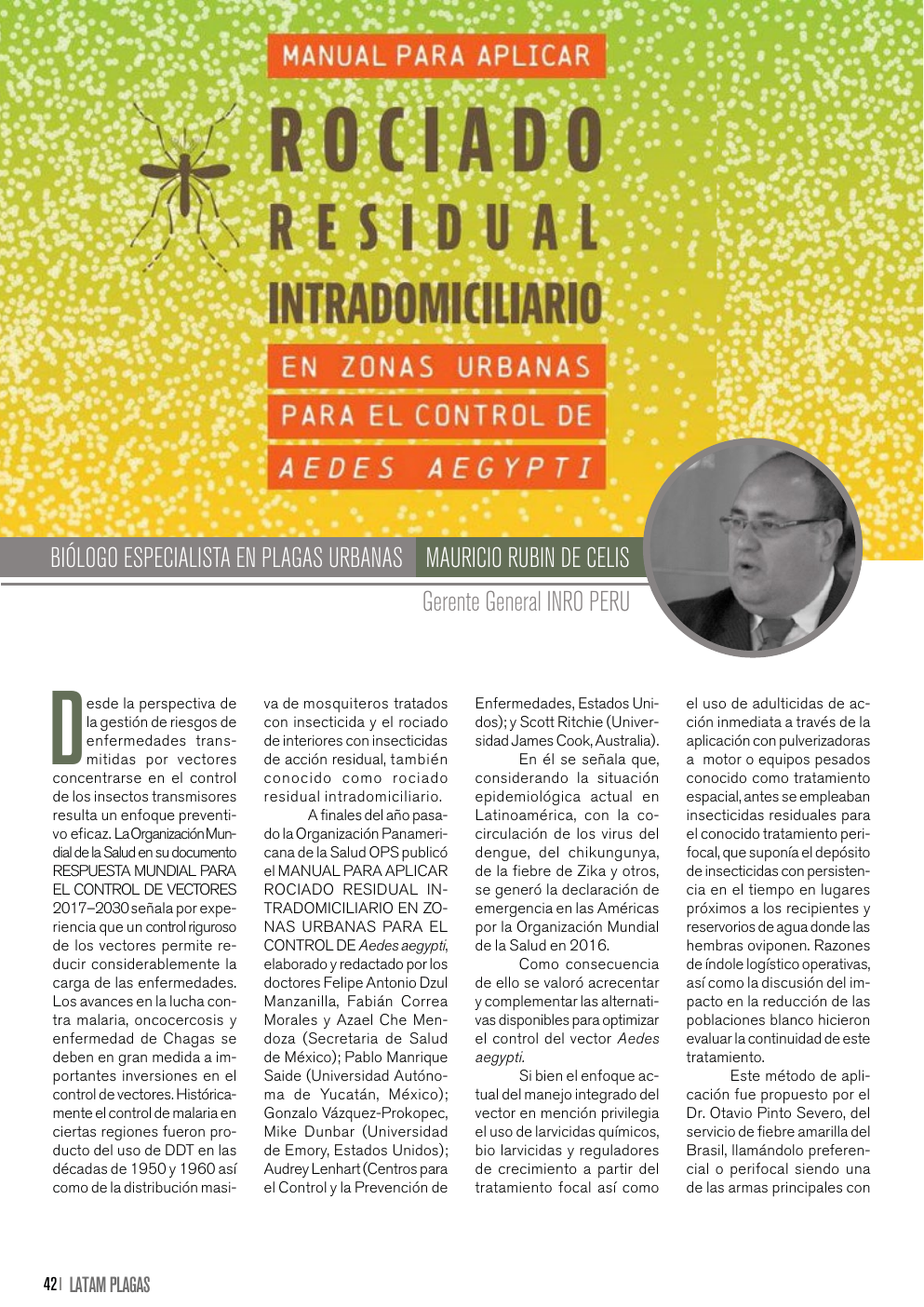
From the perspective of vector-borne disease risk management, focusing on the control of transmitting insects is an effective preventive approach. The World Health Organization in its document GLOBAL RESPONSE FOR VECTOR CONTROL 2017–2030 points out from experience that rigorous vector control makes it possible to considerably reduce the burden of diseases. Advances in the fight against malaria, onchocerciasis and Chagas disease are largely due to significant investments in vector control. Historically, malaria control in certain regions was a product of the use of DDT in the 1950s and 1960s as well as the mass distribution of insecticide-treated mosquito nets and indoor spraying with residual insecticides, also known as indoor residual spraying. At the end of last year, the Pan American Health Organization PAHO published the MANUAL FOR APPLYING RESIDUAL INDUSTRIAL SPRAYING IN URBAN AREAS FOR THE CONTROL OF Aedes aegypti, prepared and written by doctors Felipe Antonio Dzul Manzanilla, Fabián Correa Morales and Azael Che Mendoza (Secretary of Health of Mexico); Pablo Manrique Saide (Autonomous University of Yucatán, Mexico); Gonzalo Vázquez-Prokopec, Mike Dunbar (Emory University, United States); Audrey Lenhart (Centers for Disease Control and Prevention
Diseases, United States); and Scott Ritchie (James Cook University, Australia). It points out that, considering the current epidemiological situation in Latin America, with the cocirculation of dengue, chikungunya, Zika fever viruses and others, the declaration of emergency in the Americas was generated by the World Health Organization in 2016. As a consequence, it was considered to increase and complement the available alternatives to optimize the control of the Aedes aegypti vector. Although the current approach to integrated management of the vector in question favors the use of chemical larvicides, biolarvicides and growth regulators based on focal treatment as well as
the use of immediate action adulticides through application with motorized sprayers or heavy equipment known as spatial treatment, previously residual insecticides were used for the well-known perifocal treatment, which involved the deposit of insecticides with persistence over time in places close to the containers and water reservoirs where the females lay eggs. Operational logistical reasons, as well as the discussion of the impact on the reduction of target populations, made it necessary to evaluate the continuity of this treatment. This application method was proposed by Dr. Otavio Pinto Severo, from the Brazilian yellow fever service, calling it preferential or perifocal, being one of the main weapons with which Aedes aegypti was successfully combated in the mid-20th century, in several countries in America. The treatment technique devised by Dr. Pinto Severo resulted from comparing the perifocal treatment that treated only the vector breeding sites in a home and its immediate surroundings, and the intra-home residual treatment that treated all the internal walls of the houses, and sometimes the ceilings, with DDT. By virtue of the habits of the vector, Dr. Pinto Severo demonstrated that both treatment methods were equally effective and adopted the first of them, as it was faster and cheaper. Regarding the resting behavior of the vector in the adult stage, Michael Nelson in his book Aedes aegypti: BIOLOGY AND ECOLOGY refers to the vector's preference for shady places and dark corners, on walls, under furniture, among others. It also describes the success of the perifocal treatment that involves the application of residual insecticide on the external surfaces of containers and on those adjacent to them up to 1 m around. In general, indoor residual spraying or RRI (in English, indoor residual spraying or IRS) involves the application of an insecticide with a persistent or residual lethal effect inside homes, including surfaces where vectors of health importance perch or rest. However, recent research indicates that Aedes aegypti rests mostly in the lower part of the home, on objects and walls below 1.5 m, consequently, the first change in RRI-Aedes
INDOOR RESIDUAL SPRAYING INVOLVES THE APPLICATION OF AN INSECTICIDE WITH PERSISTENT OR RESIDUAL LETHAL EFFECT INSIDE HOMES INCLUDING SURFACES WHERE VECTORS OF SANITARY IMPORTANCE LAND OR REST, which implies that the insecticide must be applied selectively to the lower part of the walls up to 1.50 m. Thus, the selective application is called RRI for the urban control of Aedes (RRI-Aedes), differentiating it from RRI against malaria (in which a chemical treatment is applied throughout the interior of the home). The aim is to reduce vector-virus-human contact through an intra-home chemical barrier that acts by maintaining effective control over time by eliminating the vectors that land on the treated surfaces. In addition to this, when pyrethroids are used, their repellent effect ensures that the vectors do not enter the home. The parameters for an adequate application must consider a distance from the nozzle to the wall surface of 45 cm, a width or width of the application strip of 75 cm, an overlap of two application strips of 5 cm, a maximum height of the strip or band of 1.5 m. a speed or time it takes to travel the application fan per linear meter of 2.2 s, a pressure of 22 psi (1.5 bar), a discharge rate of 550 ml/min and a drop size (diameter of the droplets produced by the application) of 120-200 μm. The application must follow the flow from the
subsequent rooms towards the previous ones, applying the technique in a clockwise direction. The exposed surfaces of the wall are treated first and then the resting places. In summary, indoor residual spraying for the control of Aedes aegypti is an alternative that complements the control actions that are being used and that have been recently recommended by the Vector Control Advisory Group (VCAG) of the World Health Organization (WHO) and the Centers for Disease Control and Prevention of the United States.