
Challenges in chemical rodent control: neophobia
For more than five decades, different research groups have demonstrated the existence of two types of behavior in different animal species: neophilia or attraction to novelty and novelty-avoidance behavior or neophobia.
Technical summary
- Focus
- For more than five decades, different research groups have demonstrated the existence of two types of behavior in different animal species: neophilia or attraction to novelty and novelty-avoidance behavior or neophobia.
- Approach
- It brings together technical criteria linked to Edición 17, latam plagas and neofobia.
- Use
- Useful for professionals who need context, diagnosis and operational decisions in rodents.
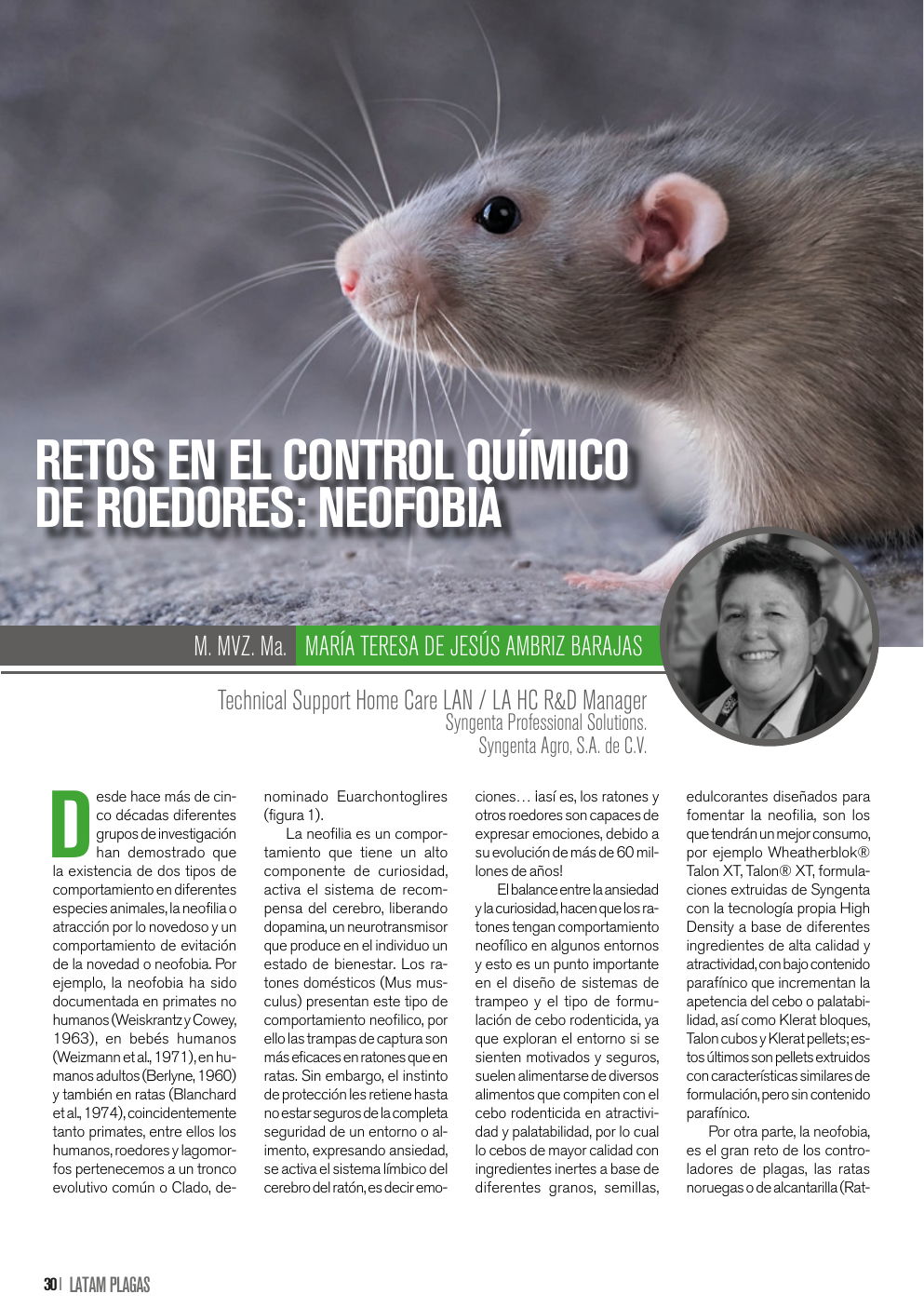
For more than five decades, different research groups have demonstrated the existence of two types of behavior in different animal species: neophilia or attraction to novelty and novelty-avoidance behavior or neophobia. For example, neophobia has been documented in non-human primates (Weiskrantz and Cowey, 1963), in human babies (Weizmann et al., 1971), in adult humans (Berlyne, 1960) and also in rats (Blanchard et al., 1974), coincidentally both primates, including humans, rodents and lagomorphs belong to a common evolutionary trunk or Clade, called Euarchontoglires (figure 1). Neophilia is a behavior that has a high component of curiosity, activates the brain's reward system, releasing dopamine, a neurotransmitter that produces a state of well-being in the individual. House mice (Mus musculus) exhibit this type of neophilic behavior, which is why capture traps are more effective on mice than on rats. However, the protective instinct holds them back until they are sure of the complete safety of an environment or food, expressing anxiety, the limbic system of the mouse brain is activated, that is, emotions... that's right, mice and other rodents are capable of expressing emotions, due to their evolution of more than 60 million years! The balance between anxiety and curiosity causes mice to have neophilic behavior in some environments and this is an important point in the design of trapping systems and the type of rodenticide bait formulation, since they explore the environment if they feel motivated and safe, they usually feed on various foods that compete with the rodenticide bait in attractiveness and palatability, which is why they use higher quality baits with inert ingredients based on different grains, seeds,
sweeteners designed to promote neophilia are those that will have better consumption, for example Wheatherblok® Talon XT, Talon® The latter are extruded pellets with similar formulation characteristics, but without paraffinic content. On the other hand, neophobia is the great challenge for Pest Management Professionals, Norway or sewer rats (RatSPECIAL REPORT
Figure 1. Cladogram: Euarchontoglires.
tus norvegicus) and the black or roof rat (Rattus rattus) that can express neophobia, avoiding new objects or foods in their territories or on their usual routes (Meehan 1984; Barnett 1988; Brigham, Sibly 1999, Brigham and Sibly 1999). Neophobia, avoidance of novelty, according to the hypothesis proposed by Berlyne (1960), the approach or avoidance of novelty would depend on the degree of novelty, that is, the degree of distance/similarity between the perceived stimuli and the internal representations existing in the rodent's brain, because rats of these species are very intelligent animals, which is why they learn quickly from environmental situations, generation after generation to adapt and survive. The insular cortex of the rodent brain is the main site of learning and memory for novel flavors and the site of memory storage, memories or association with negative events for the rodent depends on the cerebral cortex. Neophobia of new foods and causes animals to ingest only small amounts of the new foods or rodenticide baits
new to their environment. If no detectable negative situation occurs in the rodent population due to consumption and if the bait is highly palatable, the rodents will gradually increase their consumption. The palatability of a bait is determined by flavor, smell and texture, according to the preferences of pest rodents. Due to the above, baits with a poor palatability design and baits with an acute effect have a lesser effect on the control of populations of rodents with neophobia, since they learn from the lethal effect on their conspecifics that consumed them and are not as attractive for consumption due to their low palatability, unjustifiably increasing the population control time and increasing operating costs, as well as complaints. On the other hand, anticoagulant rodenticides, being chronic in effect, cause less neophobia than acute or subacute rodenticides, since death occurs several days after consumption of the bait, due to internal bleeding and hypovolemic shock as the coagulation chain is affected in rodents. Neophobia is a learned behavior, rats are social animals and their offspring learn from their mothers during weaning. This behavior can also trigger “shyness”, which is the aversion or rejection of the bait, due to previous negative experiences associated with its learning. “Shyness” of acute rodenticides such as Zinc Phosphide has been documented by various authors (Cowan, 1978. Cowan, Srihari & Sridhara 1979. Mukherjee & Jain, 1979. Prakash & Jain, 1971. Prakash & Ojha, 1977. Ojha, 1978. Sridhara & Srihari, 1978, 1979) and also subacute drugs such as cholecalciferol (Prescott, C.V. et al 1992). It is important to consider that capture traps are also an element that generates neophobia in the rats of these synanthropic species, which is why it can take several days, up to a week, to begin to register captures, unlike the neophilia of mice. This consideration also applies to the baits where the rodenticide baits are placed, the bait is an element that generates neophobia, so for the rats to start consuming the bait, several days may also pass during which the neophobic behavior decreases, this
The period can be prolonged if the bait does not have the appropriate palatability for the species of rodent involved, which is why it is very important to choose formulations that are highly attractive and palatable, for example Syngenta formulations, whose development of the attractant matrix is based on the behavior of this type of rodent, passing strict regulatory controls such as the Palatability Test of the US Environmental Protection Agency and the directives of the European Community for its commercial registration. Sharing this information with clients makes it possible to understand the scope and time of results of chemical pest control with rodenticides, as the client understands the behavior of the pest and cooperates with other integrated rodent management strategies such as sanitation and exclusion. BIBLIOGRAPHICAL REFERENCES: Barnett, S.A. Exploring, Sampling, Neophobia, and Feeding. Rodent Pest Management 2018. pp.295-320 Moritz, G. et al. Expression and Evolution of Short Wavelength Sensitive Opsins in Colugos: A Nocturnal Lineage That Informs Debate on Primate Origins. Evolutionary Biology. 2013. 40. pp.542553. Michael D. Breed, Janice Moore, Chapter 15 – Conservation and Behavior. Animal Behavior (Second Edition), Academic Press, 2016, pp. 499-538 Sweatt, J. D. Chapter 4 Rodent Behavioral Learning and Memory Models. Mechanisms of Memory (Second Edition), Academic Press, 2010, pp. 76-103