
Survey of flies in gastronomic establishments
In Argentina, meat consumption, around 60 kg per year, is very important, as are the establishments where it can be consumed, both in cities and in rural areas.
Technical summary
- Focus
- In Argentina, meat consumption, around 60 kg per year, is very important, as are the establishments where it can be consumed, both in cities and in rural areas.
- Approach
- The article structures the analysis around Biology and life cycle of the house fly and Damage and economic importance.
- Use
- Useful for professionals who need context, diagnosis and operational decisions in edición 5.
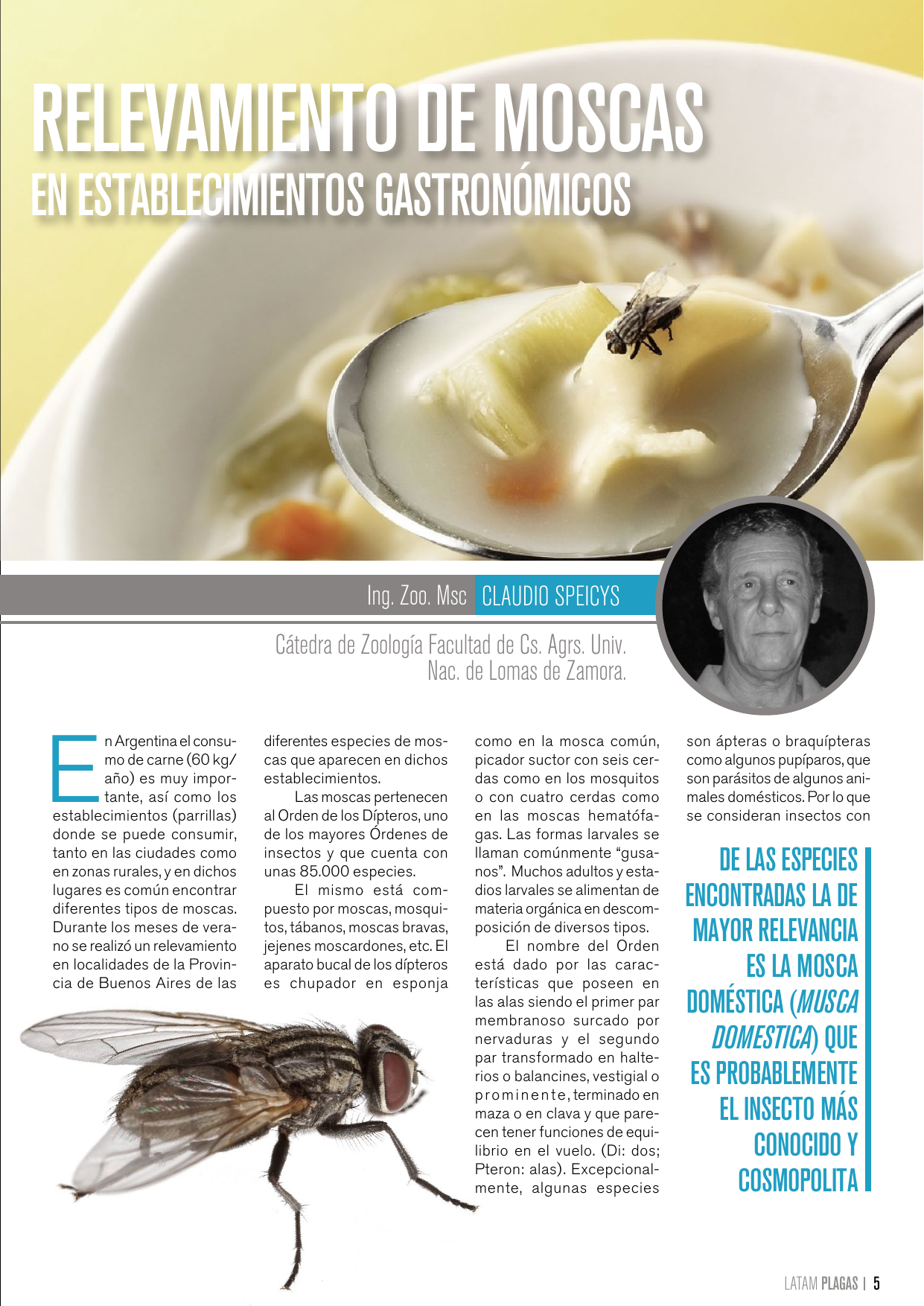
In Argentina, meat consumption, around 60 kg per year, is very important, as are the establishments where it can be consumed, both in cities and in rural areas. In these places it is common to find different types of flies. During the summer months, a survey was carried out in locations in the province of Buenos Aires of the different species of flies that appear in these establishments.
Flies belong to the order Diptera, one of the largest orders of insects with about 85,000 species. It is made up of flies, mosquitoes, horseflies, wild flies, gnats, botflies and others. The mouthparts of diptera are sponge-sucking as in the common fly, suction-biting with six bristles as in mosquitoes or with four bristles as in blood-sucking flies. The larval forms are commonly called “worms.” Many adults and larval stages feed on decomposing organic matter of various types.
The name of the order is given by the characteristics they have on the wings, the first pair being membranous furrowed by ribs and the second pair transformed into halteres or rockers, vestigial or prominent, ending in a club or club and which seem to have balance functions in flight. Exceptionally, some species are apterous or brachypterous, such as some pupiparous, which are parasites of some domestic animals. Therefore, they are considered insects with a single pair of wings and have a size ranging from 1 mm to 3 cm.
Among the fly species collected, the majority corresponded to the house fly, Musca domestica, by 90%; 5% to Calliphorids, known as metallic flies, the species found being Cochliomyia hominivorax and Lucilia sericata, with a predominance of the latter; 3% to Sarcophagids or flesh flies, with Sarcophaga carnaria. The rest, occasionally, were Phorids like Megaselia scalaris, Nematoceran Psychodidas like Psychoda sp., horseflies Tabanus punctifer and Drosophilidae, Drosophila melanogaster, known as the vinegar fly.
Biology and life cycle of the house fly
The house fly is associated with man from the tropics to the polar regions. It is a universal pest in livestock farms, food storage and processing, restaurants and other environments. It is one of the most difficult pests to control. This is due to its ability to feed on any type of organic matter, to develop efficiently and quickly in many substrates and to quickly become resistant to insecticides.
Adult houseflies, 7 to 9 mm, feed on liquids rich in sugars and proteins that they ingest with their sucking mouth. If the substrate is dry, they vomit on it to dissolve the nutrients. This behavior and the anatomy of their legs make flies important mechanical vectors of many pathogenic organisms. House flies are excellent fliers: distances of more than 30 km have been recorded. They can be easily identified by their four dark, longitudinal stripes on top of the thorax or in the central region of the body.
The life cycle can be completed in less than two weeks. It consists of the egg, three larval stages, the pupa and the adult. They breed in all types of substances: manure, garbage and any decomposing organic or plant material. A female lays up to a total of 900 eggs in packets of 75 to 150 at a time. The larvae emerge quickly and, after three molts, pupate in six days. About five days later the adults emerge. This allows between eight and twelve generations per year in temperate climate regions. The life of adults lasts a few weeks, but can be extended in cold seasons. Both pupae and adults overwinter in soil, manure, garbage dumps, and other places.
Damage and economic importance
Biological control of house flies using their natural enemies can be quite effective, as long as the right conditions for the development of these natural enemies are maintained, which includes minimizing the use of larvicides or insecticides, as most are also toxic to beneficial insects.
Among the most effective natural enemies of flies, hymenoptera parasitoids of pupae stand out, such as Spalangia spp. , Muscidifurax spp. and Pachycrepoideus spp. Numerous predators of flies, both eggs and larvae, have also been recorded. The eggs are frequently preyed upon by mites and small beetles of the families Staphylinidae and Histeridae, which can also feed on small larvae. Mites, such as Machrocheles spp. , they feed on fly eggs and larvae. The adult females attach themselves to the adult flies and are thus transported to other places.
Several entomopathogenic fungi have been used for the biological control of flies, among others. Metarhizium anisopliae, Beauveria bassiana and Entomophthora muscae. There are also predatory diptera, such as Ophyra aenescens, commonly called black garbage fly, whose larvae exert effective control of the immature stages of the fly.
Treatment with chemicals of the surfaces where flies land, walls, posts, columns, studs and fences, with mosquitoicides gives good results, as long as the flies are susceptible, that is, not resistant. Most of these products contain conventional insecticides, organophosphates, pyrethroids, neonicotinoids and others, which kill adult flies on contact.
Some products contain oral adulticides that are mixed with sugar and applied with a brush like paint. The sugar stimulates the flies to eat, resulting in the ingestion of a lethal dose of the adulticide.
Ambient fogging with mosquitoicides is suitable for immediately reducing high fly populations. But it kills only exposed flies at the time of application, and has no residual effect. Special equipment is usually needed. For nebulization to be effective, air currents must be avoided. Otherwise, ventilation or wind may reduce its effectiveness.
Bait of various types against house flies, powders, granules and others, can be quite effective. Most use adulticides, such as organophosphates, carbamates, neonicotinoids and spinosad, often combined with attractants, for example tricosene, and are very useful in reducing fly populations.
Treatment of substrates to eliminate or reduce larval development is often combined with adult fly control methods. For this, products are used that are applied directly to the substrate in the form of sprays, granules and powders. Along with classic larvicides, especially organophosphates, several growth inhibitors are also used successfully, such as benzolureas and cyromazine.
Combining the use of adulticides with larvicides often makes sense because it involves attacking flies with two active ingredients with totally different modes of action, which reduces the risk of resistant populations emerging. Even so, multidrug-resistant populations, that is, simultaneously resistant to more than one chemical class, are increasingly abundant. Therefore, it is especially important and urgent to apply integrated pest management to fly control.