What does my Technical Director do?
In Argentina there are hundreds of pest control companies and the majority are registered in municipal or provincial registries in accordance with the regulations or laws that regulate or enable the exercise of this...
Technical summary
- Focus
- In Argentina there are hundreds of pest control companies and the majority are registered in municipal or provincial registries in accordance with the regulations or laws that regulate or enable the exercise of this noble task.
- Approach
- The article structures the analysis around Functions or responsibilities of the advisor or technical director of urban, domestic and industrial pest control companies.
- Use
- Useful for professionals who need context, diagnosis and operational decisions in edición 7.
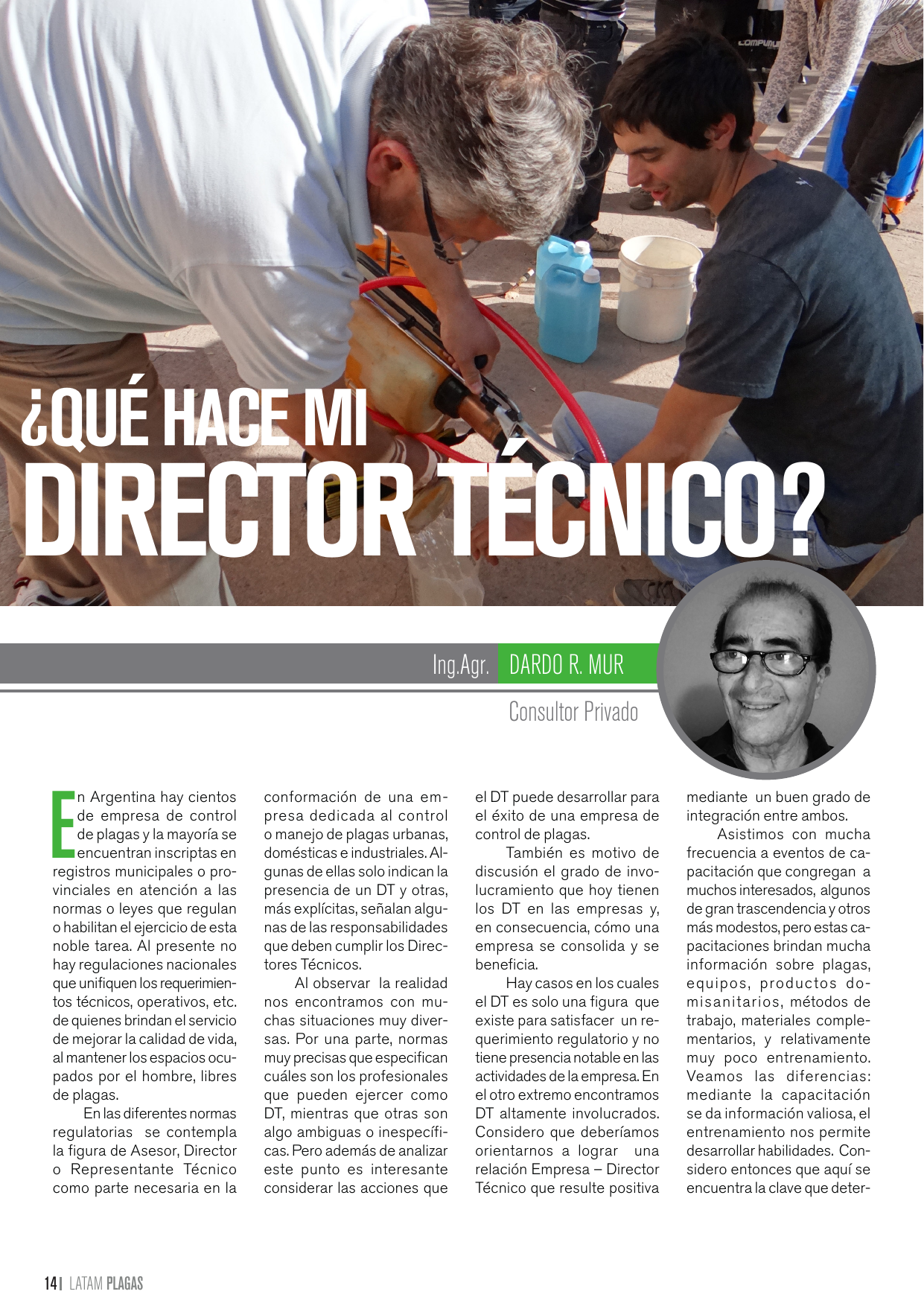
In Argentina there are hundreds of pest control companies and the majority are registered in municipal or provincial registries in accordance with the regulations or laws that regulate or enable the exercise of this noble task. At present there are no national regulations that unify the technical, operational, etc. requirements. of those who provide the service of improving the quality of life, by keeping the spaces occupied by man, free of pests. The different regulatory standards contemplate the figure of Advisor, Director or Technical Representative as a necessary part of the
formation of a company dedicated to the control or management of urban, domestic and industrial pests. Some of them only indicate the presence of a DT and others, more explicit, indicate some of the responsibilities that the Technical Directors must fulfill. When observing reality we find many very diverse situations. On the one hand, very precise rules that specify which professionals can practice as TDs, while others are somewhat ambiguous or non-specific. But in addition to analyzing this point, it is interesting to consider the actions that
the DT can develop for the success of a pest control company. The degree of involvement that DTs have in companies today and, consequently, how a company consolidates and benefits is also a matter of discussion. There are cases in which the DT is only a figure that exists to satisfy a regulatory requirement and has no notable presence in the company's activities. At the other extreme we find highly involved DTs. I believe that we should focus on achieving a positive Company – Technical Director relationship.
through a good degree of integration between the two. We frequently attend training events that bring together many stakeholders, some of great importance and others more modest, but these trainings provide a lot of information about pests, equipment, household health products, work methods, complementary materials, and relatively very little training. Let's see the differences: valuable information is given through training, training allows us to develop skills. I consider then that here is the key that determines one of the main functions of the Technical Director: working with the pest control company in the development of the necessary skills to achieve the expected results in pest control. Among the professions that carry out the Technical Management of pest control companies, that of the Agricultural Engineer stands out in particular, since according to the professional responsibilities and the activities reserved for the professions, the dispensing, handling and application of household, agrochemical, biological and biotechnological products correspond to agricultural engineers and zootechnicians. (IF-2018-06567377-APNSECPU#ME).
Functions or responsibilities of the advisor or technical director of urban, domestic and industrial pest control companies
1. Possess a university degree, Agricultural Engineer or Zootechnician, whose duties and reserved activities qualify him for this purpose.
2. Advise the company in the field of its specific competence.
3. Instruct, train and supervise operational personnel, recording the syllabus and attendance in a specific record.
4. Carry out inspections, monitoring and audits to determine the current or potential presence of pests, to establish the actions to be implemented, or to monitor and evaluate the results of work in progress.
5. Control the efficiency of field work.
6. Verify that the work is carried out in compliance with the corresponding technical, legal and safety standards.
7. Select the most appropriate methods, procedures and products for each job.
8. Organize and supervise the collection, handling, application and transportation of the products and equipment used, organize and supervise the handling and disposal of empty containers and remains of unused or expired products.
9. Advise and supervise on hygiene, safety and prevention measures for specific personnel in relation to the company's activities.
10. Organize and control the first aid and toxicological kit of the company and its vehicles.
11. Write technical information for the company's clients.
12. Respond to the technical requirements that are formulated to the company.
13. Keep the information corresponding to permits, authorizations, prohibitions, etc. updated. and supervise compliance with the corresponding requirements and regulations.
14. Stay up to date on both the legal and technical aspects that are specific to the activity of managing or controlling urban, domestic and industrial pests.
This list of functions largely summarizes the experience and criteria of Agricultural Engineers and Zootechnicians with outstanding experience in the management of urban, domestic and industrial pests in the Argentine Republic. By themselves they do not constitute any standard, but they are a guide that we hope will be useful to companies and technical directors.