
What bug is this?
It is very common that we answer the phone and someone tells us that small, dark, moving bugs have appeared in their house, and requests a quote for their elimination.
Technical summary
- Focus
- It is very common that we answer the phone and someone tells us that small, dark, moving bugs have appeared in their house, and requests a quote for their elimination.
- Approach
- It brings together technical criteria linked to Edición 9, control profesional and entomología.
- Use
- Useful for professionals who need context, diagnosis and operational decisions in research and bibliography.
It is very common that we answer the phone and someone tells us that small, dark, moving bugs have appeared in their house, and requests a quote for their elimination. We can only respond by asking some questions to help us guess what it is, or we can visit that client to do an inspection, or we can also ask them to send us some photos. Throughout the year, in the successive seasons, various insects typical of
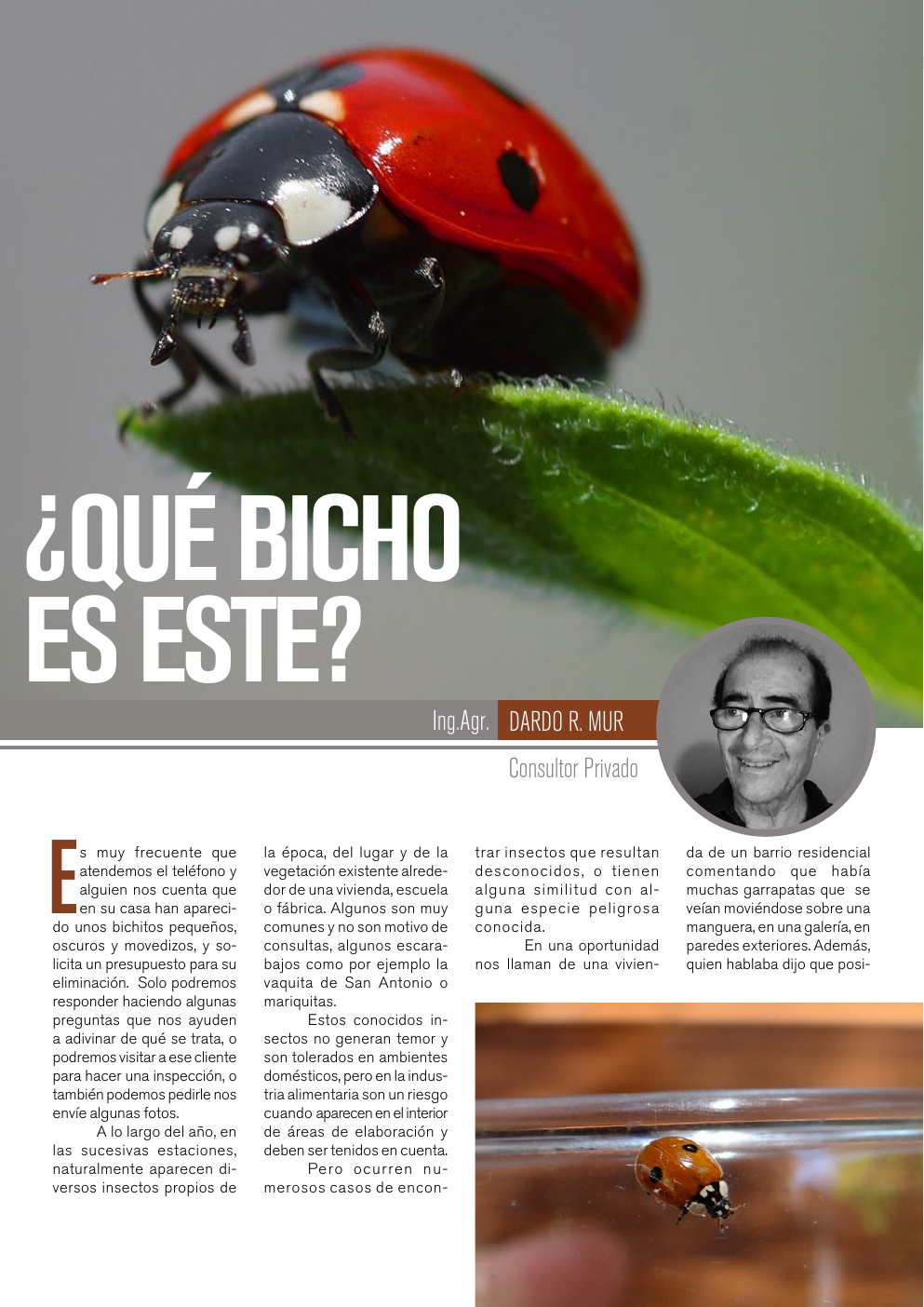
the time, the place and the existing vegetation around a home, school or factory. Some are very common and are not a reason for consultation, some beetles such as the San Antonio vaquita or ladybugs. These well-known insects do not cause fear and are tolerated in domestic environments, but in the food industry they are a risk when they appear inside processing areas and must be taken into account. But there are numerous cases of finding insects that are unknown, or have some similarity to a known dangerous species. On one occasion they called us from a home in a residential neighborhood commenting that there were many ticks that could be seen moving on a hose, in a gallery, on exterior walls. Furthermore, the speaker said that possibly his little son had been stung because when he crushed some specimens against the wall, a dark liquid had been released: blood? If so, an important situation arose and we immediately visited the place. We checked the presence of those alleged “ticks”, but when we saw them we verified that they were only aphids that fell from the branches of a tree. A tick control treatment is absolutely different from the problem posed by the presence of aphids on a tree. But you need to know the difference! These days, in the middle of summer, in Mendoza we have received several inquiries about bed bugs that have a great resemblance to vinchucas and their presence generates anxiety, fear and concern in people who do not know the difference. Such is the case of the phytophagous bug known as “palanpalán bug”, a common weed in roadside verges and vacant lots, from the tobacco family, its name is nicotina glauca due to its ashy green color.
Vinchuca: Triatoma infestans
Although the nymphs of this bug are very different from the vinchucas, the adults have a similar shape and size. But both eating behavior and some aspects of adults are totally different. Vinchucas are not found forming colonies, they are obligate hematophagous and are strongly associated with Chagas disease, while the palanpalán bug is usually found forming a true colony parasitizing its favorite plant and is absolutely irrelevant from a health point of view. Correct identification of a species is essential to differentiate a pest from an occasional infestant. Making wrong decisions leads to
Palan-palan bug: Corecoris fuscus
contamination problems, ineffectiveness of treatment, the environment and the health of people and pets are put at risk, loss of image and clients. A pest management professional must know how to identify, personally or with appropriate advice, the insects or arachnids that suddenly appear in a certain place and circumstance in order to make correct decisions.