
Pigeons and public health
There are reports of several diseases communicable from pigeons to humans and domestic animals.
Technical summary
- Focus
- There are reports of several diseases communicable from pigeons to humans and domestic animals.
- Approach
- The article structures the analysis around CONTACT WITH BIRDS: IS IT A RISK FACTOR? and CONCLUSIONS.
- Use
- Useful for professionals who need context, diagnosis and operational decisions in public health and vectors.
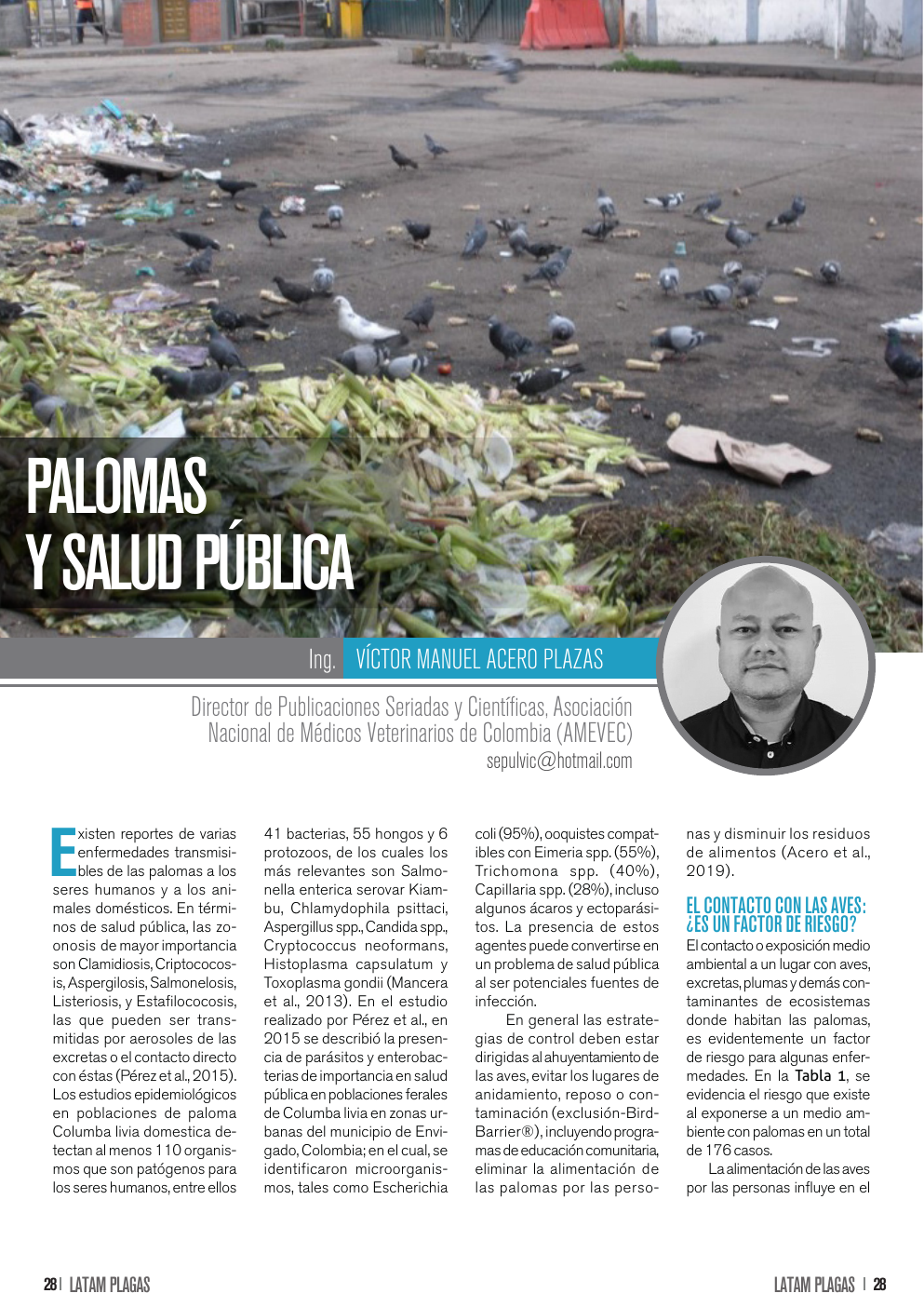
There are reports of several diseases communicable from pigeons to humans and domestic animals. In terms of public health, the most important zoonoses are Chlamydiosis, Cryptococcosis, Aspergillosis, Salmonellosis, Listeriosis, and Staphylococcosis, which can be transmitted by aerosols of excreta or direct contact with them (Pérez et al., 2015). Epidemiological studies in pigeon populations Columba livia domestica detect at least 110 organisms that are pathogenic to humans, including
41 bacteria, 55 fungi and 6 protozoa, of which the most relevant are Salmonella enterica serovar Kiambu, Chlamydophila psittaci, Aspergillus spp., Candida spp., Cryptococcus neoformans, Histoplasma capsulatum and Toxoplasma gondii (Mancera et al., 2013). In the study carried out by Pérez et al., in 2015 the presence of parasites and enterobacteria of public health importance in feral populations of Columba livia in urban areas of the municipality of Envigado, Colombia was described; in which microorganisms were identified, such as Escherichia
coli (95%), oocysts compatible with Eimeria spp. (55%), Trichomona spp. (40%), Capillaria spp. (28%), including some mites and ectoparasites. The presence of these agents can become a public health problem as they are potential sources of infection. In general, control strategies should be aimed at scaring away birds, avoiding nesting, resting or contamination places (exclusion-BirdBarrier®), including community education programs, eliminating feeding of pigeons by people and reducing food waste (Acero et al., 2019).
CONTACT WITH BIRDS: IS IT A RISK FACTOR?
Contact or environmental exposure to a place with birds, excreta, feathers and other contaminants of ecosystems where pigeons live is evidently a risk factor for some diseases. Table 1 shows the risk that exists when exposed to an environment with pigeons in a total of 176 cases. The feeding of birds by people influences the
well-being of these, a report by Schreiber et al., in 2015, demonstrates that individuals with a good nutritional status tend to show a greater infestation by ectoparasites compared to birds with a moderate or poor nutritional status, while birds with a poor nutritional status tend to suffer a greater infestation by lice. It should be noted that in this study one of the two breeding populations investigated almost abandoned its reproductive activity for two years due to the loss of its closest food source; however, this population showed a better nutritional status than the population without restrictions on food availability. This fact could be interpreted by the existence of a biological control mechanism for the suppression of reproduction in degraded environmental conditions to ensure the survival of adults. If this assumption is correct, the feeding of feral pigeons by animal lovers possibly causes a deterioration in the health of the pigeons as a consequence of the continuous stimulation of pigeon activity.
reproduction (due to the availability of food) despite the deteriorated living conditions in a city or in a degraded and contaminated habitat such as a square. The approach to this problem and the zoonoses and environmental risks of these birds must be oriented from the point of view of One Health (Chávez de Pop et al., 2020)
CONCLUSIONS
Pigeons represent a public health risk, so prevention and control measures must be implemented on a humanitarian basis for this species considered a pest, including promotion (education) and prevention strategies, reduction of environmental risks, birth control, reduction of food sources (including people who feed them with waste, grains and remains of human food) and nesting (principle of exclusion using nets and other tools to avoid perching - BirdBarrier®).
REFERENCES Acero-Plazas, Víctor Manuel, Rico-Hernández, Guillermo, Cardona-Aristizábal, Laura. (2019). Impact on public health of the pigeon Columba livia and control methods. Vectors & Pest Magazine, 6: 42-27 Chávez de Pop, VJ, Estol L, Cueva MT, Acero VM. (2020). Zoonoses: Approach within the concept of one health. Agricultural Sciences Magazine, 6(1):87-95. Haag-Wackernagel, D., Moch, H. (2004). Health hazards posed by feral pigeons. The Journal of infection, 48(4), 307–313. Mancera, V. M. M., Jiménez, L. C. V., Medina, D. A. B., Soler-Tovar, D. (2013). The pigeon (Columba livia) in the transmission of diseases of public health importance. Animal Science Magazine, 6, 177-194. Pérez, J., Monsalve, D., Márquez, C. (2015). Presence of parasites and enterobacteria in feral pigeons (Columba livia) in urban areas in Envigado, Colombia. National Faculty of Public Health Magazine, 33(3):370-376 Schreiber, T., Kamphausen, L., Haag-Wackernagel, D. (2015). Umwelteinflüsse und Gesundheitszustand bei Strassentauben (Columba livia) [Effects of the environment on health of feral pigeons (Columba livia)]. Berliner und Munchener tierarztliche Wochenschrift, 128(1-2), 46–60.