
Pigeons: a relevant pest in grain production
The losses they cause may be due to plant damage or grain consumption. A pigeon can produce up to twelve kilos of excrement per year, with guano being a source of pathogenic microorganisms capable of generating more...
Technical summary
- Focus
- The losses they cause may be due to plant damage or grain consumption.
- Approach
- The article structures the analysis around Bird pressure and Control methods.
- Use
- Useful for professionals who need context, diagnosis and operational decisions in edición 1.
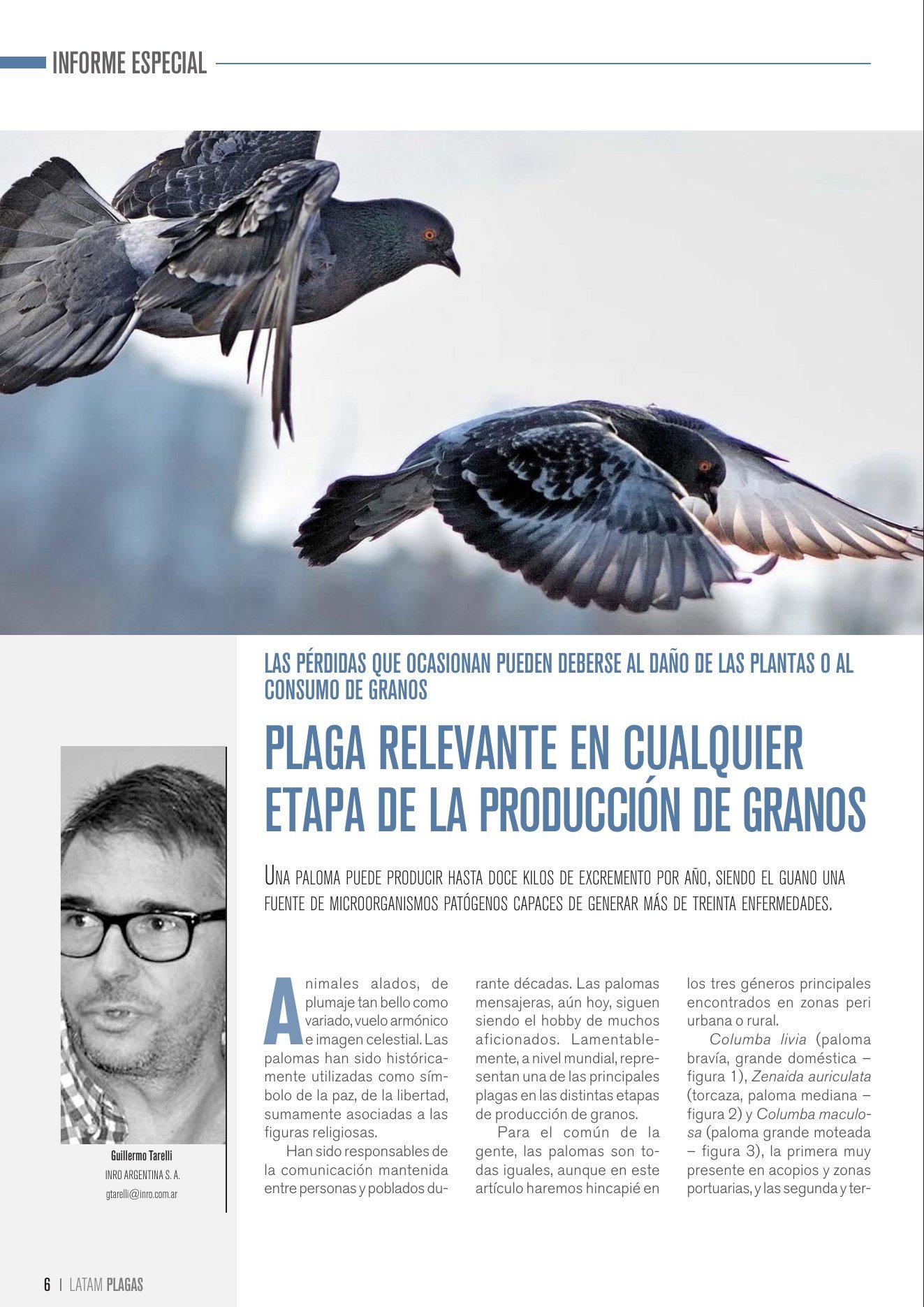
The losses they cause may be due to plant damage or grain consumption. A pigeon can produce up to twelve kilos of excrement per year, with guano being a source of pathogenic microorganisms capable of generating more than thirty diseases.
Winged animals, with plumage as beautiful as it is varied, harmonious flight and celestial image. Doves have historically been used as a symbol of peace and freedom, closely associated with religious figures.
They have been responsible for the communication maintained between people and towns for decades. Carrier pigeons, even today, continue to be the hobby of many hobbyists. Unfortunately, worldwide, they represent one of the main pests in the different stages of grain production.
For the average person, pigeons are all the same, although in this article we will emphasize the three main genera found in peri-urban or rural areas. Columba livia (rock pigeon, large domestic), Zenaida auriculata (dove, medium pigeon) and Columba maculosa (large spotted dove), the first very present in stockpiles and port areas, and the second and third most visible in crops.
They can consume seeds during sowing, damage seedlings during emergence, or consume grains in cultivation, harvested or stored.
As if this were not enough, they can contaminate much more than they consume through fecal matter, feathers or ectoparasites. A pigeon can produce up to twelve kilos of excrement per year, with guano being a source of pathogenic microorganisms capable of generating more than thirty diseases in people and domestic animals.
In terms of public health, the most important zoonoses associated with the presence of these birds are histoplasmosis, chlamydiosis, cryptococcosis, aspergillosis, salmonellosis, listeriosis and staphylococcosis, which can be transmitted through the air or their excreta.
It should be taken into account that the accumulations of guano, feathers and the presence of nests favor the proliferation of blaterids (cockroaches) and coleoptera (beetles), which represent an important source of protein for other birds and even rodents. Finally, it is important to remember that guano has acids (phosphoric and uric) that accelerate the corrosion and deterioration of silo sheets and plastered walls used for grain storage.
In cultivation, the losses they cause may be due to plant damage (5 to 30%) or grain consumption (1 to 3%). These losses are closely related to factors specific to animal populations (population density, pressure level, distribution, dietary preferences, etc.), characteristics of the attacked crop (type of crop, planting density, phenological state of plants, height, forest curtains) and finally, the geographical location and characteristics of the environment in the first 50 immediate kilometers (breeding sites, roosts, water sources, tree density, stockpiles, etc.).
Due to their dimensions and construction characteristics, grain stores represent an extremely favorable environment for the establishment and proliferation of a population of pigeons. The food source is abundant and permanent, the water is provided by the climate, natural courses or nearby fields with irrigation systems, and the shelter for nesting and spending the night arises from the very physiognomy of silos, cells and waterwheels.
Bird pressure
It is essential to keep in mind that bird management requires an exhaustive prior analysis of the situation. The problematic species, nesting sites, roosts, different sources of food and hydration, and possible relocation sites must be identified.
This is important given that the proximity of these sites can favor future recidivism. It is important to know the “pressure” of birds existing in each site and the initial population level in order to evaluate the effectiveness of the treatments once the integrated management program has been implemented.
The pressure can be high, medium or low. High pressure sites are usually nests or roosts, and represent the most complex areas to treat due to the strong relationship that birds generate with the place. Historically, failures in installed systems have been recorded in them, hence the importance of designing integrated management programs according to each situation.
Pissed off, sheds, ferris wheels, roofs, trees, etc. , represent medium pressure sites that birds use to visualize the source of food or water, or take sunbaths. Finally, low pressure sites are places that birds occasionally use to perch. They are usually exposed to air currents, they do not offer security from predatory birds and pigeons only use them as intermediate resting stations between the food source and nests or roosts.
The complexity in the design of integrated management programs is directly proportional to the level of pressure. The appropriate combination of the different tools on the market and their correct installation must be left in the hands of qualified technicians. In this way, the chances of failure and making useless investments will be reduced to a minimum.
Control methods
The strategies developed to date for pigeon management vary depending on the area. Basically, these are physical elements that force relocation (nets, spikes, etc.) or deterrents (bright balloons, silhouettes of owls, sound equipment, etc.), capture elements (cages), falconry and chemical repellents. In other countries of the world, oviposition regulating products (contraceptives) are marketed and in some you can directly obtain avicidal products.
In Argentina, despite the great damage they cause in the different stages of grain production, there is still no national law that allows them to be exterminated. Nets and spikes are elements that require suitability and specific equipment for their installation.
Scarers are excellent during the first seven to fourteen days, although due to the great learning capacity that these animals have, they quickly realize that they are only motionless silhouettes or harmless repetitive sounds. Capture cages are effective, but they generate complications when it comes to the destination of the captured birds.
Falconry, the management of birds of prey, is extremely efficient. Unfortunately, good management of falcons cannot be done by anyone and requires uneconomical specialized services in extensive production or grain storage.
Chemical repellents can be tactile or irritating to the respiratory tract. The first of them is polybutene, a sticky compound that is extremely annoying for birds. Its main drawback is that it is quickly degraded by climatic factors and requires frequent reapplications.
Methyl anthranilate, a natural compound extracted from grapes, is an excellent environmental repellent. This product generates strong irritation in the upper respiratory tract of birds when it is nebulized in the environment. The best effect is achieved when birds breathe small droplets of 10 to 20 microns of the product. Due to this, its effectiveness is highly associated with automated drive systems. Basically, the repellent should be misted into the air when pigeons are present. It is feasible, but very expensive to install and maintain.
The aforementioned elements are usually extremely effective in bird management at an urban level. In the same way, the combination of some of these tools can provide good results in limited areas in storage plants. At an extensive level, field tests carried out with these elements have not yet produced conclusive results to recommend a definitive strategy. Due to the aforementioned, and the currently existing international regulations, it can be deduced that the most problematic site in the entire grain production chain is represented by the stockpiles.
Due to the need of collection plants to have a safe, ecological and effective tool, the firm TECHLINE® from Argentina has developed the EXODUS®. It is an electronic device that generates complex waves that modify the behavior of birds. These waves, like those generated by earthquakes, alter the state of rest and induce a state of permanent “alert” that makes the animal uncomfortable and makes it move away. The waves generated can be directed. If the surface to be covered is large, more than one piece of equipment can be used, generating an “electronic network” due to the synergism caused by the superposition of waves.
EXODUS® is made up of state-of-the-art components, a shielded and weather-resistant cabinet, and consumes only 4 watts per hour. The latest equipment developed has an emitter cable that allows increasing the emission surface, increasing efficiency and simplifying installation. Generally the layout and amount of equipment varies depending on the type of construction. For the correct functioning of this equipment, it is essential to analyze the problem and design the installation according to the needs. Several years of research and a large number of successful cases make EXODUS® an excellent alternative to eradicate pigeons in plants and industries related to grain storage and processing.
The latest innovations in pest bird management are represented by laser technology and remotely operated drones. The first of them, AGRILASER®, is a device that generates a beam of intense green light (laser) with a range of 500 to 2,500 meters depending on the intensity of sunlight. On cloudy days, the range is greater. There are manual or automated equipment. When the laser reaches a surface (floor, ceilings, walls, etc.) the reflected light beam is cylindrical and approximately 5 to 7.5 cm in diameter.
The principle of operation implies that the operator must move or program the equipment so that the laser slowly approaches the birds to be eradicated. This approach, in undulating movements close to the birds, makes them perceive it as something “tangible” physical thing that is approaching. Due to the group behavior that these animals demonstrate, it usually happens that when a bird takes off and takes flight due to the “discomfort” generated, the group is completely mobilized. The light beam should not be pointed at the birds' heads or eyes as this will not scare them away.
AGRILASER® is an extremely versatile and effective system in low and medium pressure sites. In high pressure sites it is very likely that it will have to be combined with physical methods (nets or pins).
Drones have been adapted to the management of pest bird populations without any relevant effect. Despite the efforts made by marketing firms, these supposedly remotely managed birds have failed. Attempts have been made to place sound amplifiers and recordings of birds of prey without success. The latest development, the ROBIRD®, is a true remote-controlled electric falcon. They have truly achieved a robot bird, although it remains to generate success stories that support its effectiveness.
The doubt regarding this is directly related to the impossibility of imitating the behavior of the bird of prey in its entirety. Surely, and like other technologies, it can be used very effectively in places where the pressure is not high.