
International pest control news
RICKETTSIA IN BAJA CALIFORNIA MX.- Mexicali, Baja California.- Health sector authorities confirmed four more cases of death due to rickettsia, bringing the total to nine so far this year.
Technical summary
- Focus
- RICKETTSIA IN BAJA CALIFORNIA MX.- Mexicali, Baja California.- Health sector authorities confirmed four more cases of death due to rickettsia, bringing the total to nine so far this year.
- Approach
- The article structures the analysis around TWO SPECIES OF INSECTS NOT KNOWN TO SCIENCE DISCOVERED.
- Use
- Useful for professionals who need context, diagnosis and operational decisions in research and bibliography.
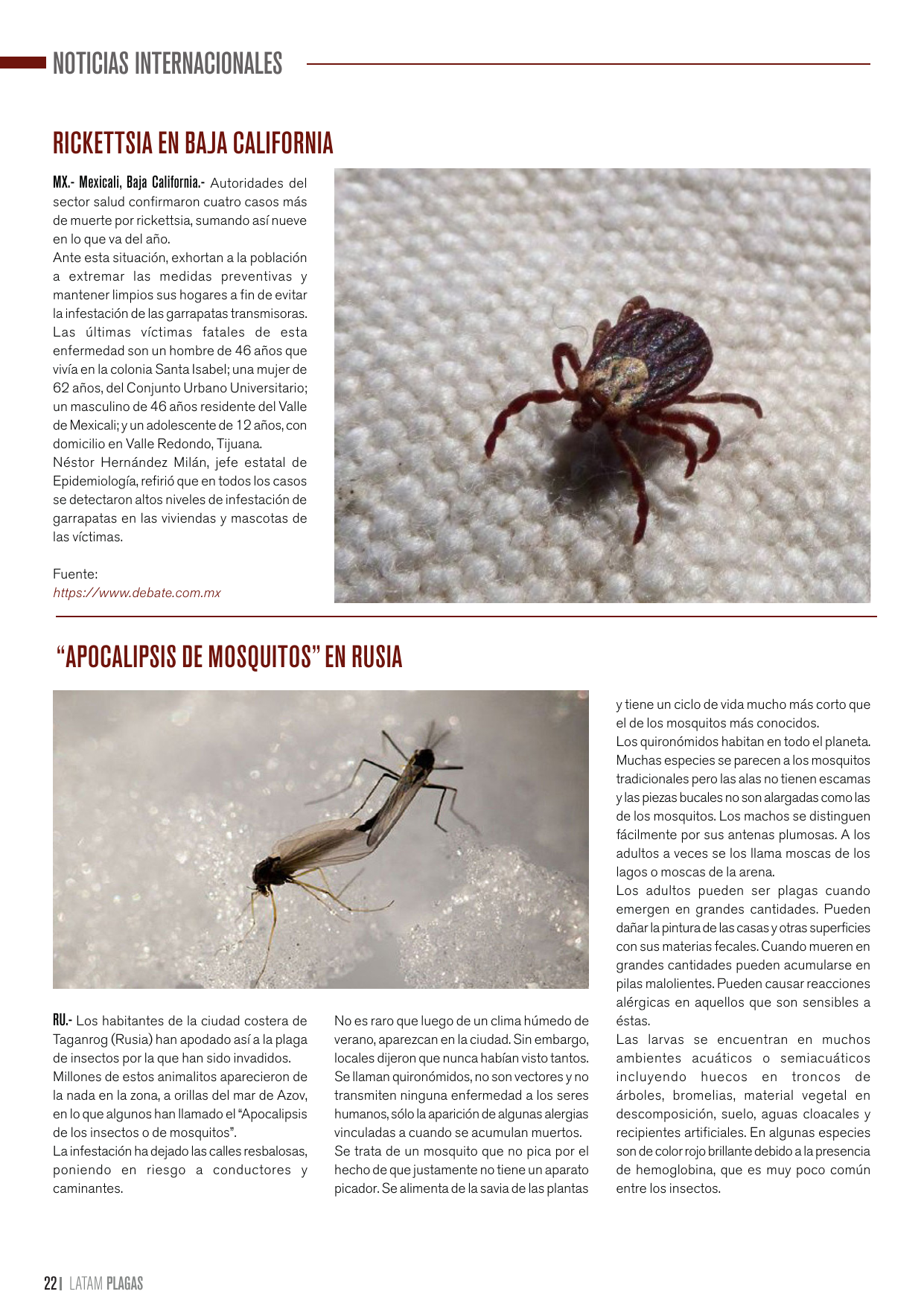
RICKETTSIA IN BAJA CALIFORNIA MX.- Mexicali, Baja California.- Health sector authorities confirmed four more cases of death due to rickettsia, bringing the total to nine so far this year. Given this situation, they urge the population to take extreme preventive measures and keep their homes clean in order to avoid infestation by transmitting ticks. The latest fatal victims of this disease are a 46-year-old man who lived in the Santa Isabel neighborhood; a 62-year-old woman, from the University Urban Complex; a 46-year-old male resident of the Mexicali Valley; and a 12-year-old adolescent, residing in Valle Redondo, Tijuana. Néstor Hernández Milan, state head of Epidemiology, said that in all cases high levels of tick infestation were detected in the victims' homes and pets. Source: https://www.debate.com.mx
“MOSQUITO APOCALYPSE” IN RUSSIA
RU.- The inhabitants of the coastal city of Taganrog (Russia) have given this name to the insect plague by which they have been invaded. Millions of these little animals appeared out of nowhere in the area, on the shores of the Sea of Azov, in what some have called the “Insect or Mosquito Apocalypse.” The infestation has left streets slippery, putting drivers and walkers at risk.
It is not unusual for them to appear in the city after humid summer weather. However, locals said they had never seen so many. They are called chironomids, they are not vectors and they do not transmit any disease to humans, only the appearance of some allergies linked to when dead people accumulate. This is a mosquito that does not bite because it does not have a biting device. It feeds on plant sap and has a much shorter life cycle than the best-known mosquitoes. Chironomids live all over the planet. Many species look like traditional mosquitoes but the wings do not have scales and the mouthparts are not elongated like those of mosquitoes. Males are easily distinguished by their feathery antennae. Adults are sometimes called lake flies or sand flies. Adults can be pests when they emerge in large numbers. They can damage house paint and other surfaces with their fecal matter. When they die in large numbers they can accumulate in smelly piles. They can cause allergic reactions in those who are sensitive to them. Larvae are found in many aquatic or semi-aquatic environments including cavities in tree trunks, bromeliads, decaying plant material, soil, sewage and artificial containers. In some species they are bright red due to the presence of hemoglobin, which is very rare among insects.
SWARM OF BEES CAUSES UPDATE IN TIMES SQUARE USA - New York. A swarm of bees swarmed a hot dog cart at the emblematic New York intersection, causing the mobilization of emergency teams and outages in the busy area. NYPD officers were present early in the afternoon. With proper protection to avoid bites, an effective
began patiently vacuuming up the insects that had made their home on the corner of Broadway and 43rd St. Several photographs and videos of the incident have been shared on social media. There were no reports of affected people and it is unknown how the bees arrived in the area, one of the most visited tourist attractions in the city.
TWO SPECIES OF INSECTS NOT KNOWN TO SCIENCE DISCOVERED
AR. - Two species of insects not known to science were discovered in Argentina. And, for scientists, it is necessary to be vigilant, because they are close “relatives” of a well-known pest of flower and vegetable crops, such as asparagus, lettuce and garlic. The two new species, which were detected in cultivated plants, weeds and native to the Province of Mendoza,
They belong to the order of Thysanoptera: tiny insects that are popularly known as thrips. They have a thin body and measure between 1 and 2 millimeters. "They feed on plants. At the moment they are not pests, but their status could change," explained to the CyTA-Leloir Agency, one of the authors of the discovery, agronomist Carlos Manuel de Borbón, researcher at the Station's Entomology Laboratory.
INTA Agricultural Experimental in Mendoza. As described in the magazine “Zootaxa”, the insects discovered belong to the Frankliniella genus, the same as flower thrips or Frankliniella occidentalis: a pest of horticultural crops and ornamental plants that causes significant economic losses around the world. In this case, the species were named Frankliniella juancarlosi (in reference to Juan Carlos, the deceased father of one of the researchers) and Frankliniella inesae, whose epithet or second term refers to a person from the researchers' environment and coincides with the name of another of them, María Inés Zamar, an entomologist at the National University of Jujuy. To identify the insects, the authors of the study made microscopic preparations and studied features of their morphology such as the relative position of hairs in a region of the head, their length and the presence of glandular areas. “Distinguishing between pest species, which cause economic damage, and species that so far have not been shown to be harmful is essential because it can define whether a plant is a source of infestation or not,” said De Borbón. The study was carried out with financing from the scholarship program and the National Fruit Tree Program of INTA. Source: http: //www. agencycyta. org. ar