International pest control news
SOUTH GEORGIA DECLARED RODENT FREE. UK- At a press conference held on May 8 in central London, the Antarctic island of South Georgia was officially declared rodent-free, a situation it was two centuries ago, before...
Technical summary
- Focus
- SOUTH GEORGIA DECLARED RODENT FREE UK- At a press conference held on May 8 in central London, the Antarctic island of South Georgia was officially declared rodent-free, a situation it was two centuries ago, before the invasion...
- Approach
- The article structures the analysis around SOUTH GEORGIA DECLARED RODENT FREE, LITTLE TERMITE HOUSE: HOW TERMITES DESTROY FROM THE INSIDE OUT and WASP WITH LIFE CYCLE SIMILAR TO “ALIEN” DISCOVERED.
- Use
- Useful for professionals who need context, diagnosis and operational decisions in rodents.
Index
SOUTH GEORGIA DECLARED RODENT FREE
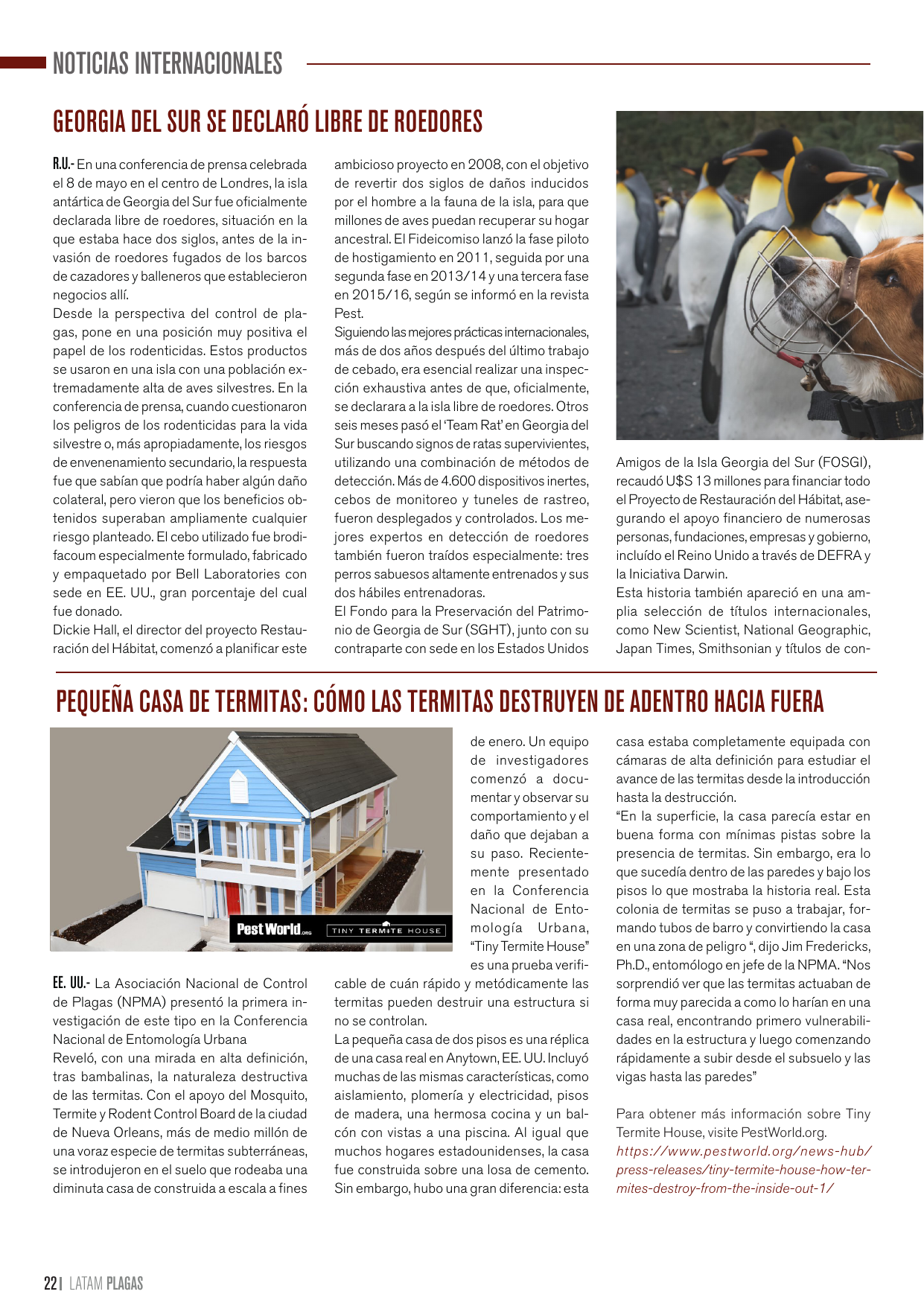
UK- At a press conference held on May 8 in central London, the Antarctic island of South Georgia was officially declared rodent-free, a situation it was two centuries ago, before the invasion of escaped rodents from the ships of hunters and whalers who established businesses there.
From a pest control perspective, this puts the role of rodenticides in a very positive light. These products were used on an island with an extremely high population of wild birds. At the press conference, when they questioned the dangers of rodenticides to wildlife or, more appropriately, the risks of secondary poisoning, the response was that they knew there could be some collateral damage, but saw that the benefits gained far outweighed any risks posed. The bait used was specially formulated brodifacoum, manufactured and packaged by US-based Bell Laboratories, a large percentage of which was donated.
Dickie Hall, the Habitat Restoration project manager, began planning this ambitious project in 2008, with the goal of reversing two centuries of human-induced damage to the island's fauna, so that millions of birds can regain their ancestral home. The Trust launched the harassment pilot phase in 2011, followed by a second phase in 2013/14 and a third phase in 2015/16, as reported in Pest magazine.
Following international best practice, more than two years after the last priming work, a thorough inspection was essential before the island was officially declared rodent-free. Another six months Team Rat spent in South Georgia searching for signs of surviving rats, using a combination of detection methods. More than 4,600 inert devices, monitoring baits and tracking tunnels, were deployed and controlled. The best experts in rodent detection were also specially brought in: three highly trained bloodhound dogs and their two skilled trainers.
The South Georgia Heritage Fund (SGHT), together with its US-based counterpart, Friends of South Georgia Island (FOSGI), raised US$13 million to fund the entire Habitat Restoration Project, securing financial support from numerous individuals, foundations, businesses and government, including the UK through DEFRA and the Darwin Initiative.
This story has also appeared in a wide selection of international titles including New Scientist, National Geographic, Japan Times, Smithsonian and conservation titles including Island Conservation and BBC Wildlife Magazine.
Source: Pest Magazine.
More information: https: //www. pestmagazine. co. uk/en/news/posts/2018/may/they-ve-done-it-south-georgia-declared-rodent-free
Caption: Photograph: Oliver Prince/South Georgia Heritage Trust.
LITTLE TERMITE HOUSE: HOW TERMITES DESTROY FROM THE INSIDE OUT
USA - The National Pest Management Association (NPMA) presented the first research of its kind at the National Urban Entomology Conference. It revealed, with a high-definition look behind the scenes, the destructive nature of termites. With the support of the City of New Orleans' Mosquito, Termite and Rodent Control Board, more than half a million of a voracious species of subterranean termites burrowed into the soil surrounding a tiny house built to scale in late January.
A team of researchers began documenting and observing their behavior and the damage they left in their wake. Recently presented at the National Urban Entomology Conference, Tiny Termite House is verifiable proof of how quickly and methodically termites can destroy a structure if left unchecked. The tiny two-story house is a replica of a real house in Anytown, USA. It included many of the same features, such as insulation, plumbing and electrical, hardwood floors, a beautiful kitchen, and a balcony overlooking a pool. Like many American homes, the house was built on a slab of cement.
However, there was one big difference: this house was fully equipped with high-definition cameras to study the progress of termites from introduction to destruction. "On the surface, the house appeared to be in good shape with minimal clues to the presence of termites. However, it was what happened inside the walls and under the floors that showed the real story. This termite colony went to work, forming mud tubes and turning the house into a danger zone,” said Jim Fredericks, Ph.D., NPMA chief entomologist. "We were surprised to see that the termites acted much like they would in a real house, first finding vulnerabilities in the structure and then quickly beginning to climb from the subfloor and joists to the walls."
For more information about Tiny Termite House, visit PestWorld. org.
WASP WITH LIFE CYCLE SIMILAR TO “ALIEN” DISCOVERED
AUS. - A University of Adelaide PhD student has discovered a new species of wasp, called the Xenomorph, due to its parasitic life cycle that echoes the predatory behavior of the monster from the Alien movie franchise.
The new species Dolichogenidea xenomorph, injects its eggs into live caterpillars and the wasp larvae slowly eat the caterpillar from the inside out, bursting once they have eaten their fill. The wasp larvae transform into adult wasps and continue the search for more caterpillars in which to lay their eggs. This is one of three recently documented wasps that are parasitoids, they must kill their host to complete their life cycle.
«The xenomorph Dolichogenidea "It acts as a parasite on caterpillars in a similar way to the fictional Alien creature on its human host," says lead researcher Erinn Fagan-Jeffries, a PhD student in the University's School of Biological Sciences. "The wasp is also black and shiny like the alien, and has a couple of strange traits for the genus, so xenomorph, which means strange shape, fits very well."
In their natural environment, these wasps play an important role in regulating populations of their insect hosts, and have been used in agricultural crops to control caterpillar pests. The xenomorph of Dolichogenidea It has been collected in Queanbeyan, New South Wales and in southern Western Australia, but is likely to have a wider distribution throughout Australia. It has an extremely long ovipositor, a needle-like structure that female wasps use to inject their eggs into their host. The host of this species is a moth caterpillar that feeds on eucalyptus leaves.
Ms Fagan-Jeffries' research is supervised by Professor Andrew Austin of the University's Australian Center for Evolutionary Biology and Biodiversity, in collaboration with Professor Steven Cooper of the South Australian Center and Museum. These three new species are among thousands more wasps in Australia still awaiting a description and names. "We collected more than 500 wasps from a particular subfamily, from across Australia, and determined that there were more than 200 different species in that relatively small number of specimens," Professor Austin says. "There are currently only 100 species described in this subfamily for Australia, so we have at least doubled the number of known species. It is important to document our biodiversity so that we can make informed conservation decisions about our environment. "Some of these wasps can potentially be useful biological control agents for pests, but we don't know about them yet."
Note: Content was edited for style and length.
Journal: Erinn P. Fagan-Jeffries, Steven J. B. Cooper, Andrew D. Austin. Three new species of Dolichogenidea Viereck (Hymenoptera, Braconidae, Microgastrinae) from Australia with exceptionally long ovipositors. Journal of Hymenoptera Research, 2018; 64: 177. DOI: 10. 3897/jhr. 64. 25219
RATS EAT US$18,000 IN CASH
INDIA. - Shredded banknotes discovered after ATM stops working in Assam state. Rats munched on more than $18,000 (Rs 1.2 million) in cash after breaking into an ATM in northeast India. The invasion was only detected by bank officials after customers complained that the machine was defective and had stopped delivering cash, police in Tinsukia district said.
During the inspection they found a dead rat and the shredded bills. The rats apparently entered the machine through a small opening for cables. Footage showed an overturned ATM filled with torn and torn Rs 500 and Rs 2,000 notes.