
International pest control news
Spain: two new exotic species of cockroaches for the Iberian Peninsula. During our work as urban pest control professionals, two new exotic species of cockroaches were detected for the Iberian Peninsula.
Technical summary
- Focus
- Spain: two new exotic species of cockroaches for the Iberian Peninsula During our work as urban pest control professionals, two new exotic species of cockroaches were detected for the Iberian Peninsula.
- Approach
- The article structures the analysis around Spain: two new exotic species of cockroaches for the Iberian Peninsula, Canada: he set fire to his house trying to fight ants and Fuerteventura: alarm due to the presence of Aedes...
- Use
- Useful for professionals who need context, diagnosis and operational decisions in rodents.
Index
Spain: two new exotic species of cockroaches for the Iberian Peninsula
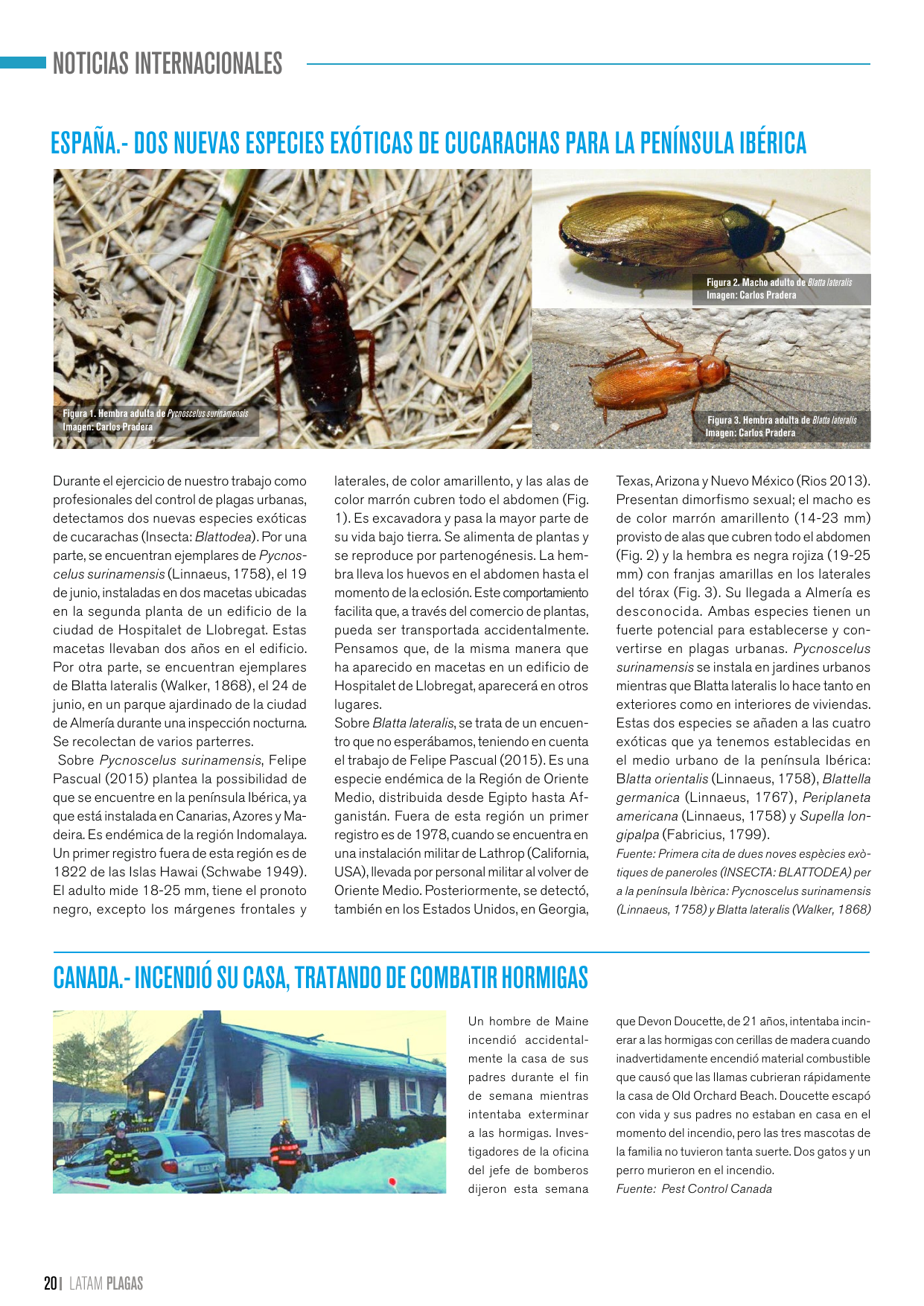
During our work as urban pest control professionals, two new exotic species of cockroaches were detected for the Iberian Peninsula. On the one hand, there are examples of Pycnoscelus surinamensis installed in two pots located on the second floor of a building in Hospitalet de Llobregat. These pots had been in the building for two years. On the other hand, specimens of Blatta lateralis in a landscaped park in the city of Almería during a night inspection.
About Pycnoscelus surinamensis, Felipe Pascual raises the possibility that it is located in the Iberian Peninsula, since it is installed in the Canary Islands, Azores and Madeira. It is endemic to the Indo-Malay region. A first record outside this region is from 1822 in the Hawaiian Islands. The adult measures 18 to 25 mm, has a black pronotum, except for the yellowish front and lateral margins, and the brown wings cover the entire abdomen. It is an excavator and spends most of its life underground. It feeds on plants and reproduces by parthenogenesis. The female carries the eggs in her abdomen until hatching. This behavior makes it easy for it to be accidentally transported through the plant trade.
About Blatta lateralis, this is an encounter that we did not expect. It is an endemic species to the Middle East region, distributed from Egypt to Afghanistan. Outside this region, the first record is from 1978, when it is found in a military installation in California, taken by military personnel upon returning from the Middle East. It was later also detected in Georgia, Texas, Arizona and New Mexico. It presents sexual dimorphism; The male is yellowish brown and has wings that cover the entire abdomen, while the female is reddish black with yellow stripes on the sides of the thorax. Both species have a strong potential to establish and become urban pests.
Source: “First date of dues new exotic species of paneroles for the Iberian Peninsula.”
Canada: he set fire to his house trying to fight ants
A Maine man accidentally set his parents' house on fire over the weekend while trying to exterminate ants. Investigators with the fire marshal's office said Devon Doucette, 21, was attempting to incinerate the ants with wooden matches when he inadvertently ignited combustible material that caused flames to quickly engulf the Old Orchard Beach home. Doucette escaped with his life and his parents were not home at the time of the fire, but the family's three pets were not so lucky. Two cats and a dog died in the fire.
Source: Pest Control Canada.
Fuerteventura: alarm due to the presence of Aedes aegypti
Public health officials met with residents of Fuerteventura, part of the Canary Islands, after the discovery of the mosquito Aedes aegypti on the island, providing them with advice and recommendations to avoid an infestation.
The General Directorate of Public Health, the Department of Health of Fuerteventura and the University Institute of Tropical Diseases and Public Health, together with the Ministry of Environment of the Government of the Canary Islands, coordinated actions to delimit the exact area in which the invasive species was introduced. Inspections were carried out inside and outside houses in the area where the mosquito was found and some of the properties were treated with an appropriate disinfectant, ensuring the safety of residents by evacuating the premises for 12 hours.
Recommendations included keeping water clean and changed regularly, keeping drains dry and clean, monitoring plants for the presence of eggs, and ensuring water tanks are checked at least once every 24 hours. Cars also had to be treated for disinfection. The importance of citizen participation was also stressed and it was asked that if anyone spotted what they believe could be one of the mosquitoes, they should send details or photos to the health department or through the Mosquito Alert mobile app.
Source: Tenerife News.
United States: Boston freezes rats
The city of Boston is experimenting with a chilling new way to kill rats: dry ice. According to William Christopher, commissioner of the city's Department of Inspectional Services, agency workers have been using conservators to collect dry ice from a local company for the past few weeks.
They carry the frozen substance to identified problem spots and use steel shovels and gloves to place the dry ice at the burrow exits. Dry ice is the solid form of carbon dioxide. As it melts, it turns into carbon dioxide gas, which fills the burrow suffocating the rats inside. This method is more effective and cheaper than using rat poison.
Using dry ice reduces the risk that the poison may pose to other animals and children. Officials in other cities have asked about the method because they are interested in adopting it.
Source: The Boston Globe.