
International pest control news
USA: EPA registers the Wolbachia ZAP strain of Asian tiger mosquitoes. On November 3, 2017, the EPA registered a new mosquito biopesticide ZAP Males, which can reduce local populations of Aedes albopictus, or Asian...
Technical summary
- Focus
- USA: EPA registers the Wolbachia ZAP strain of Asian tiger mosquitoes On November 3, 2017, the EPA registered a new mosquito biopesticide ZAP Males, which can reduce local populations of Aedes albopictus , or Asian tiger...
- Approach
- The article structures the analysis around USA: EPA registers the Wolbachia ZAP strain of Asian tiger mosquitoes, Tanzania: biological control program manages late armyworm and U.K.: British Airways plane does not take off due...
- Use
- Useful for professionals who need context, diagnosis and operational decisions in public health and vectors.
Index
USA: EPA registers the Wolbachia ZAP strain of Asian tiger mosquitoes
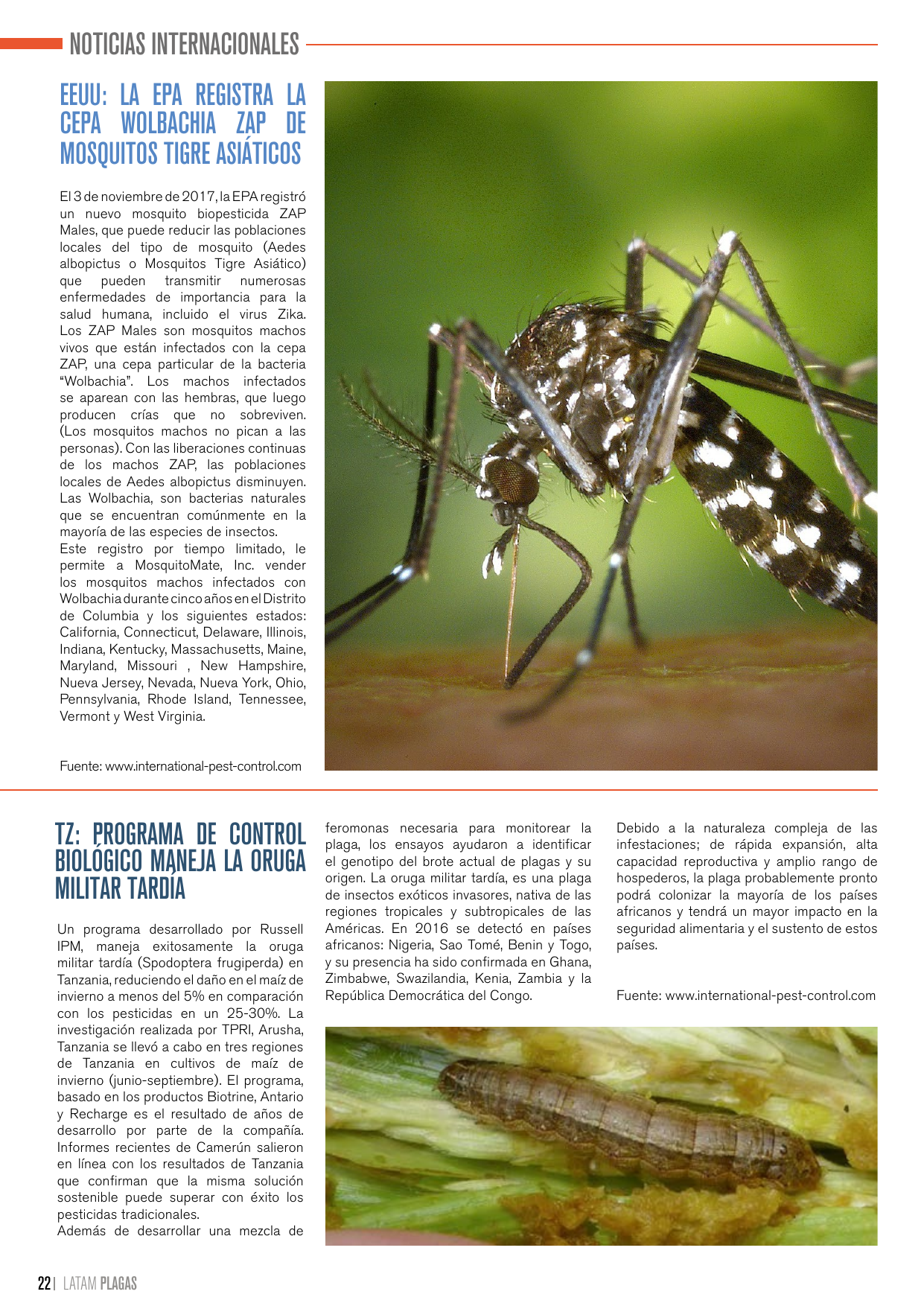
On November 3, 2017, the EPA registered a new mosquito biopesticide ZAP Males, which can reduce local populations of Aedes albopictus, or Asian tiger mosquito, a species capable of transmitting numerous diseases of importance to human health, including the Zika virus.
ZAP Males are live male mosquitoes that are infected with the ZAP strain, a particular strain of the bacteria Wolbachia. Infected males mate with females, who then produce offspring that do not survive. Male mosquitoes do not bite people. With continued releases of these males, local populations of Aedes albopictus decrease.
The Wolbachia They are naturally occurring bacteria commonly found in most species of insects. This limited-time registration allows MosquitoMate, Inc. to sell male mosquitoes infected with Wolbachia for five years in the District of Columbia and in several United States states, including California, Connecticut, Delaware, Illinois, Indiana, Kentucky, Massachusetts, Maine, Maryland, Missouri, New Hampshire, New Jersey, Nevada, New York, Ohio, Pennsylvania, Rhode Island, Tennessee, Vermont and West Virginia.
Source cited by the magazine: International Pest Control.
Tanzania: biological control program manages late armyworm
A program developed by Russell IPM successfully managed the late military caterpillar, Spodoptera frugiperda, in Tanzania, reducing damage to winter corn to less than 5%, compared to pesticide treatments that caused damage of 25 to 30%.
The research, conducted by TPRI in Arusha, Tanzania, was carried out in three regions of that country on winter maize crops between June and September. The program, based on the Biotrine, Antario and Recharge products, was presented as the result of years of development by the company. Later reports from Cameroon also confirmed that the same sustainable solution could successfully outperform traditional pesticides.
In addition to developing a pheromone mixture needed to monitor the pest, the trials helped identify the genotype of the current outbreak and its origin. The late armyworm is an invasive pest native to tropical and subtropical regions of America. In 2016 it was detected in Nigeria, Sao Tome, Benin and Togo, and later its presence was confirmed in Ghana, Zimbabwe, Swaziland, Kenya, Zambia and the Democratic Republic of the Congo.
The magazine highlights that, due to the complex nature of these infestations, their rapid expansion, high reproductive capacity and wide host range, the pest would probably colonize much of the African continent with a strong impact on food security.
Source cited by the magazine: International Pest Control.
U.K.: British Airways plane does not take off due to the presence of bed bugs
British Airways was forced to cancel one of its flights after a bedbug infestation was detected and cabin crew refused to fly. The crew stood down shortly before taking off from Heathrow for Ghana. A replacement plane was finally found and the flight left four hours late.
The company said it took the plane out of service as soon as the problem arose. The source cited in the magazine was Daily Mail.
U.K.: rats and mosquitoes for pest control using gene drive
Researchers in Scotland have developed two different ways to alter female fertility in rats and mice, based on an approach similar to that already tested in the laboratory to eliminate malaria-carrying mosquitoes. The technique, known as gene drive, seeks to push modified genes through multiple generations by overriding normal biological processes.
In this way, all offspring end up carrying two copies of a gene, one from the mother and one from the father. Although the technique is extremely powerful, it is also controversial, as these genetically modified organisms could have an irreversible impact on the ecosystem.
The central appeal of the gene drive is its lasting effect on pests, whether disease-carrying insects or crop-eating rodents. Furthermore, with a relatively small number of initially released animals required, the potential cost of the approach would be low. If successful, it could be applied to other non-insectile pest species, such as rabbits, mink or cane toads.
Source cited by the magazine: Reuters.