
Musca domestica: technical collectible
Musca domestica It is an insect belonging to the order of Diptera. Among its relevant morphological characteristics we can mention its great cephalic development, with two very prominent compound eyes that occupy a...
Technical summary
- Focus
- Musca domestica It is an insect belonging to the order of Diptera.
- Approach
- The article structures the analysis around Life cycle and Efficient control.
- Use
- Useful for professionals who need context, diagnosis and operational decisions in edición 3.
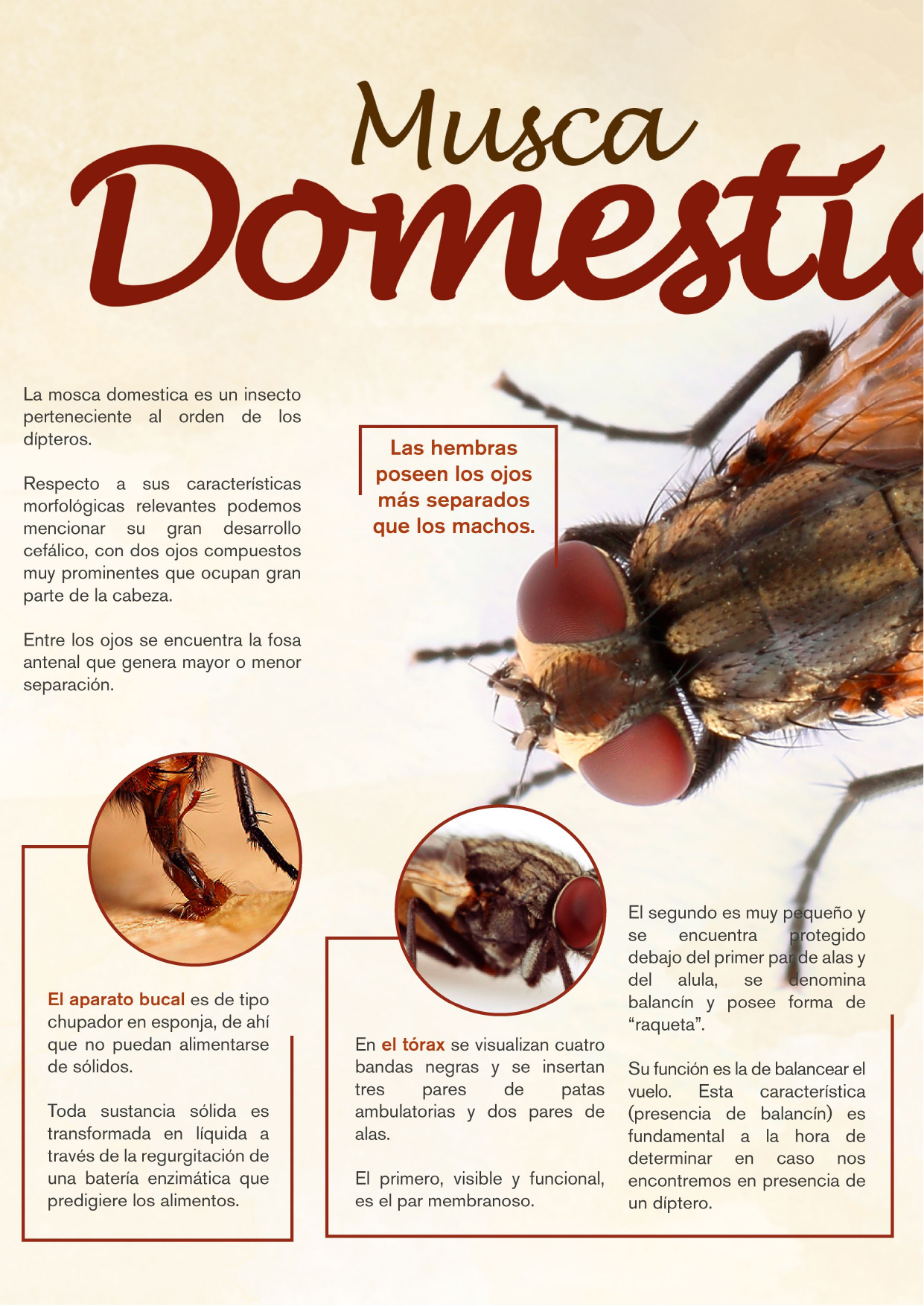
Musca domestica It is an insect belonging to the order of Diptera. Among its relevant morphological characteristics we can mention its great cephalic development, with two very prominent compound eyes that occupy a large part of the head.
Between the eyes is the antennal fossa, which generates greater or lesser separation. In females this distance is greater than in males, a useful feature to differentiate them visually.
The oral apparatus is a sponge-sucking type, hence they cannot feed on solids. Every solid substance is transformed into a liquid through the regurgitation of an enzymatic battery that predigests food.
Four black bands are visible on the thorax and three pairs of ambulatory legs and two pairs of wings are inserted. The first, visible and functional, is the membranous pair. The second is very small and is protected under the first pair of wings and the alula; It is called a rocker and is shaped like a racket. Its function is to balance the flight and this characteristic is essential when determining if we are in the presence of a dipteran.
The size of the house fly can vary between 8 and 12 millimeters. It has sexual reproduction, therefore copulation between male and female is necessary. Females can lay 200 to 300 eggs in clusters of 20 to 30 or singly.
The eggs are elongated, pearly white and approximately 1.2 millimeters long. The larva emerges from the egg after 18 to 24 hours of incubation.
Life cycle
As an example for a place between 24 °C and 28 °C, the cycle can be organized as follows: eggs on day 0, larvae on day 8, pupa on day 11 and adult on day 12. In this reference population distribution, eggs represent about 40%, larvae 30%, pupae 20% and adults 10%.
Efficient control
The collectible highlights the convenience of using adulticides and larvicides together to achieve more efficient control of the house fly population.