
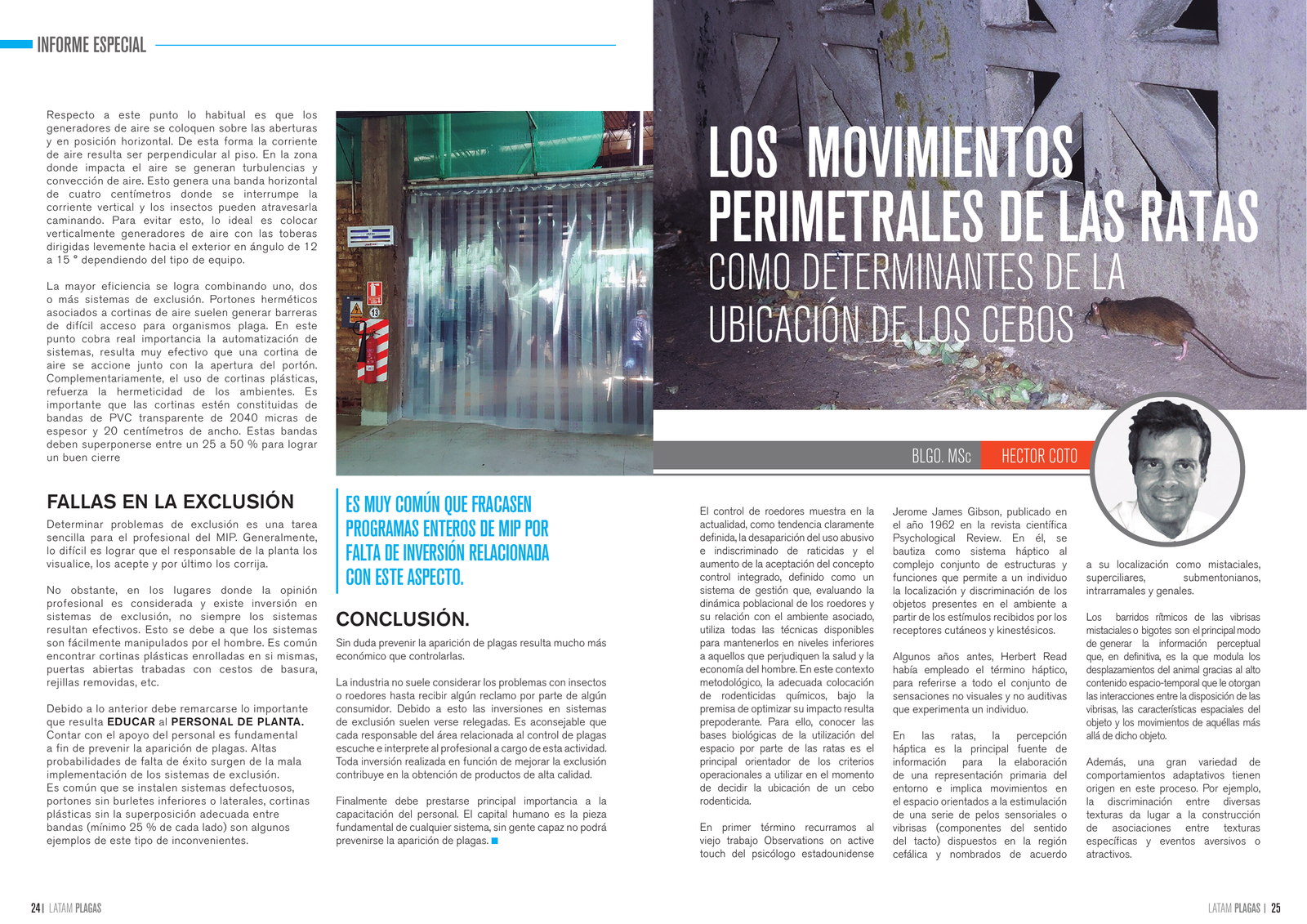
Perimeter movements of rats as determinants of bait location
Rodent control currently shows, as a clearly defined trend, the disappearance of the abusive and indiscriminate use of rodenticides and the increase in acceptance of the concept of integrated control, defined as a...
Technical summary
- Focus
- Rodent control currently shows, as a clearly defined trend, the disappearance of the abusive and indiscriminate use of rodenticides and the increase in acceptance of the concept of integrated control, defined as a management...
- Approach
- The article structures the analysis around 1. Baiting in burrows Rattus norvegicus, 2. Priming in transit places and 3. Indoor priming.
- Use
- Useful for professionals who need context, diagnosis and operational decisions in rodents.
Index
Rodent control currently shows, as a clearly defined trend, the disappearance of the abusive and indiscriminate use of rodenticides and the increase in acceptance of the concept of integrated control, defined as a management system that, evaluating the population dynamics of rodents and their relationship with the associated environment, uses all available techniques to keep them at levels lower than those that harm human health and economy.
In this methodological context, the appropriate placement of chemical rodenticides, under the premise of optimizing their impact, is preponderant. To this end, knowing the biological bases of the use of space by rats is the main guide for the operational criteria to be used when deciding the location of a rodenticide bait.
First let's turn to the old work Observations on active touch by the American psychologist Jerome James Gibson, published in 1962 in the scientific journal Psychological Review. In it, the complex set of structures and functions that allows an individual to locate and discriminate objects present in the environment based on the stimuli received by the skin and kinesthetic receptors is called the haptic system.
In rats, haptic perception is the main source of information for the elaboration of a primary representation of the environment and involves movements in space oriented to the stimulation of a series of sensory hairs or vibrissae, components of the sense of touch, arranged in the cephalic region and named according to their location as mystacial, superciliary, submental, intraramal and genal.
The rhythmic sweeps of the mystacial vibrissae or whiskers are the main way of generating perceptual information that, ultimately, is what modulates the movements of the animal thanks to the high spatio-temporal content provided by the interactions between the arrangement of the vibrissae, the spatial characteristics of the object and their movements beyond said object.
Furthermore, a wide variety of adaptive behaviors originate from this process. For example, discrimination between various textures leads to the construction of associations between specific textures and aversive or attractive events.
The information received by the vibrissae, vibration, contact and pressure differences caused by the proximity of an object, is transmitted through the nervous system through neurons that are capable of encoding location, deflection, direction, start, end, duration, amplitude, speed and temporal patterns of the stimuli applied to each vibrissae.
The representation of the environment provided by the vibrissae represents approximately 20 percent of the rat's total somatic input and occupies approximately 30 percent of the total surface area of the somatosensory cortex.
Due to the fact that this cortical representation greatly exceeds that of the other senses, it can be stated that these animals are primarily vibrissal. That is why the movements of Rattus rattus and Rattus norvegicus They are primarily governed by touch and show marked thigmotaxis, a term defined by Treit and Fundytus in 1989 as the tendency of rodents to stay and move close to vertical surfaces.
By virtue of this, the question concerning the choice of places to place the rodenticide requires us to keep in mind that the spatial movements of rats are carried out mainly in the vicinity of vertical surfaces. It is necessary to remember that these routes are repeated daily. Therefore, the presence of signs will allow us to infer that the individuals who provoked them will almost certainly return to the place.
Based on these and other elements, it is possible to develop a series of basic rules to take into account when establishing the priming points.
1. Baiting in burrows Rattus norvegicus
The control of Rattus norvegicus Outdoors, the priority will be to place rodenticides inside the burrows. To do this, with the help of a funnel or a long-handled spoon, 50 grams of product should be introduced about 20 centimeters into the burrow. The replacement will be daily.
Rattus norvegicus It is sensitive to changes in its environment. Therefore, the baits must be applied causing the least possible disturbance to the nest, since its inhabitants will reject unknown elements, or those that they associate with a disturbance in their daily routine. It is then possible that, during the first and second day, the members of the burrow remove the bait from inside without consuming it. In this case it must be replaced until consumption begins. Once this happens, the amount of product placed will be doubled, 100 grams.
The success of this practice lies in the fact that individual responses to food are dictated by a foraging strategy that seeks to minimize the risk of attack by more dominant or predatory rats. Consequently, the acceptance of the bait placed in this way is optimal, twice as high as that placed at external baiting points.
2. Priming in transit places
When rodenticides are placed outside the burrows, it will be done in places where rodents travel or on trails. The individualization of these will be carried out through careful inspection of the areas with abundant vegetation cover and the spaces adjacent to the buildings.
The bait must be placed in protected places, both natural, for example hollows, stones or branches, and artificial, cracks in buildings or behind any object existing as a result of human activity, but always out of direct sunlight. The medium to cover the bait can be discreetly modified through the relocation of objects already present in it. The location of a priming point must be unchanged.
3. Indoor priming
Indoors, bait placement will be five centimeters away from walls or other vertical surfaces. As part of their spatial movements, rats establish stops during which they rest and groom themselves. They are carried out in corners or other places that allow both flanks to make contact with some surface; Consequently, these points are the ones that should be primed preferably.
The distance between the baiting points will range between 3 and 20 meters, depending on the severity of the infestation. In environments where food and shelter are distributed irregularly, rat abundance is likely to be non-homogeneous and therefore baiting points should also have a non-regular arrangement.
4. Particularities of the control of Rattus rattus
The control of Rattus rattus It presents a greater degree of difficulty due, in the first instance, to the fact that this species is notably more neophobic than its congener, so the acceptance of baits is slower, and secondly, to the complexity of locating the areas of activity, as a result of its predilection for sites far from the ground.
As a result of the latter, unlike Rattus norvegicus, the placement of rodenticide will be concentrated in the high places of buildings, crawl spaces, roofs, attics and upper parts of silos. Priming points must also be established in transit areas, pipes, cornices, beams, and electrical and telephone lines. The characteristics of all these places mean that, due to its versatility in handling, the waxed block is the formulation of choice.
5. Eating pattern Rattus rattus
It should be taken into account that the dietary pattern of Rattus rattus It involves obtaining small amounts of food from different sources. Therefore, the strategy based on a large number of priming points will have greater possibilities of increasing its efficiency.
6. Tree burrows
The aforementioned climbing abilities of Rattus rattus They allow it to build spherical burrows from remains of foliage in the upper sectors of the tree vegetation. In urban environments it frequently nests in the tops of trees and palm trees in public parks. In this case, the concept developed as a basis for priming burrows of Rattus norvegicus: the bait must be placed in the place where the nest is located and, when this is not possible, at the base of the tree in question.
The universe of variables that converge in the modeling of an infestation caused by rodents is what will give the final format to the operational criteria to be applied in each case. Therefore, in this as in so many other aspects of rodent control, conceptual generalizations such as the one that makes up this article can never replace the particular information obtained in each situation diagnosis, the indispensable beginning of any intervention.