
Remote monitoring of mosquito populations through sensorized traps
Summary: The recent implementation of remote vector surveillance systems based on artificial intelligence represents a major turning point in current comprehensive mosquito management plans.
Technical summary
- Focus
- Summary: The recent implementation of remote vector surveillance systems based on artificial intelligence represents a major turning point in current comprehensive mosquito management plans.
- Approach
- It brings together technical criteria linked to Edición 16, inteligencia artificial and latam plagas.
- Use
- Useful for professionals who need context, diagnosis and operational decisions in public health and vectors.
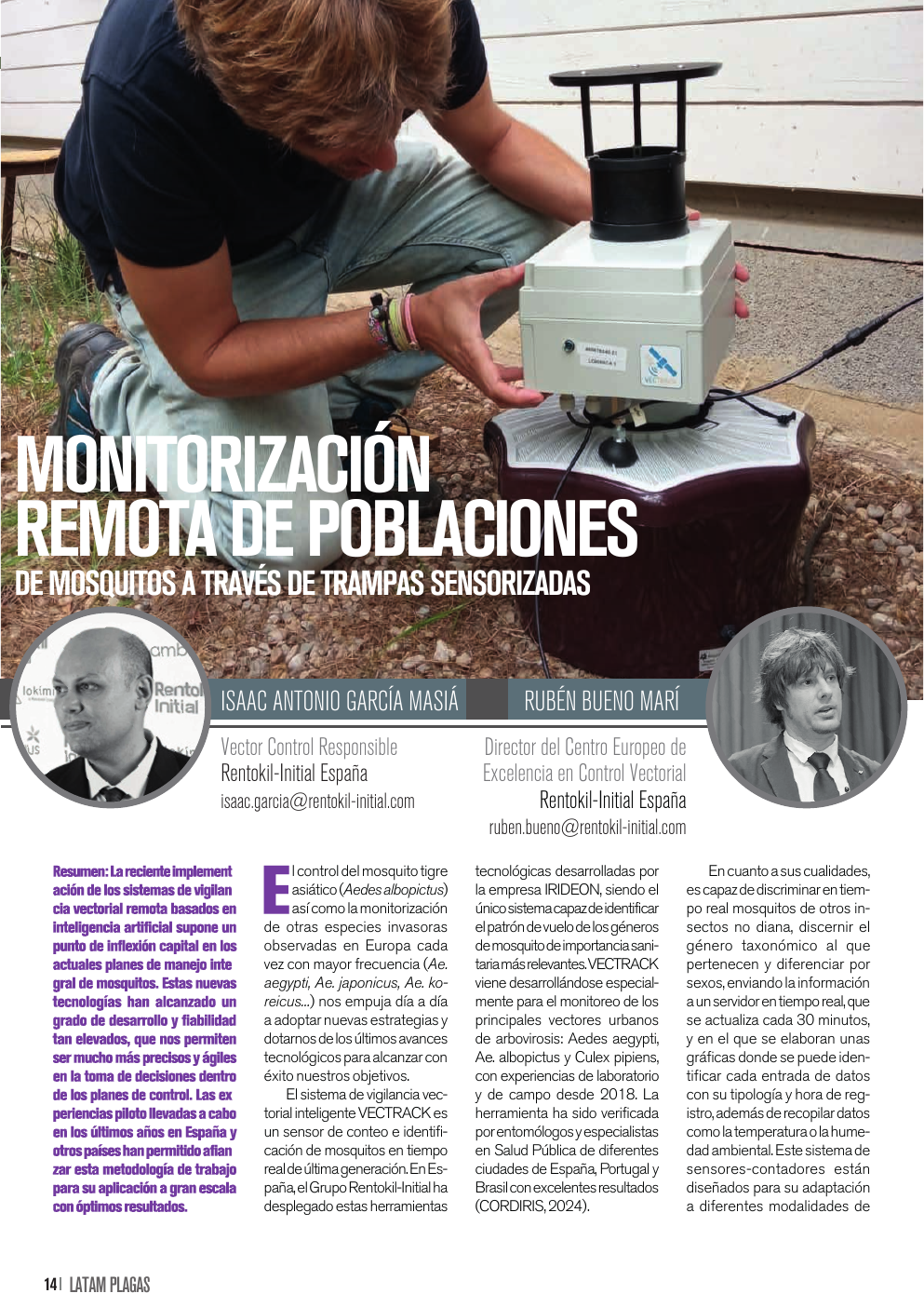
Summary: The recent implementation of remote vector surveillance systems based on artificial intelligence represents a major turning point in current comprehensive mosquito management plans. These new technologies have reached such a high degree of development and reliability that they allow us to be much more precise and agile in making decisions within control plans. The pilot experiences carried out in recent years in Spain and other countries have allowed this work methodology to be consolidated for its large-scale application with optimal results. The control of the Asian tiger mosquito (Aedes albopictus) as well as the monitoring of other invasive species observed in Europe with increasing frequency (Ae. aegypti, Ae. japonicus, Ae. koreicus...) pushes us every day to adopt new strategies and equip ourselves with the latest technological advances to successfully achieve our objectives. The VECTRACK smart vector surveillance system is a state-of-the-art real-time mosquito counting and identification sensor. In Spain, the Rentokil-Initial Group has deployed these technological tools developed by the company IRIDEON, being the only system capable of identifying the flight pattern of the most relevant mosquito genera of health importance. VECTRACK has been developed especially for the monitoring of the main urban vectors of arboviruses: Aedes aegypti, Ae. albopictus and Culex pipiens, with laboratory and field experiences since 2018. The tool has been verified by entomologists and Public Health specialists from different cities in Spain, Portugal and Brazil with excellent results (CORDIRIS, 2024). Regarding its qualities, it is capable of discriminating mosquitoes from other non-target insects in real time, discerning the taxonomic genus to which they belong and differentiating by sex, sending the information to a server in real time, which is updated every 30 minutes, and in which graphs are created where each data entry can be identified with its typology and time of registration, in addition to collecting data such as temperature or environmental humidity. This sensor-counter system is designed to adapt to different types of standardized mosquito capture traps, being compatible with the main models currently on the market and widely used in state and municipal entomological surveillance networks. VECTRACK has evolutionary artificial intelligence (AI), which “learns” the more data it processes. The system identifies 27 different characteristics of the insects that pass through the optical part of the sensor, one of the most relevant being the mosquito's flight frequency. Thanks to this and based on the results of different scientific publications carried out in laboratory and field conditions, we know that VECTRACK identifies with a percentage greater than 95% reliability, whether it is mosquitoes of the genus Culex spp. or Aedes spp., and whether they are males or females (González et al., 2022, González et al., 2024). At the time of installation in the field, each device is triangulated with three different satellites to be able to geolocate the captures and send the data to the server where the data is stored and processed. It is designed to operate in open spaces and in outdoor conditions, high temperatures and other inclement weather, such as heavy rain. It is resistant to moderate impacts and is capable of emitting continuously for prolonged periods. Likewise, each sensor adapts to changes in location, and can be used discontinuously and in various locations, which gives them great versatility. The VECTRACK system is specially designed to continuously monitor mosquito populations in predominantly urban environments, and also in peri-urban environments. Its degree of reliability is remarkably close to 100% in these first environments (although it continues to be extremely reliable in more disparate locations where the devices have been expressly subjected to a certain “data stress”). It can be used intermittently and on an outpatient basis, in various cases, such as in arbovirus case studies, mosquito population reduction effectiveness studies, in citizen alert systems, etc. It offers a series of advantages such as immediacy and reliability and its degree of technological maturity is much higher than that of other competitors. It allows remote surveillance programs to be carried out without the need for travel, to estimate population and specific densities in a specific area, to schedule specific interventions based on the captures made, to carry out sampling in search of viruses hours after captures of females have been detected, to evaluate the effectiveness of adulticidal treatments, to establish citizen alert systems or to carry out various entomological studies. One of its main advantages is to avoid unnecessary costs, since in the case of carrying out laboratory analyzes in search of viruses, for example, specimen collections would only be carried out if the recent entry of individuals useful for molecular analysis was detected. VECTRACK's artificial intelligence continues to constantly learn, improving identification models with each capture. In the future, the system could be able to identify more specific flight patterns, including other mosquitoes of great interest to Public Health such as Anopheles spp., transmitters of malaria. In Spain, in 2023, through Rentokil Initial, the Autonomous Community of Andalusia has been a pioneer in the deployment of devices of this nature on a large scale (Junta de Andalucía, 2023), although some pilot programs with this technology had already been carried out in other autonomous communities, they had never been carried out in such a long period of time nor in the current evolutionary state of AI. Many Spanish regions, and even other European countries, have echoed this use of cutting-edge technologies and have shown their interest in implementing these surveillance systems in the immediate future, as well as learning more about the Andalusian experience. In Andalusia, installation points of a varied nature were contemplated, including transportation nodes such as ports of intercontinental magnitude, large health centers, sports centers, large urban green areas and strategic places due to the confluence of various types of ecological landscape, generating an ecotone environment. The project involved overcoming several challenges linked to the logistics and field operation of the system, which have also allowed us to improve the technology and the current state of the art. Likewise, it allowed us to confirm the presence and activity of the Aedes albopictus vector in various locations until the last periods of the year (winter 2023), as was also confirmed for the first time in some regions of France in the same year. In addition, the 95% success threshold was exceeded in the correct identification of species and sex of the mosquitoes captured in the traps of typical urban locations (Bueno Marí, 2024). Among the final considerations, it should be noted that if the final objective of using this technology is the continuous monitoring of vector populations in certain localities, the deployment of devices must be abundant, understood as fixed and balanced monitoring stations distributed in said specific territory. If the objective is to detect the possible entry of foreign vectors (e.g. Ae. aegypti or Ae. japonicus), the deployment of devices must be carried out surgically in strategic facilities, such as ports or airports or large freight transport nodes, without changing their position throughout the year and regardless of the number of captures (even if they occur in a very small number). In this case it would be a matter of deploying sentinel stations at entry points of the first magnitude. The use of this type of intelligent monitoring systems is extremely useful in controlling outbreaks of arboviruses such as dengue, Zika or chikungunya, which are expected to become increasingly frequent in Europe. But it is also currently useful for the monitoring and control of West Nile Virus (WNV) in populations of Culex pipiens and Culex perexiguus, very present in certain areas of Andalusia and protagonists of outbreaks in recent years. Likewise, it will be useful in vector surveillance processes against malaria cases, once it is able to correctly identify the Anopheles pattern. In short, it is one of the greatest innovations in the field of mosquito population management in recent years, and can be used as an Early Warning System (EWS) and make faster, more reasoned and cost-effective control decisions. Finally, it should be noted that the system also allows the integration of microclimatic data on temperature and humidity along with real-time captures of mosquitoes, which can be very useful to generate predictions of outbreaks or sudden increases in mosquito activity in the medium term in the monitored territories.