
Forensic IPM or archaeologist Pest Management Professional
It's the beginning of the week, it's eleven at night and the C. Pest Control phone rings insistently.
Technical summary
- Focus
- It's the beginning of the week, it's eleven at night and the C.
- Approach
- It brings together technical criteria linked to Edición 18, auditoría and evidencia técnica.
- Use
- Useful for professionals who need context, diagnosis and operational decisions in food safety and industry.
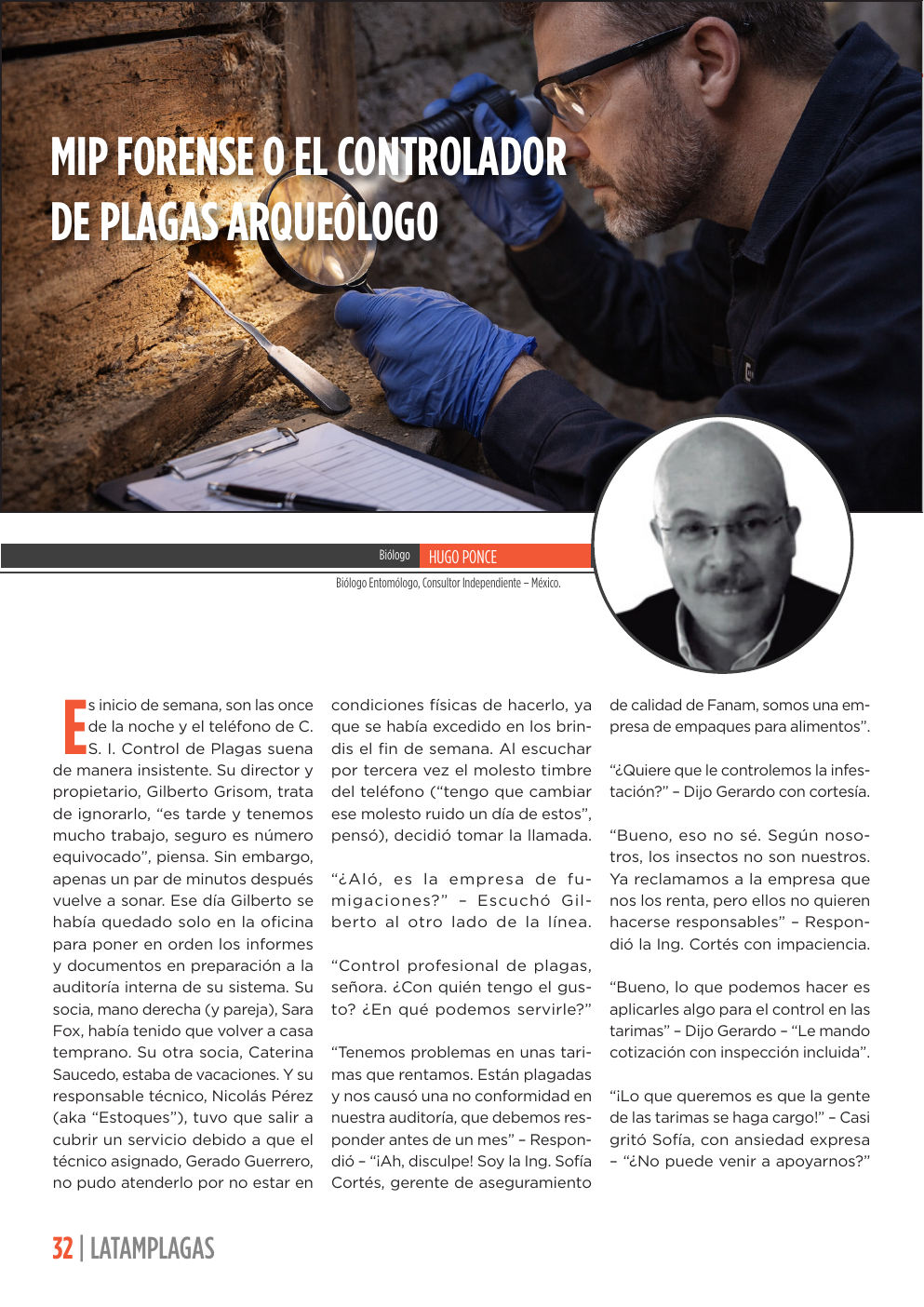
It's the beginning of the week, it's eleven at night and the C. S. I. Pest Control phone rings insistently. Its director and owner, Gilberto Grisom, tries to ignore it, “it's late and we have a lot of work, it's probably the wrong number,” he thinks. However, just a couple of minutes later it rings again. That day Gilberto had been left alone in the office to put the reports and documents in order in preparation for the internal audit of his system. His partner, right-hand woman (and partner), Sara Fox, had had to return home early. His other partner, Caterina Saucedo, was on vacation. And his technical manager, Nicolás Pérez (aka “Estoques”), had to go out to cover a service because the assigned technician, Gerado Guerrero, could not attend to him because he was not in
physically able to do so, since he had overindulged in toasting over the weekend. Hearing the annoying ringing of the phone for the third time (“I have to change that annoying noise one of these days,” he thought), he decided to take the call. “Hello, is it the fumigation company?” – Gilberto heard on the other side of the line. "Professional pest control, ma'am. Who do I have the pleasure of? How can we be of service to you?" "We have problems with some pallets that we rent. They are plagued and caused us a non-conformity in our audit, which we must respond to within a month" - She responded - "Ah, excuse me! I am Engineer Sofía Cortés, quality assurance manager at Fanam, we are a food packaging company." “Do you want us to control the infestation?” – Gerardo said politely. "Well, I don't know about that. According to us, the insects are not ours. We already complained to the company that rents them to us, but they don't want to take responsibility" - Engineer Cortés responded impatiently. “Well, what we can do is apply something to control the pallets” – Gerardo said – “I'll send you a quote with inspection included.” “What we want is for the people on the platforms to take charge!” – Sofia almost shouted, with expressed anxiety – “Can't you come and support us?”
“IN OTHER SIMPLE WORDS, DETERMINE WHAT HAPPENED AND WHY, TO DETERMINE RESPONSIBILITIES.” And what does this case have to do with forensics? There are no bodies of people or police involved. Forensic practices have much more scope than that.
place. Risk determination is rarely considered if there is no problem with an animal in the area that could cause damage, but it is always advisable to do so, which reduces the costs and consequences of the infestation. In both cases it involves identifying conditions and behaviors that favor or could favor pest damage. To achieve this, an inspection must be carried out, both practical and documentary, of the facilities and their context (surroundings, service or input providers, personnel movements, types of products, etc.), a “photograph” that allows us to define the starting point of the IPM plan. That's why we don't
We understand evidence to be the available set of facts or information that indicate whether a belief or proposition is true or valid (RAE), or the clear and manifest certainty of the truth or reality of something (Pan-Hispanic Dictionary of Doubts). We can talk about two types of evidence. Scientific evidence, which is the data and knowledge generated by rigorous, peer-reviewed research to support or and manifest certainty of the truth or reality of something (Pan-Hispanic Dictionary of Doubts). We can talk about two types of evidence. Scientific evidence, which is the data and knowledge generated by rigorous, peer-reviewed research to support or refute a hypothesis. Technical evidence, on the other hand, is the direct results of the application of methods or processes, which is what must be obtained in monitoring. Technical evidence becomes scientific when it is subjected to the scientific method to
It is recommended to make applications or some type of intervention during the inspection, as this modifies and biases the result, except for taking evidence.
analyze and validate its application and results, that is, when tests are carried out to validate a hypothesis and make inferences from them and repeat this process in each monitoring, which means collecting adequate samples,
In general, forensic comes from the Latin forensis, derived from forum: relating to the forum, public or manifesto. Related to discussion, debate or public exhibition, argumentative, rhetorical. It applies to disciplines that provide objective evidence to clarify the truth, especially in conflicts or discrepancies that are normally related to regulatory or legal aspects. In other simple words, determine what happened and why, to determine responsibilities. When an integrated pest management service has to be carried out, it is always advisable to have the history of the case or problem. Determine not only the organism involved, whether insect, rodent, bird or whatever, but the reasons why it is in the
“IT IS NOT RECOMMENDED TO MAKE APPLICATIONS OR ANY TYPE OF INTERVENTION DURING THE INSPECTION, AS THIS MODIFIES AND BIAS THE RESULT.”
“THE MEMORY OF A WITNESS IS FALLIBLE.”
preserve them correctly and maintain the integrity of the context to avoid erroneous conclusions. There is another source of information which is interviews or testimonies, which are usually given greater weight than they really have and must be handled with caution. The testimonial refers only to the facts that the person observed and should not include his or her opinion or value judgment about those facts. In this part, the principle that “the memory of a witness is fallible” is applied, especially when time has passed or if it is obtained after having heard the opinion of others, which usually fills in gaps in their history with unverifiable assumptions, the evidence being more subjective (figure 1). Normally, inspection and monitoring results should be used in the decision making of a dynamic IPM plan, contrary to rigid plans based on application calendars and rotation of traditional Pest Management Professionals. A structured inspection and a good definition of controls allow reliable information on sources, times, sequence and degrees of infestation, as well as data for the
risk management (from which preventive management arises), the pest complex, evaluation of hidden damage, infestations to and from neighboring areas until death time, for example, of rodents (to more adequately link treatments with results). I suggest reviewing the trilogy of IPM methods in numbers 15, 16 and 17 of LATAMPLAGAS and their application in an IPM plan. It is precisely in its approach to risks that the application of
a structured IPM plan can be useful for forensic aspects. Many companies require much more than the elimination or mitigation of those living beings in pest situations, but rather an explanation of the reasons and situations of the pest to modify and prevent them, especially in situations of certifications, regulatory compliance or internal standards. Precisely, considering the strictness of norms, standards and laws, it is necessary to provide the greatest possible certainty to leave as few doubts as possible, without room for subjective assumptions. When you begin the process of hiring a pest control service, the first step
where the control points on which the monitoring will be based are also defined. Both inspection and monitoring must be reflected in a report to the client (table 1).
Legal pest control certificates are a permit and are not sufficient to demonstrate technical ability and evaluation of complex situations.
"MANY COMPANIES REQUIRE MUCH MORE What should Gilberto respond to Grisom's call from the Eng. REMOVAL is not sufficient in Sofía Cortés' situations? Should he reject the request? Can he offer a service or judgments on contracts, damages in different, but related, products, claims or possible non-compliance? Can THOSE offer it? For this, a LIVE IN SITUATION opinion is necessary. Unlike the report, the opinion goes beyond detailing PLAGA, BUT the observations, it does not define plans.