
The three triad method in integrated pest management
When talking about integrated pest management, it is understood (or should be) the coherent application between the different existing methods to prevent or mitigate a problem potentially or actually caused by some...
Technical summary
- Focus
- When talking about integrated pest management, it is understood (or should be) the coherent application between the different existing methods to prevent or mitigate a problem potentially or actually caused by some organism...
- Approach
- It brings together technical criteria linked to Edición 16, inspección and latam plagas.
- Use
- Useful for professionals who need context, diagnosis and operational decisions in integrated management.
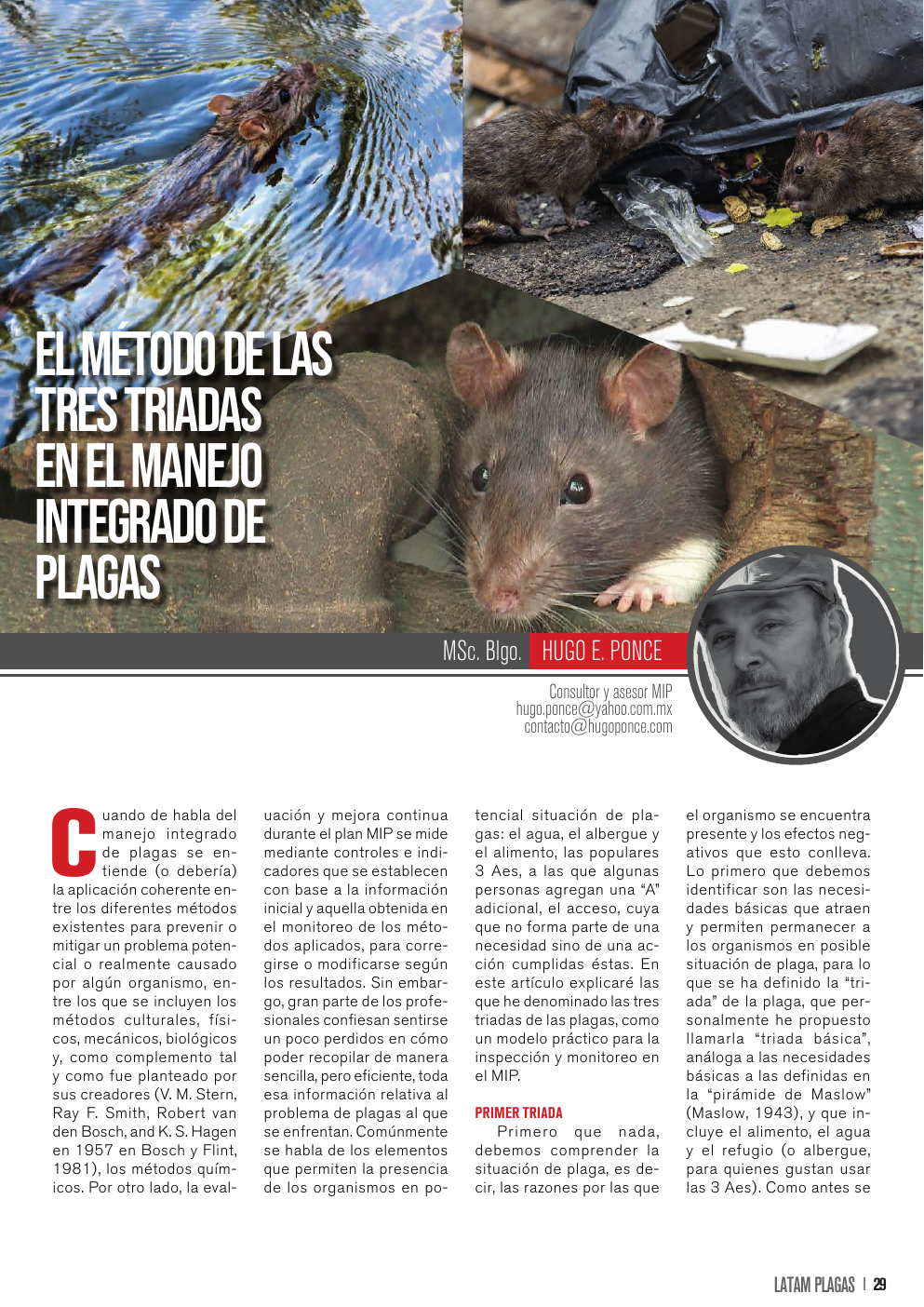
When talking about integrated pest management, it is understood (or should be) the coherent application between the different existing methods to prevent or mitigate a problem potentially or actually caused by some organism, which include cultural, physical, mechanical, biological methods and, as a complement as proposed by its creators (V. M. Stern, Ray F. Smith, Robert van den Bosch, and K. S. Hagen in 1957 in Bosch and Flint, 1981), chemical methods. On the other hand, continuous evaluation and improvement during the IPM plan is measured through controls and indicators that are established based on the initial information and that obtained from monitoring the methods applied, to be corrected or modified according to the results. However, many professionals confess to feeling a little lost in how to simply, but efficiently, collect all the information related to the pest problem they face. We commonly talk about the elements that allow the presence of organisms in potential pest situations: water, shelter and food, the popular 3 A's, to which some people add an additional "A", access, which is not part of a need but of an action once these are fulfilled. In this article I will explain what I have called the three pest triads, as a practical model for inspection and monitoring in IPM. FIRST TRIAD First of all, we must understand the pest situation, that is, the reasons why the organism is present and the negative effects that this entails. The first thing we must identify are the basic needs that attract and allow organisms to remain in a possible plague situation, for which the "triad" of the plague has been defined, which I have personally proposed to call the "basic triad", analogous to the basic needs of those defined in the "Maslow pyramid" (Maslow, 1943), and which includes food, water and shelter (or shelter, for those who like to use the 3 A's). As previously mentioned, there are those who add access, which is actually part of the following triad, or temperature, which is actually implicit in shelter. The main need is undoubtedly water. It is said that living beings can survive for weeks without food, but only a few days without water as it leads to dehydration and loss of extracellular fluids. Water is essential for the transport of nutrients, gas exchange (respiration), allowing adequate muscle, blood, skin and neuronal functions. Among the “pests” (which we will call potentially harmful organisms by convention) there are various adaptations to survive conditions with low access to water, as is the case with house mice that are capable of taking advantage of the minimum amount of water present in grains, reducing their needs by up to 60% through adjustments in their excretion (urine and feces), evaporation (lungs and skin) and secretion (sweat, saliva and milk); although when they eat foods high in protein they usually require 3 to 13 grams of water per day. For their part, German cockroaches are capable of storing water in their body, representing up to almost 70% of their body weight, thanks to the particular permeability of their cuticle. For its part, foods are what provide nutrients to the body after the oxidation of carbohydrates, fats and proteins, as well as fibers and organic and inorganic salts. Minerals and vitamins are essential in the functions of metabolism. Rats often hoard food as a reminder of their wildlife, in preparation for lean seasons. In cockroaches there is a food preference depending on their phase of the life cycle, in which adult males and virgin females prefer carbohydrates, while nymphs and fertilized females prefer foods rich in proteins. Among the different species of ants we can find those that are generalists or specialists, in addition to some usually changing their diet depending on the time of year, such as Tapinoma. By refuge we normally understand that it refers to those places where animals seek protection from the conditions of their environment, whether biotic (living, such as competitors or predators) or abiotic (non-living, such as temperature, relative humidity or wind). The refuge allows activities such as socialization, reproduction, feeding, among others, to be carried out, in addition to compensating for the limitations of its ecological valence or the margin of tolerance they have to certain environmental factors. When talking about refuge or shelter, we must also automatically understand those conditions from which they are protected. Thus, for example, during the life cycle of a house fly we can identify that organic matter, including excrement or dead matter, offers a more or less stable temperature and available food at the same time; while the adult, being mobile, will look for shady places protected from the sun (such as roofs or trees), temporarily abandoning them in search of food. SECOND TRIAD After we have identified the elements that satisfy the needs of the organisms, it is necessary to understand the dynamics of the infestation, which represent what I have called “population triad”, which is based on population dynamics in ecology (Pianka, 1982). It is in this that the aforementioned access intervenes, the entry of the organisms actively or passively, after it is inside it completes its life cycle, from birth to death, survival. Finally, in the search for water, food or shelter, they lead it to invade new areas through dispersal. The population density of organisms Figure 2. Population factors essentially depends on the existence of sufficient resources, which represent the carrying capacity (K in ecology). Essentially and in a simplistic way, those considered in the first triad. A dynamic is established that is defined by its increase and decrease due to various factors. Initially, entry occurs when organisms are attracted or carried toward the area of interest. Some have a great capacity for movement and can arrive on their own, even from relatively distant places, that is, actively. Such as the arrival of mosquitoes or flies. But other species do not have as much capacity and their entry occurs passively, facilitated by human activity, such as with cockroaches or bed bugs. Of course, these phenomena are not exclusive. If favorable conditions are found, the natural consequence is reproduction, which must produce new individuals that, hand in hand with the death of others, will define the average survival of the population between births and deaths. In a wild environment some species produce high offspring to compensate for high mortality. But in urban environments, where many of the adversities they would normally face, the survival of both juveniles and adults tends to be prolonged, increasing population density. Due to population growth, more resources and space are necessary for optimal development, for which living beings with a survival strategy seek to invade new areas, extending their distribution by dispersing through various channels, reaching neighboring apartments, transportation, other rooms, neighboring houses, among others. We can mention, as an example, the spread of some grain pests that infest nearby silos or warehouses either due to their high mobility such as Oryzaeohilus (toothed woodworm) or by contact with infested product or surfaces, such as Sitophilus (weevils or weevils). THIRD TRIAD The “risk triad” allows us to establish the levels of damage and establish the guidelines to measure the IPM plan. Figure 3. Heat or risk map As we have established before, what defines the pest is not the organism itself but the damage it causes. To carry out the appropriate risk analysis, as established in ISO 31000:2018, it is important to identify said damages and make the corresponding evaluation, through the probability that said risk will occur, the impact or severity it will have when it materializes, together with the susceptibility of the area to be affected. To carry out adequate risk management, the dangers and the effect they could cause must first be identified. That is, the probability that an insect, rodent, bird or other animal will cause damage or harm, in other words, losses or reduced profits. This damage is not simply the presence of the organism, but its consequences, which can be of different types, such as reputational (for example, presence of bedbugs in hotels), health (cockroaches in restaurants), public health (presence of mosquitoes), food safety (flies in the food industry), structural (subterranean termites), etc. Next, it is defined how serious the damage may be if it materializes, the impact. This is independent of probability, since it measures the effect that would occur if there was damage, directly or indirectly, due to the presence of the pest. It is perhaps the catastrophic part of the analysis, but it must also remain objective. That is, imagine the worst, but with bases and evidence. Let's say you are evaluating the reputational risk of finding a fly larva in baby food. Possibly and given the preventive measures, the probability is very low, but if it occurs it would be very serious for the brand image. The combination of impact and probability gives us a measure called “criticality”, which allows us to develop the so-called “heat map” to determine priorities (appetite, tolerance and capacity for risk), which should not be confused with the risk matrix where the narrative of observations and assumptions are developed. Finally, it is very important as part of the analysis to consider risk susceptibility, which represents how robust or fragile the conditions are in which the pest problem could arise. An exposed horizontal warehouse will be more susceptible than a sealed silo; The kitchen of the hotel restaurant will be more susceptible to pathogen contamination due to the presence of cockroaches than the lobby. This also allows us to visualize where to direct corrective actions and monitoring points. 3 OF 3 IN IPM This model is a simple way of organizing the inspection, locating the conditions that make pest risks more easily visualized and mapped. It is obvious that it is not excluded to identify as best as possible the species that may or may not occur, since through the background of their theoretical biology and bionomics, it will be easier to make a prediction that focuses the work on what is most important, making it more productive. Plagues will always carry some dose of uncertainty, in other words, information that we do not know. Likewise, the knowledge of the environmental, cultural and process conditions, including the transition from the symptom expressed by the client, the living organism, to alleviating and preventing the disease, the damage as such. A good analysis based on the method of the three triads can help us reduce this uncertainty, improve our critical thinking and take the IPM plan, in any of the sectors, from a simple incident report, static, rigid, artificial and useless, to a true analysis of trends that involves continuous improvement, versatile, agile and truly efficient and effective. BIBLIOGRAPHICAL REFERENCES Flint, M. L. and R. van den Bosch (1981) Introduction to Integrated Pest Management. Springer US, 1. International Standard Organization (2018) ISO 31000:2018(es) Risk management. Maslow, A.H. (1943) A Theory of Human Motivation. Martino Pub. Pianka, Eric R. (1982) Evolutionary ecology. Omega, Spain. Ponce, Hugo E. (2022) Advanced course in pest control. Mexico (hybrid event). Sponsors Veseris and Lab. Rivas.