
Pest management in hotel and related complexes
The concept of plague has an anthropogenic origin and as such, varies from person to person.
Technical summary
- Focus
- The concept of plague has an anthropogenic origin and as such, varies from person to person.
- Approach
- It brings together technical criteria linked to Edición 15, hoteles and latam plagas.
- Use
- Useful for professionals who need context, diagnosis and operational decisions in urban pests.
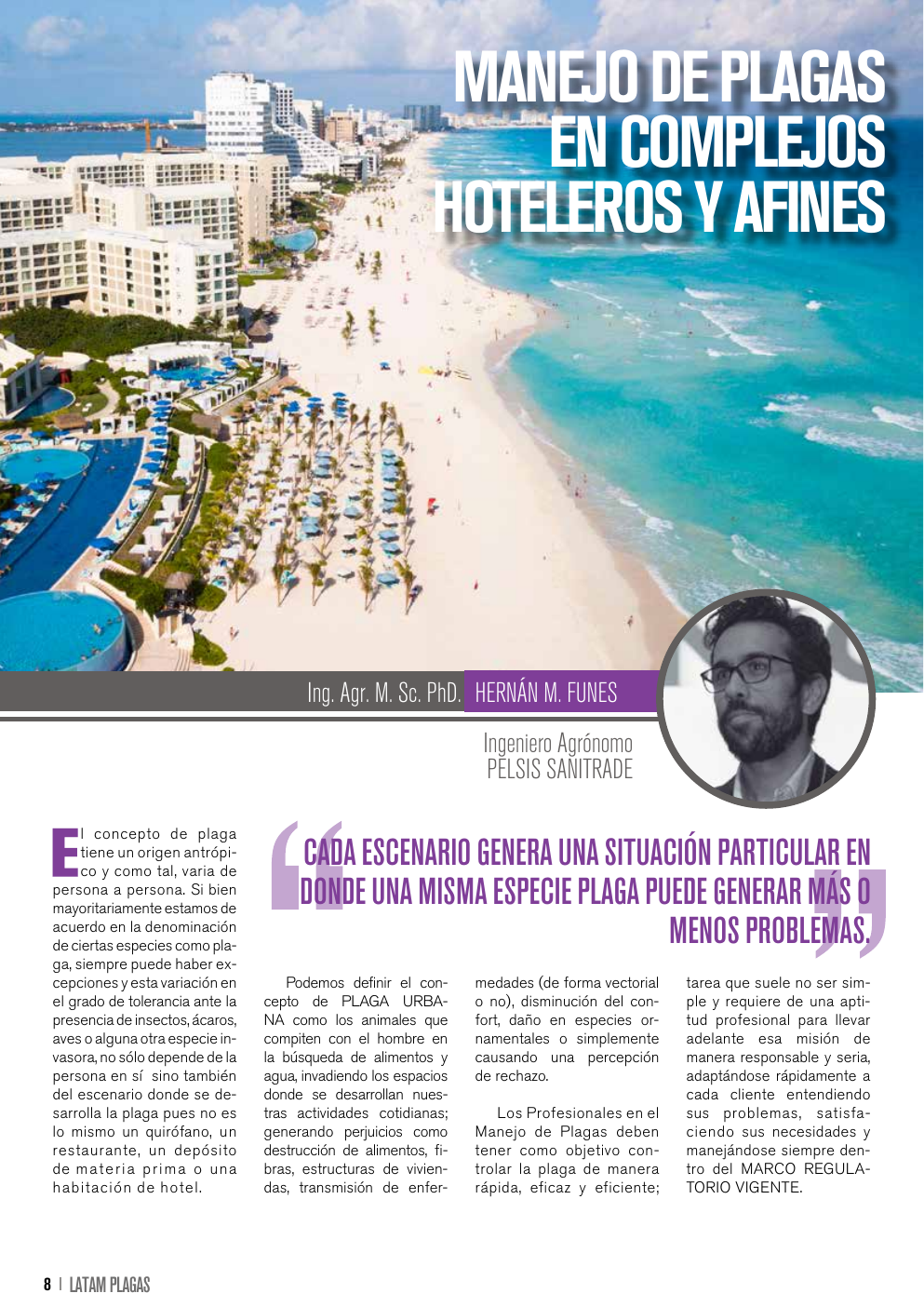
The concept of plague has an anthropogenic origin and as such, varies from person to person. Although we mostly agree on the designation of certain species as pests, there can always be exceptions and this variation in the degree of tolerance in the presence of insects, mites, birds or some other invasive species, not only depends on the person themselves but also on the setting where the plague develops since an operating room, a restaurant, a raw materials warehouse or a hotel room is not the same. EACH SCENARIO GENERATES A PARTICULAR SITUATION WHERE THE SAME PEST SPECIES CAN GENERATE MORE OR LESS PROBLEMS. We can define the concept of URBAN PLAGUE as animals that compete with man in the search for food and water, invading the spaces where our daily activities take place; generating damages such as destruction of food, fibers, housing structures, transmission of diseases (vectorally or not), decreased comfort, damage to ornamental species or simply causing a perception of rejection. Pest Management Professionals must aim to control the pest quickly, effectively and efficiently; a task that is usually not simple and requires professional aptitude to carry out that mission in a responsible and serious manner, quickly adapting to each client, understanding their problems, satisfying their needs and always managing within the CURRENT REGULATORY FRAMEWORK. When we talk about pest control in hotels, resorts and the like, let us remember that there is a wide range of pests in a wide range of environments with a large flow of people, spaces with green areas, restaurants, recreational areas, rooms and places open to the public 24 hours a day, etc. All these aspects must be kept in mind when implementing Integrated Pest Management. Hotels and the like live on reputation, so poor pest management has a direct impact on a decrease in customers. Guests should not see pests or smell insecticides. You should always approach work with a low profile, hiding the treatments to be performed and trying to go unnoticed. Rooms without guests must also be treated, as well as bars and restaurants when they are closed. In summary, there are numerous pests and for this reason we will address the concept of integrated management applied in this case referring to two pests that we can usually find in these places in order to cover the main topics, leaving the classic cockroaches and rodents to delve into bed bugs and ants. BED BUG In recent years, consultations on the management of these hymenoptera have increased significantly. It is one of the main species that DIALOGUE WITH EMPLOYEES AND A CAREFUL INSPECTION IS VERY IMPORTANT IN ORDER TO QUICKLY DETECT PROBLEMS AND BE ABLE TO ACT ACCORDINGLY. It keeps the entire hotel industry worried. This bedbug (Cimex sp.) turns out to be a complex insect to manage since the inspection process prior to treatment is complex and usually requires a lot of time within the proposed service, which results in the temporary closure of the problem rooms. As a result of said prospecting, targeted treatments may be carried out with specific products approved for this purpose and/or the use of complementary “non-chemical” tools. But... what do we look for when we inspect? Adult bed bugs measure between 4 and 8 mm. in length, they do not have wings and are light brown distributed evenly throughout the entire body. They have well-developed legs that allow them to hold tightly to the host during feeding, and they have somewhat prominent antennae adjacent to the compound eyes. Inspections and treatments have to be very thorough. As a guide we can mention that the bed bug (or signs of presence such as molts, droppings, eggs) can be found hidden in:
- The mattresses, including under the buttons and in the seams.
- The frame and headboard of the bed, as well as the pillows and bed linens.
- The legs of the bed (pay special attention, especially if they are hollow)
- Nightstands and furniture in general.
- Any crack in the wall.
- Under the wallpaper.
- Inside the covers of sockets and light switches.
- Behind pictures and mirrors.
- Inside telephones, alarm clocks, televisions.
- In closets, laundry baskets and laundries.
- In bags and suitcases.
- In short, anywhere. Regarding the Application of insecticides, let us always remember to use products registered for that use; fan nozzles are recommended for extensive surface treatments and cannulas for crevices; Misting is not recommended since it does not provide sufficient penetration; If the product allows it, treat the mattress at the seams and zippers; do not apply insecticide to sheets; treat the structural elements of the bed; apply powder formulations on
A CHEMICAL APPLICATION THAT OMITS PLACES WHERE THERE COULD BE HIDDEN INDIVIDUALS OF THIS INSECT WILL BE A FAILED TREATMENT. electrical elements such as telephones, alarm clocks, electrical boxes and televisions; use insecticide on the walls (joints with the floor and under the baseboards); the switches can be disassembled and treated; Treat all furniture and all items that may be arranged on the walls. Inspect and treat all rooms, all rooms in contact with the infested room should be inspected and treated if necessary, this includes adjacent rooms, also those on upper and lower floors. Targeted treatments with Microencapsulated Pyrethroids, Growth Regulating Insecticides and Powdered Insecticides usually give positive results, especially when we include in the rotation the application of active ingredients with different modes of action or combinations of pyrethroids with synergists such as piperonyl butoxide. WASHING TO CONTROL BED BUGS Washing clothing and fabrics at 60º C for 30 minutes kills all stages of the bed bug. Drying the fabrics with hot, dry air at a temperature of 40-45º C for 30 minutes also eliminates all stages. It is recommended to complement the washing with drying at the highest possible temperature and for as long as possible in both procedures. Dry cleaning (perchlorethylene) kills all stages of the biological cycle of bed bugs. Freezing at -20º C also achieves 100% control; the treated materials must be left long enough to ensure that the temperature reaches the desired freezing value. Treatments can range from a few days to weeks. EXTREME TEMPERATURE TREATMENTS: There is equipment that produces extreme heat or cold that can be used to treat beds and other surfaces. These techniques are especially useful in sensitive areas where insecticides cannot be used. These techniques have been shown to be effective against bed bugs, complemented by vacuuming. Of course, this type of treatment has zero residuality. Steam treatments: The success of this technique depends on the quality of the steam. This method can be particularly useful as it can kill all stages of the insect, including the egg. Dry steam with a humidity of less than 5% and a temperature of 94º C, applied at high pressure, is recommended. Mattress covers: Mattresses are one of the most important points of bed bug infestations, where there is normally a higher concentration of insects, but they are also the most delicate places to treat because people spend a third of their lives in direct contact there. The special protective covers that cover the mattress as a seal, preventing new bedbugs from settling in them and killing the bedbugs that were already in it by starvation. They can be used preventively and as a treatment. By using these covers, one of the most problematic elements in a bed bug infestation is protected, the mattress. Mattresses are expensive so unless necessary it is advisable to avoid having to replace them. If you want or have to replace the infested mattress, it is essential to protect it from the possibility of re-infestation. PROBLEMS WITH ANTS There are numerous species of ants that we can find, but it is recommended to place special emphasis on the species that can cause a problem for guests through the inconvenience caused by their presence or, if applicable, their bites. That is why we will make a special mention of the Fire Ant or Red Ant (Solenopsis spp.). This species is mainly found in green spaces, so recreation areas such as places near swimming pools are usually a suitable place for them to nest and proliferate. They are territorial and aggressive individuals (their level of aggressiveness will depend on the species in question). They nest under the ground and eventually in wood and building structures (always close to the ground), forming a mound of earth proportional to the depth of the anthill. They thrive in warm, sunny conditions. They prefer dry land and avoid shady areas. They are omnivorous ants that need foods with high protein content to survive. The sting of Solenopsis contains a natural alkaloid (piperidine) that shows powerful necrotoxic activity and causes both pain and the formation of white pustules that appear a day after the sting, also producing an allergic reaction in hypersensitive individuals. The total metamorphosis time from egg to adult averages 30 days. Workers live up to 180 days; the queen lives for two to six years. The key to its management is inspection and frequency of application to avoid reinfestation. In places with a high presence of this pest, an application of liquid insecticides with active ingredients that stand out for their turning power, such as Praletrin and Cypermethrin, should be made. The application of Floables or Microencapsulated in ant transit areas favors control by exploiting the residual effect provided by the formulation. The use of gels inside, Concentrated Suspensions or Microencapsulated in green spaces and as perimeter treatments as well as intense inspection to identify and apply to the nests is essential when implementing a correct strategy for the management of this pest. During treatment with gels, other insecticides (liquids, powders, aerosols, etc.) should not be used since they would cause rejection of the Gel bait and failure of the treatment. The goal of using gels is to provide electricity. Priming stations can be used to place the gels, resulting in a neater, more effective and professional job. There are other species of ants with habits similar to Fire Ants such as the Big-headed Ants (Pheidoles sp.) and the Pharaoh Ant (Monomorium pharaoni), although they have small differences between them. Trophallaxia. Biological behavior through which ants “spread” the toxic effect of baits. The ant gradually becomes intoxicated and “transports the toxic effect” to the nest or anthill where it spreads through different biological behaviors such as regurgitation of food or trophallaxis. Cleaning and repairing cracks is the best way to restrict the three parameters that the pest needs to develop (food, shelter and water). Powdered insecticides are an alternative to consider when we must apply in areas where there are cables or installations. Other ants such as the Argentine Ant, Carpenter Ant, Odorous Ant or Acrobat Ant can be present in hotels as well as Pruning Ants, the latter affecting ornamental plant species. Each species will require specific actions, so the starting point of all ant management must be the correct identification of the species in order to know its biology, its habits and the most effective way to combat them.