
Integrated fly management in intensive production
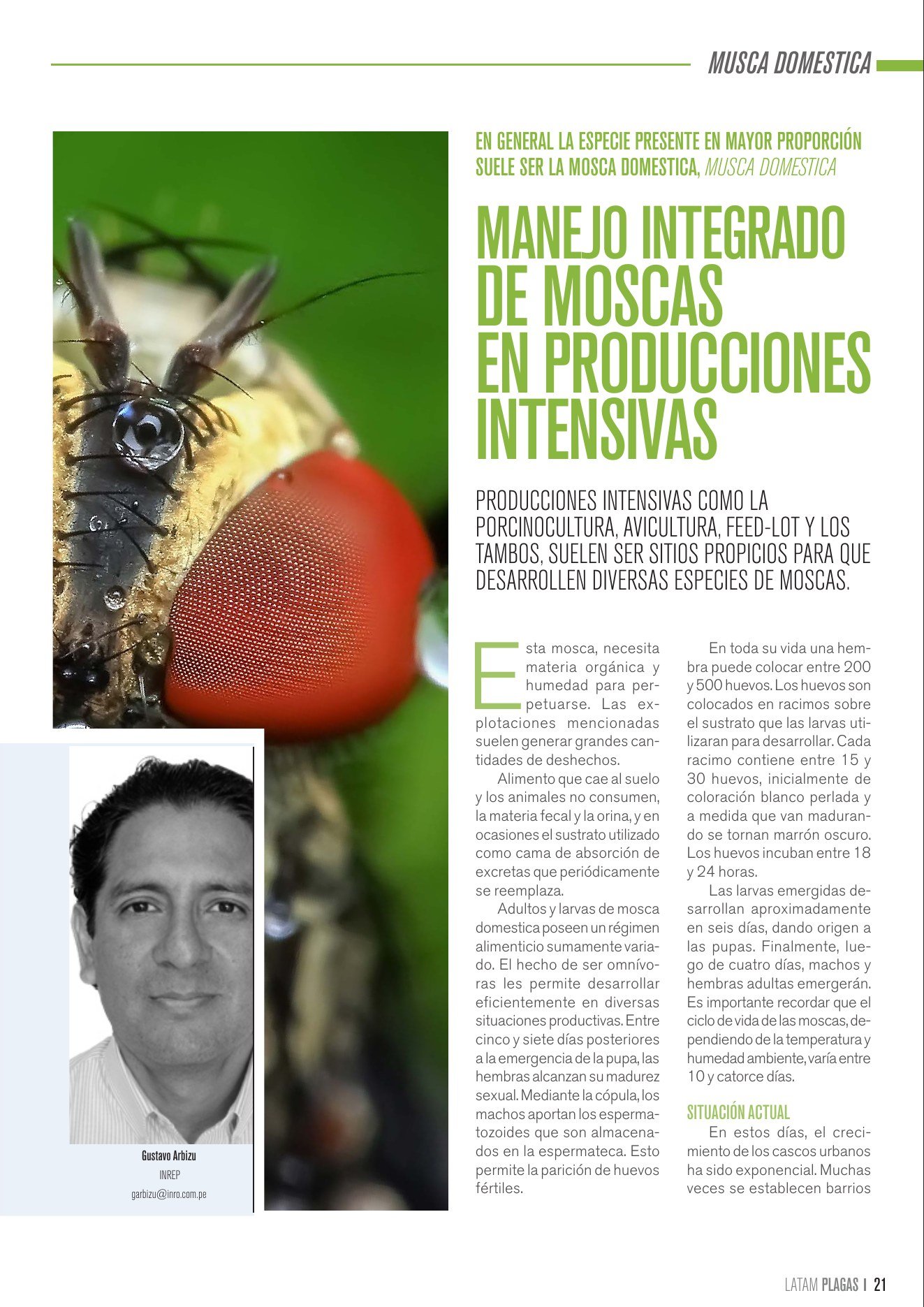
In general, the species present in the greatest proportion is usually the house fly, Musca domestica.
Technical summary
- Focus
- In general, the species present in the greatest proportion is usually the house fly, Musca domestica .
- Approach
- The article structures the analysis around Current situation, Joint actions with municipalities and Production establishment.
- Use
- Useful for professionals who need context, diagnosis and operational decisions in edición 1.
Index
In general, the species present in the greatest proportion is usually the house fly, Musca domestica. Intensive production such as pig farming, poultry farming, feed-lot farming and dairy farms are usually favorable sites for various species of flies to develop.
This fly needs organic matter and humidity to perpetuate itself. The aforementioned operations usually generate large amounts of waste. Food that falls to the ground and the animals do not consume, fecal matter and urine, and sometimes the substrate used as an excreta absorption bed that is periodically replaced.
Adults and larvae of house flies have an extremely varied diet. The fact of being omnivorous allows them to develop efficiently in various productive situations. Between five and seven days after the emergence of the pupa, the females reach sexual maturity. Through copulation, males provide sperm that are stored in the spermatheca. This allows the birth of fertile eggs.
In her entire life a female can lay between 200 and 500 eggs. The eggs are placed in clusters on the substrate that the larvae will use to develop. Each cluster contains between 15 and 30 eggs, initially pearly white in color and as they mature they turn dark brown. The eggs incubate between 18 and 24 hours.
The emerged larvae develop in approximately six days, giving rise to pupae. Finally, after four days, adult males and females will emerge. It is important to remember that the life cycle of flies, depending on ambient temperature and humidity, varies between 10 and fourteen days.
Current situation
These days, the growth of urban centers has been exponential. Many times neighborhoods are established in historically productive areas. There are other occasions where productive establishments are mistakenly enabled in urban areas. In both cases, the owners of affected homes direct the claims to the owners of the productive establishments.
An interesting proposal to maintain the population density of flies below acceptable levels arises from coordinating actions between producers and municipalities. It will be the obligation of each of the parties to ensure that the counterparty complies with its obligations.
Joint actions with municipalities
This allows us to determine which establishment does or does not comply with the minimum management guidelines for this and other pests harmful to public health. These controls must be carried out by qualified personnel to avoid underestimation of infestation levels. The inspector determines the levels of larval and adult infestation, effectiveness of the strategies used, evaluation of product rotation programs, etc.
Production establishment
Integrated management brings together different management strategies with a positive and additive effect on each other. Finally, the efficiency of integrated management turns out to be much higher than the application of the different strategies separately. Cultural Control, Biological Control, Physical Control and Chemical Control are the four fundamental pillars of this type of management.
Cultural control
The arrangement of the environment directly influences the density of flies present in a given population. Clean and well-maintained facilities prevent the proliferation of flies and other important pests. The management of organic waste is essential, since the accumulation of excreta, food and spilled liquids are well used by these diptera.
Initially, these wastes must be removed from the place where they are generated. Once relocated, specific treatment will be carried out. It can be treated with insecticides or transform this organic matter into a medium that is not suitable for the development of fly larvae. For this, the pH of the medium can be modified (liming) or dehydrated (spreading).
If you choose to spread, the height of the substrate should not exceed two centimeters in height. The latter will depend on the initial moisture content of the substrate; If it is low (less than 40%) the pile can be higher. It is extremely important that the loss of moisture be accelerated, maximum 3 days; Otherwise larval development may be feasible.
Biological control
It is represented by the use of biological agents that in one way or another interrupt the normal life cycle of a fly. In our country the most used agents are microhymenoptera.
These little wasps, Spalangia endius and Muscidifurax raptor, lay their eggs inside the housefly pupae. The wasp larva feeds on the contents of these pupae, preventing the adult fly from emerging.
In poultry farming it is a widespread technique; The critical point is that its efficiency is directly proportional to the frequency of release and the number of individuals involved in each of them.
Physical control
Adult capture traps are very effective. The drawback is that they easily reach saturation levels. These traps can be glue, attracting by light refraction, or capture, with food attractants and/or pheromones. The efficiency of this type of implement depends on maintenance: replacement of glue plates, replacement of attractants, etc.
Chemical control
Chemical control is based on the use of specific insecticides to control adults and larvae respectively. Emulsifiable concentrates, concentrated suspensions, dispersible granules and baits are some of the most used formulations.
Space applications can be made to control adult individuals. It is important to consider that this type of applications lack residuality. Small droplets of nebulized insecticide, hot or cold mists, kill by direct contact.
To use in buildings or sheds where animals are present, a pyrethroid of low toxicity and zero irritation should be used. Some examples of this type of product are deltamethrin, praletrin, etc. To apply outdoors and in areas far from animals, other pyrethroids can be used, for example cypermethrin. Emulsifiable concentrates are the most used in these cases.
Specific applications on different surfaces frequented by flies give very good results. In sheds it is common to see these insects concentrated in certain places, walls, columns, tables, etc. The use of products with greater residuality, concentrated suspensions, applied in these sites causes high mortalities. Another possibility is to place colored boards, attractive due to light refraction, and spray them with insecticides. Microencapsulated products with high residual power are very good for this.
Control of larvae is based on the use of growth inhibitors. This type of product inhibits the molting process in mature larvae and prevents evolution to the pupal stage. In this way the reduction in the number of adults is extremely noticeable. This type of product is applied directly by spraying onto the substrate used by the larvae. It is important that the depth of the treated layer does not exceed thirty centimeters in height. If material used in animal diet must be treated, it is advisable to remove the affected portion from the rest of the pile.