
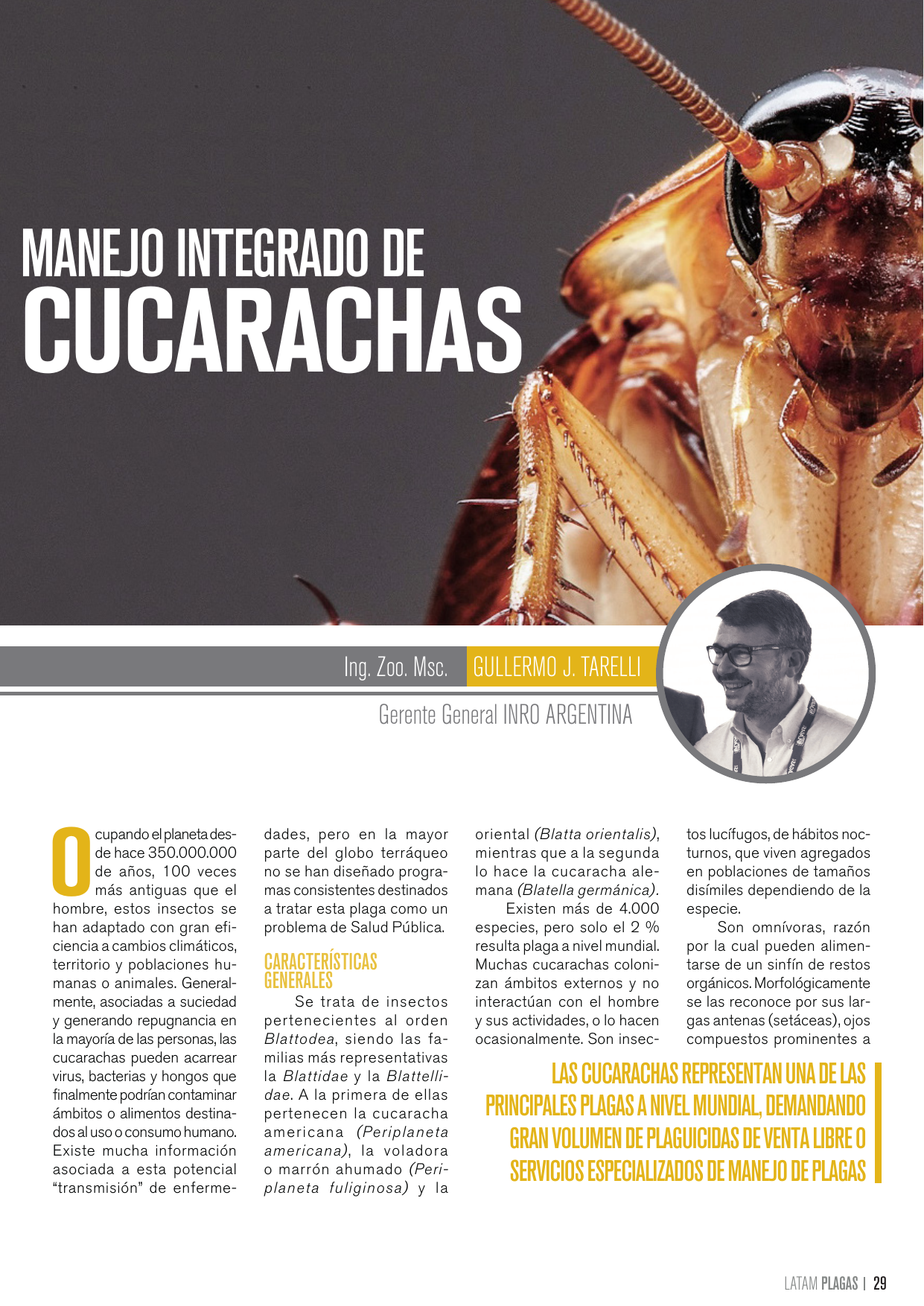
Integrated cockroach management
Occupying the planet for 350,000,000 years, 100 times older than man, these insects have adapted with great efficiency to climate changes, territory, and human or animal populations.
Technical summary
- Focus
- Occupying the planet for 350,000,000 years, 100 times older than man, these insects have adapted with great efficiency to climate changes, territory, and human or animal populations.
- Approach
- The article structures the analysis around GENERAL CHARACTERISTICS, MONITORING AND CONTROL TOOLS and PHYSICAL CONTROL TOOLS.
- Use
- Useful for professionals who need context, diagnosis and operational decisions in edición 6.
Index
- GENERAL CHARACTERISTICS
- MONITORING AND CONTROL TOOLS
- PHYSICAL CONTROL TOOLS
- CHEMICAL CONTROL TOOLS
- PARTICULAR CHARACTERISTICS AND SPECIFIC CONTROL
- AMERICAN COCKROACH ( American periplanet )
- FLYING OR SMOKY BROWN ROACH ( Periplaneta fuliginosa )
- EASTERN COCKROACH ( Blatta orientalis )
- GERMAN COCKROACH ( Germanic Blatella )
Occupying the planet for 350,000,000 years, 100 times older than man, these insects have adapted with great efficiency to climate changes, territory, and human or animal populations. Generally associated with dirt and generating disgust in most people, cockroaches can carry viruses, bacteria and fungi that could ultimately contaminate areas or foods intended for human use or consumption. There is a lot of information associated with this potential disease transmission, but in most of the world, consistent programs have not been designed to treat this pest as a Public Health problem.
GENERAL CHARACTERISTICS
These are insects belonging to the order Blattodea, the most representative families being the Blattidae and the Blattellidae. The American cockroach belongs to the first of them (American periplanet), the flying or smoky brown (Periplaneta fuliginosa) and the eastern (Blatta orientalis), while the second is done by the German cockroach (Germanic Blatella). There are more than 4,000 species, but only 2% are pests worldwide. Many cockroaches colonize external environments and do not interact with humans and their activities, or they do so only occasionally. They are lucifugal insects, with nocturnal habits, that live in aggregates in populations of dissimilar sizes depending on the species. They are omnivores, which is why they can feed on endless organic remains.
Cockroaches represent one of the main pests worldwide, demanding a large volume of over-the-counter pesticides or specialized pest management services.
Morphologically they are recognized by their long antennae, prominent compound eyes on both sides of the head, chewing mouthparts with robust jaws and maxillae with exposed sensory palps. At the dorsal level of the thorax is the pronotum, often used for species determination, and the two pairs of wings. The first of them is a tegmen type, without a specific function, while the second is membranous and is used for flight in some species. The ambulatory or running legs are inserted on the ventral side of the thorax, provided with pulvinules at the distal end. This structure allows it to adhere to various surfaces and move either vertically or horizontally. The abdomen is formed by uromeres or rings that cover the internal organs, revealing only one spiracle or respiratory pore per side on the sides. The last pair of uromers can be modified according to sex, giving rise to the genitalia. Females usually have a single pair of sensory cerci on the caudal part, while males have two pairs.
The life cycle or metamorphosis is incomplete and is made up of the egg, nymph and adult stages.
In those species that are pests, reproduction is sexual, the copulation process being necessary for the females to be fertilized by the males. During fertilization, females store the seminal fluid in a bag or sac called the spermatheca. Without fertilization, females cannot produce offspring. Multiplication, or form of propagation, occurs from the laying of eggs. What is characteristic of cockroaches is that the eggs are protected within an ootheca, of characteristic color and size depending on the species. The oothecae or egg sacs can be released into the environment, attached to different substrates, or carried by the female until the nymphs emerge.
Depending on the species, each female can generate between 8 and 90 oothecae. Usually females that can develop a greater number of oothecae place fewer eggs inside them. Due to this metamorphic process, cockroaches are part of the group of paurometabolous heterometaboles. Name given to those insects whose juvenile stages differ from adults due to the lack of wings, but they live in the same habitat and feed on the same things. Depending on the species, there may be 5 to 6 nymphal stages between which a molt or shedding of the exoskeleton occurs. Nymphs and adults differ in size, but the latter are mainly recognized by the existence of complete wings that cover the abdomen. This cycle can take between 2 and 36 months depending on the species, population density, food availability and climatic conditions. These same factors are determining factors on the number of generations that can occur each year. Cockroaches can live indoors or outdoors, in dry or humid, cool or warm places, depending on the species. From this, the management and control strategies will be different. Having analyzed this and knowing the total spectrum of prevention and specific control tools, it will undoubtedly be possible to act on the pest population obtaining favorable results.
MONITORING AND CONTROL TOOLS
MONITORING. House-type sticky traps are used for monitoring. These traps, correctly located, usually represent a fundamental element in establishing the initial infestation level and subsequent population reductions resulting from the implementation of the integrated pest management program.
To establish an integrated management program, it is extremely relevant to carry out a correct inspection of the infested sites to determine what species is present, where they enter or where they come from, and what they feed on and where they stay.
The traps should be located in places where cockroaches travel, close to sources of food and hydration, under or inside furniture, under appliances, or in those places where aggregation has been detected. The use of food baits can increase the effectiveness of traps. It should be taken into account that in areas with high infestation, sticky traps also function as physical control elements due to the capture and elimination of nymphs, males and females, the latter being responsible for the spread and population growth.
At the beginning of a cockroach management program, it is important to determine the infestation levels of the pest. To do this, a trap must be placed every 10 square meters. On the first day, place the traps in the chosen sites and after 24 hours remove them to count the captured insects. The purpose of the count is to determine if the infestation is low, less than 5 insects per trap, medium, 5 to 10, or high, more than 10, and how it is reduced after prevention and control activities have begun.
After counting the cockroaches captured in the first traps used, it is essential to establish the periods in which traps will be placed again, once a week or once a month, coinciding as much as possible with the times of visit to the site. The traps must be left for 24 hours, in the same places and in the same quantity as those used in the first capture, otherwise the data would not be comparable. If the management strategies used are effective, the number of insects captured between samplings should be reduced.
CULTURAL CONTROL. It is the tool that contemplates the environmental conditions and behavior of people. Maintaining clean, orderly environments and in good building conditions is essential to avoid the establishment and development of pests. Educating people and teaching what to do and not do regarding pest-related aspects usually contributes positively during the implementation of integrated management programs. Example: Teaching the cleaning operator of a food industry that the organic matter that he collects and eliminates can be a source of food for cockroaches is a way of telling him that the dirt must be eliminated as much as possible and finally disposed of.
In the presence of cockroaches, as a priority Germanic Blatella, it is important to remember that this is a pest that is introduced mechanically from infested sites. This can be from furniture, appliances and finished foods or raw materials. For this reason, it is worth highlighting the importance of checking any of these elements very well before entering them into any type of installation. In gastronomy or industry, where the handling of raw materials is abundant and also the existence of these pests, it is extremely relevant to have quarantine inspection areas to carefully check the absence of insects.
PHYSICAL CONTROL TOOLS
COLD. Any insect reduces its metabolism below 10° C, cockroaches do so below 7° C. Below this temperature, locomotion functions slow down, as does food intake and reproduction. Life cycles become longer and may even be interrupted. For this reason, and after many tests, pest control and management specialists have experimented with the minimum temperatures that affect different pests. Regarding cockroaches, they can die in a matter of minutes if they are subjected to subzero temperatures in a freezer (-15 to -21 degrees). For this, it is extremely important that they are subjected to intense cold suddenly, starting from room temperature to maximum cold directly. If the drop in temperature is gradual, they could adapt their metabolism to survive. However, any insect will die exposed to sub-zero temperatures, it is just a matter of time. For this reason, it is suggested to treat infested items with cold for at least 24 hours. The German cockroach, due to its living habits inside small furniture or appliances, is the one that requires the greatest frequency of use of this highly effective tool for all stages that make up the metamorphic cycle. Extreme cold does not leave residue, just like heat, which is why it integrates the tools of ecological pest management. The use of dry ice generating equipment from CO2 is important to cold treat those colonies located in cracks or unreachable places. The ice crystals generated by the equipment reach temperatures of -78 °C. This technology, originally known as Cryonite, is currently spread throughout the world.
HEAT. Most insects suffer strong dehydration mechanisms above 45° C. Cockroaches are successfully controlled between 60° and 65° C for 5 or 6 hours. Like severe cold, the exposure time required to control pests reduces as the temperature increases. However, it is essential to consider the maximum tolerance temperature of the elements that the cockroaches contain and will be subjected to heat. Industrial heaters designed for this purpose are often used throughout the world, although in Latin American countries this technology is not widespread. Furthermore, many countries have serious structural problems in their electrical networks that make this model not applicable, at least for the moment. Yes, furniture or appliances can be treated in heat chambers or ovens intended for this purpose. Many companies transform small rooms into heat chambers, taking into account that the heat must be dry and stable, which is why the heat must be generated by some electrical source and the room must be properly insulated.
ATMOSPHERE MODIFICATION. It involves replacing oxygen with another gas in the area in which the insects are found. The most used is the injection of CO2. This gas, in the appropriate concentration, causes irreversible damage to the central nervous system. This damage can occur between 2 and 24 hours, depending on the concentration and ambient temperature. It acts effectively against mobile stages, nymphs and adults, but not on eggs. The usual treatments involve placing the furniture or appliances to be treated inside a 200 micron nylon bag, removing the air using a vacuum and injecting CO2 until the bag is inflated again, finally closing it and leaving it for 24 hours. It has been widely demonstrated that this practice eliminates all of the mobile stages of cockroaches.
ASPIRATION. Aspiration is an important practice that favors the elimination of organic food remains, residual exoskeletons from molting processes, dead insects and fundamentally oothecae that may be in the environment. The ideal equipment is cyclonic vacuum cleaners of 1,800 to 2,000 watts, bagless and with transparent collecting cups. These equipment do not require additional application of pesticides or placing the aspirated material in a freezer since everything is crushed. Clearly it is not a hygienic process, but it is very effective. It is advisable to remove what is aspirated after each service, place it in a hermetically closed bag and dispose of it.
ABRASIVE POWDER. Diatomaceous earth, fossilized algae, and boric acid, a component of salts, are the main ones used. Very safe in use, due to its low toxicity. They are ideal powders for sensitive places, nurseries, kitchens or hospitals, and their application should be reserved for tight compartments, cracks and pipes that may harbor insects. They can be applied separately or together, in which case the diatomaceous earth acts as an external cuticular abrasive and the boric acid acts internally, damaging the digestive tract. In both cases they promote dehydration. Diatoms sand the exoskeleton of cockroaches, in addition to lodging in the exposed joints they have. These actions increase the points of water loss and immobilize the insects. Boric acid enters the body when cockroaches clean their legs or antennae with their mouthparts. As it travels through the digestive system, it grinds away its internal covering, creating small cuts or ulcers that promote the loss of internal fluids, generating an osmotic imbalance or dehydration. Both products should be applied with eye, skin and respiratory protection, mainly to avoid irritation to the eyes, nose and mouth.
EXCLUSION ELEMENTS. Everything that guarantees the airtightness of a place. If there are no entrances, there is no chance for pests to enter and establish themselves, simple as that. The elements of exclusion are represented by physical barriers that separate the external from the internal sphere. In reference to these insects, these barriers become relevant depending on the problem species, such is the case of the American cockroach, where anti-insect meshes placed in sinks are very effective. Weather stripping under the door, mosquito nets, etc., are some of the elements used.
CHEMICAL CONTROL TOOLS
POWDER. These formulations are applied directly using appropriate machinery. The active material is dispersed in an inert solid vehicle, talc or clay, and if necessary, flow agents and stabilizers are added. The active ingredient is usually found in concentrations ranging from 1 to 20%. In good formulations, the active ingredient, the inert material and its adjuvants have similar particle sizes. If this does not happen and, for example, the inert material is heavier and thicker than the active ingredient, it happens that the areas close to the duster receive a good amount of product, but less active ingredient than the distant areas, which are instead covered excessively by the active ingredient. Visually, the application would be homogeneous, but the effectiveness of the product would be uneven. This type of formulation is ideal in those treatments where residuality is required for long periods of time. It is also ideal in those occasions where liquids cannot be used, for example electrical panels.
EMULSIFIABLE CONCENTRATE. This type of mixture is known as an oil-in-water emulsion or normal emulsion. At adequate dilution, normal emulsions provide low viscosity fluids which do not present mixing, pumping or spraying problems. A typical emulsifiable concentrated formulation is composed of an active ingredient, solvent, emulsifiers and other additives that have a defined function, such as antifoams or wetting enhancement additives. The largest proportion of a CE formulation is given by the solvent. The emulsifying agent is commonly a nonionic adjuvant; the humectant is usually an anionic surfactant. An emulsion is a heterogeneous system consisting of at least one immiscible liquid intimately dispersed in another in the form of droplets, whose diameters generally exceed 0.1 microns. Such systems have minimal stability, but can be increased by additives such as surfactants or finely divided solids. Milk is an example of an oil-in-water emulsion in which the fat is dispersed in water, with casein acting as the emulsifying agent. Mayonnaise and butter are examples of inverted, water-in-oil emulsions, in which water is dispersed in vegetable oil or animal fat, respectively. Emulsifiable concentrates are the ones chosen when contact tumbling is required. This type of formulation, depending on the active ingredients and the solvent used for its manufacture, usually generates tumbling more quickly than concentrated suspensions. Example: praletrin 2.5% + deltamethrin 1.5% + piperonyl butoxide 10%, cypermethrin 20 or 25%, pirimifos methyl 48%, etc.
CONCENTRATED SUSPENSION (Floables). Dense liquids containing a solid or liquid pesticide, adsorbed to an inert solid, suspended in water. They contain little or no organic solvent, so the possibility of phytotoxicity is reduced. SCs are highly viscous liquids and tend to separate during storage or transportation, requiring careful agitation before use. This type of formulation is used in those cases where residuality is sought. Because the active ingredient is micronized, ground, but in a solid phase, it usually remains available for longer on the treated surfaces. Example: deltamethrin 2.5%, alfacypermethrin 6%, betacypermethrin 5%, etc.
AEROSOLS. Characterized by mixtures of solvent, propellant, one or more active ingredients and sometimes synergizers (PBO). They are usually 440 ml containers and may be provided with total or partial discharge valves. Ideal for spot or space applications. Example: deltamethrin 0.5% + tetramethrin 0.35% + bifenthrin 1% + piperonyl butoxide 1.5%.
There are also foam aerosols that allow liquid, water-based formulations to be applied without the need to load sprayers or wet excessively. This type of formulation has an active ingredient in minimum effective doses, suspended in an aqueous liquid with great capacity to generate dense and firm foams, like shaving foam, that dissipate after a few minutes. In this way, foams turn out to be an indispensable tool when treating hollow compartments that are difficult to access. When applied, the foam occupies the entire treated volume and disappears after 20 to 40 minutes. All surfaces that were in contact with the foam will contain insecticide residues, crystals. Example: deltamethrin 0.1%.
BAITS. Generally viscous liquids in gel form. They usually contain a food base with components attractive to cockroaches, an active ingredient and preservatives. The active ingredient is found in a low proportion and varies between 1 and 6%. Example: imidacloprid 2.15%, fipronil 0.5%, hydramethylnonone 2% or 2.15%. These products have a slow effect, to the point that mortality occurs between 48 and 72 hours. This characteristic allows the cascade effect to be generated, where some insects consume the product and transfer it into the nest through feces or the body of dead insects, corpophagy or necrophagy.
PARTICULAR CHARACTERISTICS AND SPECIFIC CONTROL
AMERICAN COCKROACH (American periplanet)
The American cockroach is characterized by its size, coloration, odor and habitat. It is the second most important species regarding the request for control services. It is a reddish-brown insect throughout its body, except for its dorsal shield or thoracic pronotum, which has strong perimeter discoloration. It measures 3.5 to 5.3 centimeters. Its optimal development temperature is 28 to 33 °C. It lives in warm and humid places, sinks, sewers, septic chambers, etc. Females normally produce 10 oothecae throughout their adult life with an average of 16 eggs per ootheca. This structure is dark brown, measures approximately 8 millimeters and can be found loose or attached to different substrates close to the food source. The incubation period for eggs varies from 1 to 2 months, nymphs develop between 5 and 36 months, while adults can live for 12 to 15 months. The complete life cycle, egg to adult, can take between 6 and 36 months, depending on population density, food availability and climatic conditions.
Considering that we will find them colonizing drains, sinks, septic chambers, basements and places with high humidity content, we will prioritize control with the application of liquid insecticides. Whether by spraying, cold fogging or thermofogging, emulsifiable concentrates are recommended to reduce the population initially. Because the products do not have an ovicidal effect, it is recommended to make a second application after 30 days to control any nymphs that have emerged from pupae present in the environment. Additionally, concentrated suspensions can be applied in those places where there may be circulation and possible entry of cockroaches from the outside. For the latter, it would be advisable to implement appropriate exclusion elements, grilles, weather stripping, etc. Usually the use of gels and powders to control this species is not convenient due to the high degree of contamination or humidity suffered by the products.
FLYING OR SMOKY BROWN ROACH (Periplaneta fuliginosa)
The flying or smoky brown cockroach is characterized by its dark brown to black color, evenly distributed throughout the body, and its great ability to fly. It is one of the few species that can fly and that moves using this mechanism. In summer it is very common for people to see them entering through the windows, since they are very attracted to light. It measures 2.5 to 3.5 centimeters. Its optimal development temperature is 26 to 32 °C. It lives in warm, humid, dark places protected from drying air currents, ceilings with humidity problems, attics, etc. It is a species extremely susceptible to dehydration, and unlike other species, it requires drinking water more frequently.
Females normally produce 10 oothecae throughout their adult life with an average of 20 eggs per ootheca. This structure is dark brown, measures approximately 10.5 millimeters and is usually found attached to different substrates. The incubation period of eggs varies from 1 to 1.5 months, nymphs develop between 3 and 24 months, while adults can live from 4 to 15 months. The entire life cycle can take between 2.5 and 24 months. Liquid insecticides can be used to control it, either by spraying, cold misting or thermo-fogging. Insecticidal powders can also be used in sealed compartments that allow it. On infested roofs, the use of insecticidal dust guarantees efficient short-term control and long-term residuality. In attics or warehouses, it is suggested to apply a concentrated emulsifiable insecticide using cold fogging or thermal fogging. In these cases, it is suggested to make a second application after 30 days to eliminate nymphs that could be born from residual oothecae. This cockroach can even feed on pigeon fecal matter, which is why the use of gels is not recommended, it would be a waste of a valuable tool and the chances of failure are very high.
EASTERN COCKROACH (Blatta orientalis)
It is characterized by its shiny black color and the lack of complete wings in adults. Females have small wing buds, almost non-existent, and males have short wings that cover three-quarters of the abdomen. They measure 2.5 to 3.2 centimeters. Its optimal development temperature is 20 to 29 °C. It lives in cool, humid places outdoors, tree bark, vines, leaf litter, etc. Females produce 8 oothecae throughout their adult life with an average of 16 eggs per ootheca. The ootheca is almost black and measures 8 to 10 millimeters, and can be loose or attached. The incubation period of eggs varies from 37 to 80 days, nymphs develop between 6 and 36 months, while adults can live from 3 to 7 months. The complete life cycle can take between 7 and 36 months.
Due to its presence in outdoor areas, control must primarily consider the organization of the environment, cleanliness and order, avoiding the accumulation of decomposing plant matter. Regarding the application of insecticides, use emulsifiable concentrates to control insects present during spraying and concentrated suspensions to generate perimeter barriers and areas protected by residuality. Applications can be made using manual sprayers or motorized sprayers, motorcycle backpacks.
GERMAN COCKROACH (Germanic Blatella)
Without a doubt the most relevant species compared to the rest of the cockroaches and pest insects in general. This insect demands the largest amount of control services worldwide and permanently challenges integrated pest management systems. It has a high biotic potential and a great capacity for adaptation. It is light brown, almost golden in color, whose dorsal shield or pronotum has two parallel dark bands that run along it longitudinally. It measures 1.3 to 1.6 centimeters. Its optimal development temperature is 28 to 33 °C. It lives in warm and dry places, but close to water sources, kitchens and bathrooms.
Females produce up to 8 oothecae throughout their adult life with an average of 45 eggs per ootheca. The latter is very light brown, 6 to 9 millimeters, without lateral sutures and is usually carried by the female up to 12 to 24 hours before the first nymphs emerge. The incubation period of eggs varies from 1 to 1.5 months, nymphs develop between 1 and 3 months, while adults can live for 9 to 12 months. The entire life cycle can take between 2 and 5 months, depending on population density and food availability. The climate is not considered because it is an insect that lives inside buildings, isolated from harsh temperatures.
The original infestations of Germanic Blatella They are of exogenous origin, this indicates that they are introduced from areas with insects through contaminated equipment, raw materials, furniture, etc. For this reason, cultural control is important, communicating and instructing people linked to the infested area to correctly clean, organize and inspect any material or element coming from risky areas.
All the physical and chemical control tools mentioned above are applicable to the efficient management of populations of this insect. Clearly, the choice of tools will depend on the scope, order and cleanliness, and level of infestation. Adhesive plates, cold or heat, atmosphere modification, inert powders and aspiration are essential tools applicable to any situation related to the presence of German cockroaches.
In very dirty and messy environments, cleaning and tidying should be suggested. However, and before that, in order to avoid dissemination of insects, fogging with concentrated emulsifiable insecticide or the use of a total discharge aerosol can be carried out to reduce the adult population. In watertight places, panels, light switches, motors, etc., insecticidal powder or diatomaceous earth or boric acid can be applied. Those hollow spaces or compartments, where there is no electrical risk, can be treated with insecticidal foams.
Next, we will proceed to clean and organize, considering not to move anything in the infested area. Finally, it will be determined if a second application is required or if a gel treatment can be started. In this type of area, the use of gels as the only tool can trigger low-efficacy treatments, wasting time and resources. In orderly and clean places, where the environment does not offer competition to the gels, they can be used exclusively to carry out safe and effective treatments. It is essential to place the bait in the correct place and in the necessary quantity. Insect aggregation and nesting sites must be detected during the inspection. From there, the precise location of the gel will be given, regardless of whether it is applied with or without feeders. Ideally the gel should be placed in small drops, using the same number of drops per priming point. In this way the determination of consumption is simpler. As long as there is consumption there is presence, therefore, the amount of missing drops must be replaced at each priming point.