
Integrated management of Cimex lectularius
The bed bug, Cimex lectularius, is an insect belonging to the family Cimicidae of the order Hemiptera. From 1920 to 1950 it represented one of the most important pests.
Technical summary
- Focus
- The bed bug, Cimex lectularius, is an insect belonging to the family Cimicidae of the order Hemiptera.
- Approach
- It brings together technical criteria linked to Edición 8, chinches de cama and cimex lectularius.
- Use
- Useful for professionals who need context, diagnosis and operational decisions in integrated management.
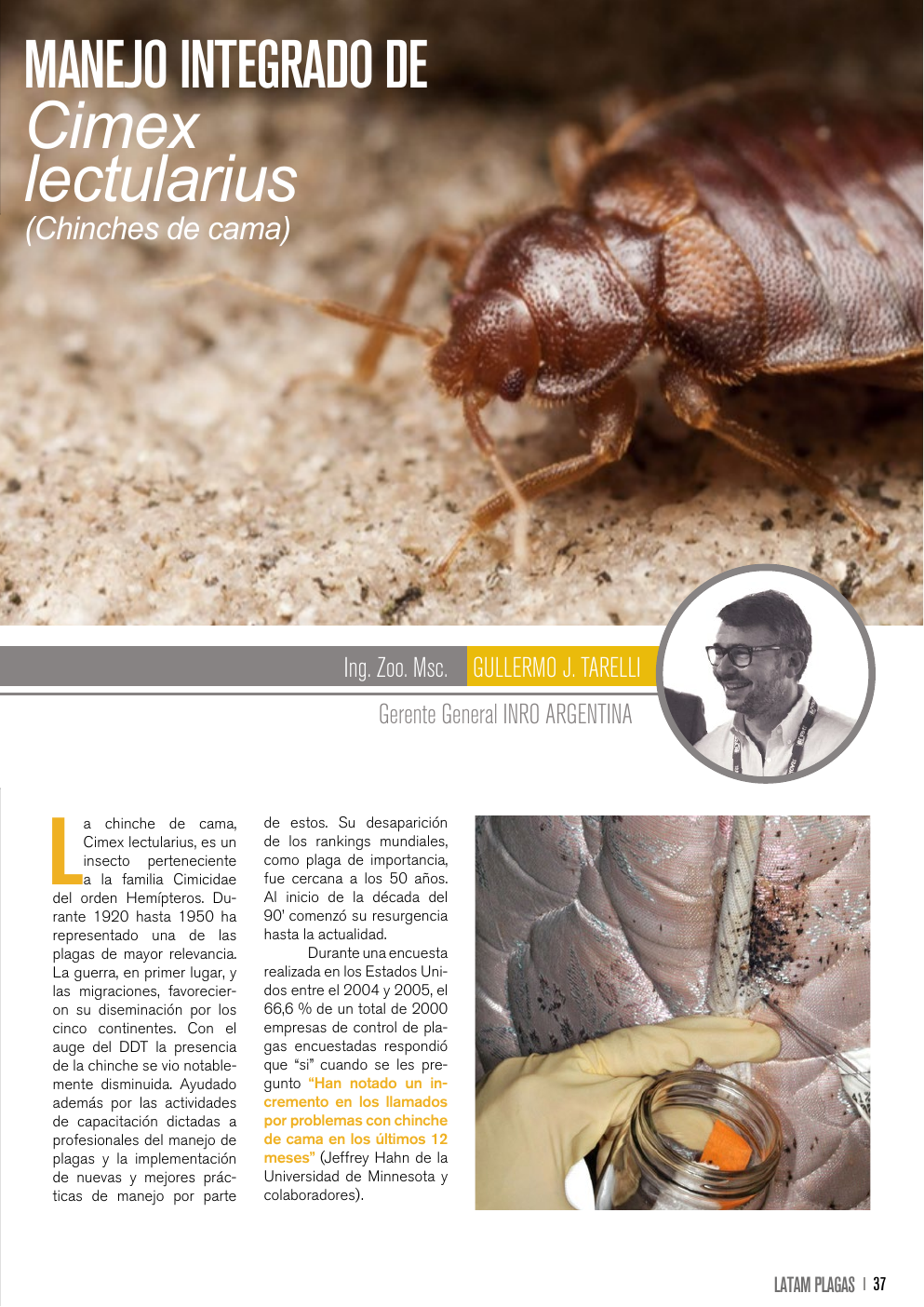
The bed bug, Cimex lectularius, is an insect belonging to the family Cimicidae of the order Hemiptera. From 1920 to 1950 it represented one of the most important pests. The war, in the first place, and migrations, favored its spread across the five continents. With the rise of DDT the presence of the bed bug was significantly diminished. Also helped by the training activities given to pest management professionals and the implementation of new and better management practices by them. Its disappearance from the world rankings, as a major plague, was close to 50 years. At the beginning of the 90's its resurgence began until today. During a survey conducted in the United States between 2004 and 2005, 66.6% of a total of 2,000 pest control companies surveyed responded “yes” when asked “Have you noticed an increase in calls about bed bug problems in the last 12 months” (Jeffrey Hahn of the University of Minnesota et al.).
Despite there being no natural transmission of diseases, these bed bugs turn out to be potential transmitters of some diseases such as hepatitis B, Q fever, Brucellosis, Chagas disease, leprosy, etc. , all of them confirmed experimentally in the laboratory. This potential is feasible given the dietary regime of these insects. Males and females, adults and nymphs, feed on the blood of their hosts. They generally bite humans and birds, although they can bite various species of mammals. Cimex lectularius turns out to be the most common species of bed bug in the world. They are gregarious insects with nocturnal habits. Their body is dorso-ventrally flattened, a characteristic that allows them to get into small cracks and crevices. At the cephalic level they have a pair of short antennae and small compound eyes. Its mouthparts are of the sucking type, composed of four stylets, covered by the labium. This structure has two transverse sutures that divide it into three parts (trimer), unlike the phytophagous hemipterans that have the labium divided into four parts (tetramer) and feed on plant sap. The head joins the thorax through a short, imperceptible neck. They have three pairs of moving legs and lack wings. The abdomen, fused with the thorax, lacks accessory structures. At the level of the fourth uromere, in females, is the paragenital sinus or organ of Ribaga, where males inject sperm.
REPRODUCTION is of a traumatic sexual type, without copulation. The male punctures the female's abdomen with his hypodermic genital parts and inoculates the sperm. These will look for the ovaries using the hemolymph as a means of movement. Multiplication occurs through egg laying. Each female lays between 200 and 500 eggs throughout her reproductive life. Each daily oviposition is around 12 eggs per female. These eggs can be placed in groups or isolated, generally attached to rough surfaces with choletheric substances secreted by the females. Structurally, the eggs are small (1-2 mm), elongated, semilunar in shape, pearly white in color, and apical operculum. Metamorphosis is incomplete (heterometaboly) beginning with the egg stage, followed by five nymphal stages and finally the adult. The first nymphal stage emerges after an incubation period of 7 to 17 days. From egg to adult it can take between 5 and 20 weeks, depending
fundamentally of nutritional conditions. For the molt to occur from one nymphal stage to another, the digestive tract must be filled. It is easy to recognize fasting bed bugs (flattened body) compared to those that are engorged (tubular, cylindrical body). Depending on the size of the nymphs, feeding time varies between 5 and 10 minutes. Adults may take up to 15 minutes; once engorged they can undergo fasting periods of up to 12 months.
INSPECTION. As the first tool of Integrated Pest Management, it is essential to carry out efficient controls. Sometimes, inspections are carried out with reluctance and without adequate meticulousness, allowing erroneous diagnoses to be made. When requesting a bed bug control service, the first thing to look at is the homeowner. This type of insect generates typically circular bites, pink in color, usually visible. Nevertheless
This, and given the possibility of observing various host-dependent bodily manifestations, this information is necessary but not sufficient. Inside a home, bed bugs will be found in those places where man spends the greatest amount of time possible at rest. These places, bedrooms, living room or daily living room, must be inspected in detail. The time needed to do this will depend on the dimensions and facilities (e.g. furniture) in the infested environment, but it is not uncommon for one or two hours to be allocated to do it properly. The information that the people who live in the house can provide is important. There may be bed bugs in all or some rooms of the home. The most common thing is that the problem occurs in the bed(s), occasionally armchairs, sofas, etc. Many times the spread of bed bugs between different rooms occurs due to the movement of
guests from one environment to another. In the bedroom(s), the bed must be considered as an inspection unit; the mattress, elastics, legs, backrests and fronts must be inspected. Night tables, dressers, closets, chairs and baseboards must be removed and carefully inspected. What are we looking for? Bed bugs (nymphs or adults), eggs, traces of droppings (dark punctate spots), skins or molts. All these signs can be observed with the naked eye, however using directed light and any optical magnification device is always convenient. Every review begins with the bed/s; The mattress should be turned from one side to the other, stretching the seams and fabric folds with both hands (using gloves). If the fabric cover is torn, with prior authorization from the homeowner, the contents of the mattress must be checked; If this practice is difficult, it is advisable to eliminate it. In wooden beds, main attention should be paid to cracks, cracks, nail and screw holes. These types of cracks can be filled with putties or silicones. In pipe beds the structure can house entire colonies of bed bugs, it is extremely important to dedicate the necessary time to rule out this possibility. If suitcases, bags, shoe boxes, etc. are stored under the beds. , they should be opened and meticulously reviewed. They will later be packed and relocated; no element from one environment should be taken to another before being thoroughly reviewed. This way you will avoid spreading bed bugs throughout the house. After bed, the nightstands will be checked; Drawers must be removed, emptied and checked inside out, as well as dresser and furniture drawers. Bed bugs can sometimes be found behind pictures, frames and other structures, sometimes inconsiderate. Finally, the baseboards should not be forgotten, regardless of the material they are made of, bed bugs can hide behind them. CONTROL. Framed within Integrated Pest Management, the control of these insects has as fundamental tools CULTURAL CONTROL, PHYSICAL CONTROL and finally CHEMICAL CONTROL. Cultural control is given by those practices aimed at modifying the environment, in such a way that it is no longer conducive for the pest to establish itself. Many of these activities could be part of physical control, for example cleaning. Because of this, we will treat these two types of control as one. The term “cleaning” is extremely broad, in this case it refers to daily cleaning and order. Cleaning these surfaces allows us to detect dead insects and/or skins if they exist. Bed bug removal can be done using stiff bristle brushes, accompanied by vacuuming. Vacuum cleaners turn out to be an excellent complement, however, it must be taken into account that simple aspiration
The insects are not always removed completely. By brushing and vacuuming at the same time, bed bugs can be removed from beds, mattresses, nightstands, etc. Another interesting and effective practice is given by the use of adhesive tapes. The tape must be placed over the insect colonies and removed, again and again. It can be repeated as many times as necessary, even changing the tape when the adhesive power is reduced. Once this is done, the tapes must be stored until the insect elimination method is selected and finally discarded. To guarantee the mortality of the collected individuals, including eggs, the container (bag) of tapes can be placed in a -20 °C freezer for at least two hours. Freezing is a very useful tool for killing bedbugs and eggs present in small furniture. If you have a “well” type freezer, you can add light tables, drawers, chairs, etc. This technique is sometimes cumbersome,
although it is an ideal option to use when the material to be treated cannot be exposed to extreme heat (steam). Steam generating machines are most commonly used in the United States, Australia and other countries with significant Cimex spp problems. It is important that the steam is not carried by strong air flows; on the contrary, the greatest efficiency is achieved by concentrating the steam in the nozzle using foam filters. This prevents air currents from releasing bed bugs and/or eggs and spreading them throughout the environment. On the other hand, it must be taken into account that the steam, when moving just a few centimeters from the nozzle, loses temperature considerably. The temperature of these drops is not enough to kill the insects. In order to kill bed bugs efficiently, the nozzle must travel approximately 30 centimeters in 15 seconds over the surface that houses them. If isolated individuals are detected, they can be
removed using tweezers suitable for this purpose. Chemical control is the complementary tool of the previous practices. The best and highest insecticidal residuality will be achieved with applications made after properly inspecting and physically eliminating as many bed bugs and/or eggs as possible. Some fundamental guidelines to consider when carrying out this type of control are given by the use of active ingredients with low toxicity for mammals, deodorized, aqueous-based formulations and high residuality, powders and on certain occasions total discharge aerosols. To determine what? and how? apply, it must be evaluated whether the home is for permanent use, weekend use or sporadic use, as well as the type of furniture to be treated. A bed can be used to sleep every night, hence the treatment to be performed may or may not be extremely different from what will be done on a light table. In the world, the most used are concentrated suspensions based on pyrethroids. These products are generally applied to walls, furniture, baseboards, behind pictures, etc. Its application must be carried out with low flow electrical equipment or manual spot application equipment. The ideal would be to try to avoid the use of insecticides on the mattress by prioritizing physical bed bug elimination practices. The use of powders, diatomaceous earth or insecticidal powders with a low concentration of pyrethroids give very good results when applied in watertight places where bed bugs usually stay. When total discharge aerosols are intended to be used, the room to be treated must be isolated, sealing windows and doors. This type of treatment usually has a high efficiency due to immediate contact on nymphs and adults, although it has no effect
on eggs and has no residual. The aerosol has great penetration power and reaches places where it is difficult to reach with conventional applications. To conclude, we could say that any bed bug situation must prioritize the INSPECTION PROCESS followed by PHYSICAL CONTROL and finally CHEMICAL CONTROL. If we translate this order of priorities into real time, we would see that, out of a global treatment of 2.5 hours, 1 hour will be dedicated to inspection, 1 hour for physical control and 30 minutes for chemical control.