
Management and control of the black fly, a priority for Europe
Until just 20 years ago, simulids or black flies were almost exclusively limited in their distribution to certain river ecosystems, many of them usually characterized by high water quality, a fact that caused these...
Technical summary
- Focus
- Until just 20 years ago, simulids or black flies were almost exclusively limited in their distribution to certain river ecosystems, many of them usually characterized by high water quality, a fact that caused these insects to...
- Approach
- The article structures the analysis around Health impact.
- Use
- Useful for professionals who need context, diagnosis and operational decisions in public health and vectors.
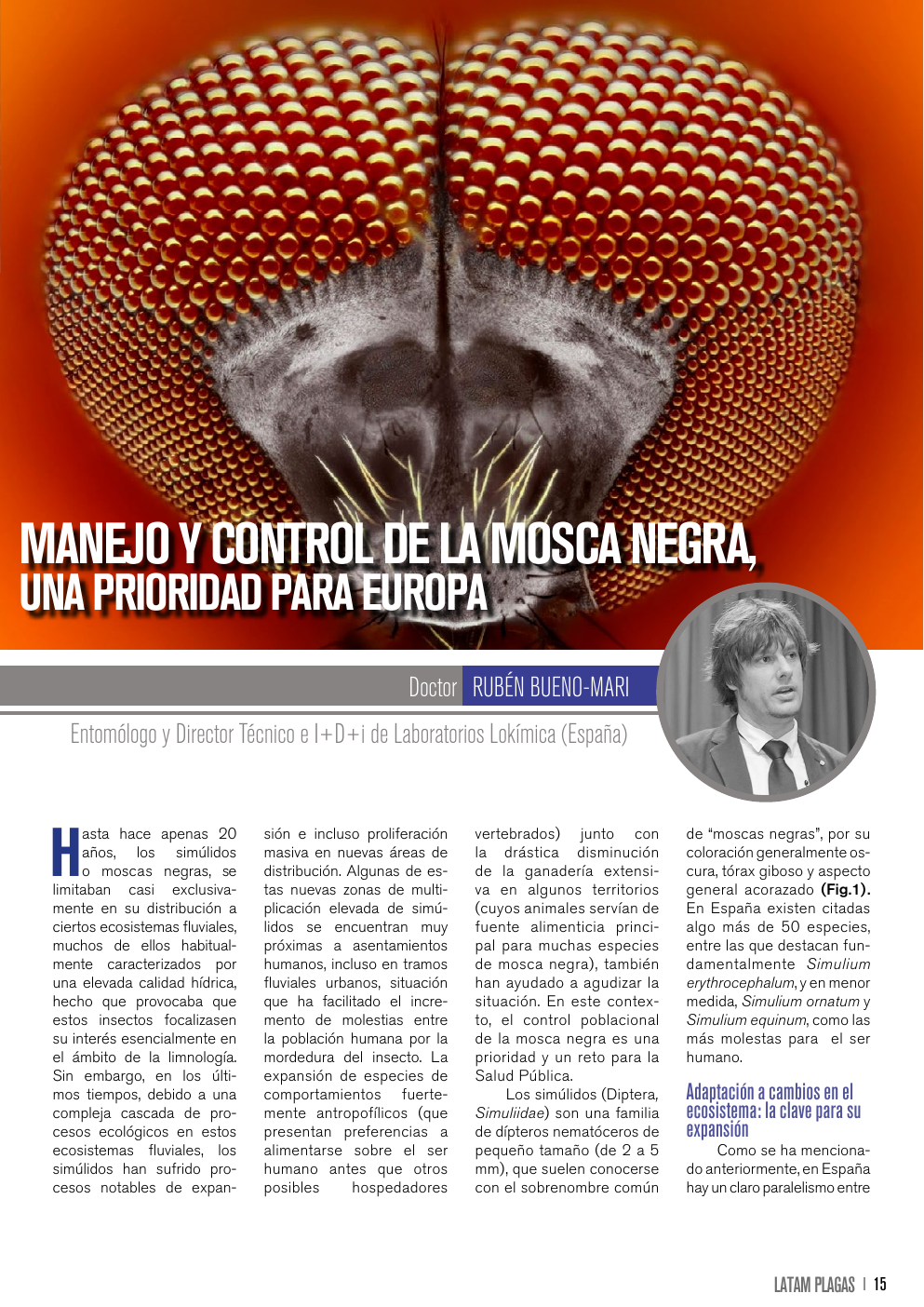
Until just 20 years ago, simulids or black flies were almost exclusively limited in their distribution to certain river ecosystems, many of them usually characterized by high water quality, a fact that caused these insects to focus their interest essentially on the field of limnology. However, in recent times, due to a complex cascade of ecological processes in these river ecosystems, simulids have undergone notable processes of expansion and even massive proliferation in new areas of distribution. Some of these new areas of high multiplication of simulids are very close to human settlements, even in urban river sections, a situation that has facilitated the increase in discomfort among the human population due to the bite of the insect. The expansion of species with strongly anthropophilic behaviors (which have preferences to feed on humans before other possible hosts)
vertebrates) together with the drastic decrease in extensive livestock farming in some territories (whose animals served as the main food source for many species of black fly), have also helped to worsen the situation. In this context, population control of the black fly is a priority and a challenge for Public Health. The simulids (Diptera, Simuliidae) are a family of small nematoceran diptera (2 to 5 mm), which are usually known by the common nickname “black flies” due to their generally dark coloration, gibbous thorax and general armored appearance (Fig. 1). In Spain there are just over 50 species cited, among which Simulium erythrocephalum stands out, and to a lesser extent, Simulium ornatum and Simulium equinum, as the most annoying for humans.
Adaptation to changes in the ecosystem: the key to its expansion
As mentioned above, in Spain there is a clear parallel between
Fig.1 Adult
certain environmental modifications in river environments and water channels for irrigation purposes, and the expansion of simulids. In general, the main points of black fly proliferation have always been in the upper and middle reaches of rivers and streams, characterized by fresh, transparent and well-oxygenated waters. In these places, simulid larvae and pupae find their main development microenvironments in different attachment substrates, such as rocks or vegetation submerged in the water column (Fig. 2). However, fortunately in recent years there has been intense work to improve the water quality of our rivers in Spain. Even in some cases with important landscape modifications of a conservation nature, also “renaturalizing” said rivers as they pass through urban sections and also declaring some river ecosystems that were heavily degraded decades ago as Natural Parks. This situation, already observed in the main river basins of territories such as Catalonia, Aragón, Comunitat Valenciana, Murcia, Andalusia and Madrid, has perFig. 5 Reed in water
Fig 2. rock simulids
It has also mitigated the expansion of invasive species, such as macrophytes of the genus Potamogeton, which due to their morphology, degree of adaptation to different types of water and speed of development, currently represent perhaps one of the “new” most productive simulid fixation elements in river ecosystems (Fig.3). The evolution towards “cleaner” waters of our rivers has led to a decrease in turbidity and an increase in transparency in some cases, a situation that has favored the penetration of light necessary for the execution of the photosynthetic action of these submerged algae that, helped by the higher temperature of the middle and lower reaches of rivers compared to the upper ones and the greater presence of nutrients, have proliferated massively in many places to the point of also being considered a “pest” by themselves in some areas (Fig. 4). So much so, that the mechanical removal of these macrophytes through specialized material means appropriate to the magnitude of the problem, such as amphibious vessels, is also considered an effective method of physical control of simulids in certain areas.
river sections. In addition to algae and rocks, another important attachment substrate that is being observed in rivers affected by black fly are the reeds or reeds of the Arundo genus that predominate in the river margins and that, partially or completely, can leave structures introduced in the water sheet where larvae and pupae of the insect anchor to live (Fig. 5 and 6). Another relevant factor for the expansion of the black fly is related to agriculture and the generation of water structures suitable for the development of the insect, such as irrigation canals and ditches. After all, with these actions man is creating “artificial rivers” (lotic waters, in constant movement) in new territories until then inhospitable for this dipteran. This is even being observed associated with different irrigated crops, such as rice fields or cornfields, in different parts of Spain that have a tremendously arid or semi-desert climate, which had never suffered severe episodes of black fly bites and that in recent years, hand in hand with anthropogenic activity, the problem has been brought to these areas.
Fig 6. Detail reed larvae
Population control, a challenge for the sector
Prevention in the fight against the black fly is based on a correct identification of the risk factors that cause the insect to proliferate in specific points of rivers, streams and canals. Direct intervention, by physical, mechanical or chemical methods, on these risk factors is the key. The mechanical removal of fixation substrates has previously been discussed as a relevant control element. Among the chemical tools included in the biocidal products that can be used, insecticides based on Bacillus thuringiensis israelensis (Bti) stand out as the most suitable for reasons of effectiveness and specificity. As they are formulated that only present the Bti bacteria as an insecticidal active substance, they are considered interesting tools for biological control. With a direct and exclusive action on the simulid larvae that filter these bacteria, therefore not affecting the rest of the river entomofauna, through selective and carefully prepared applications (dose, timeFig. 7 Terrestrial application Bti
Fig 3. Potamogeton pupae
pos, application methods, degree of channel coverage, etc.) efficacy results are usually obtained greater than 95% lethality of the population with a single application. Given that the river must be understood for what it is, a continuous ecosystem that along its path can harbor numerous obstacles to the penetration of the applied products, factors such as flow, the presence of more or less pronounced meanders, physical barriers such as weirs, etc., will really determine the place and number of applications to be executed to achieve effective large-scale population control in the river. Depending on each type of problem and the structural configuration of each river, applications can be made by spraying through terrestrial (Fig. 7) or aerial (Fig. 8) means.
Health impact
Unlike mosquitoes and other hematophagous insects that are solenophagous, that is, they introduce their long mouth stylets through the epidermis to directly access the superficial blood vessels and suck blood, in the case of simulids the feeding mode is telmophagous. They have serrated jaws that tear the skin and create a small wound, so that the blood from the blood vessels extravasates on the surface of the skin and is directly sucked by the female black flies. Therefore, they do not feed through direct suction from blood capillaries, but from the blood that emanates from the wound caused. That's why, technically, we say mosquitoes “bite” and black flies “bite.”
Obviously, at the level of dermal injuries, the simple fact of generating bites already causes a notable health impact. On certain occasions, depending on the number of bites and the degree of sensitivity of the people who have been affected), secondary medical complications may arise derived from the allergic reaction known as “simuliotoxicosis”. This is usually characterized by inflammation, itching, bleeding and edema, and even in severe cases significant medical attention may be required to avoid further complications (Fig. 9). On the other hand, simulids are also capable of acting as significant vectors of different pathogens (viruses, protozoa and nematodes) that can cause notable diseases in humans and animals (Fig. 9).
On the other hand, simulids are also capable of acting as significant vectors of different pathogens (viruses, protozoa and nematodes) that can cause notable diseases in humans and animals.
REFERENCES:
- López & Jiménez (2017). Updated checklist and distribution maps of blackflies (Diptera: Simuliidae) of Spain. The Simuliid Bulletin 48, July: 145.
- Ruiz-Arrondo et al., (2014). Expansion of simulids (Diptera: Simuliidae) in Spain: A new challenge for public health and animal health. Bol SEA 54:193-200.
- Soriano et al., (2019). The influence of aquatic vegetation on the development of “Simulium erythrocephalum” (De Geer, 1776) (Diptera, Simuliidae) populations in Madrid: its relationship with massive black fly emergencies. REMASP 2 (8):1-8.
Species/microorganisms Hosts/disease Equidae, suids and bovids Equidae Leporids Birds Different domestic and wild birds, Avian trypanosomiasis Different domestic and wild birds, malaria/avian malaria Birds (Anatidae) Birds (Phasianidae) Humans (Onchocerciasis, river blindness) Humans (Mansonellosis, Filariasis Ozzard) Bovids Bovids Bovids Cervids Ursids
Fig 9. Simulioxicosis