
Ants, tireless enemies
Ants, tireless enemies: From an anthropocentric vision we could define ants as a true pest. They are black or red, large or small, and indoor or outdoor.
Technical summary
- Focus
- From an anthropocentric vision we could define ants as a true pest.
- Approach
- The article structures the analysis around Camponotus mus, Acromyrmex spp. and Solenopsis spp..
- Use
- Useful for professionals who need context, diagnosis and operational decisions in edición 5.
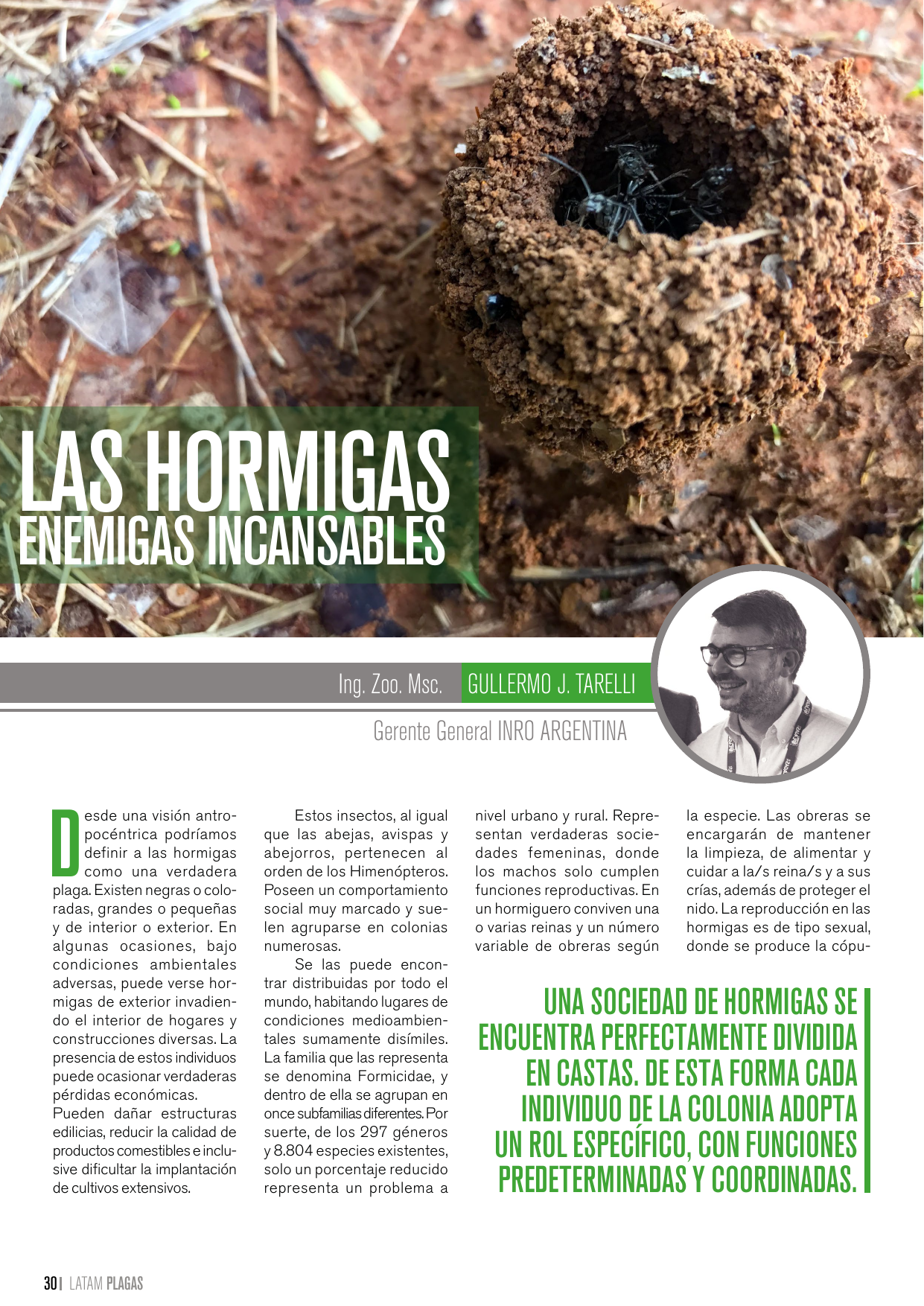
From an anthropocentric vision we could define ants as a true pest. They are black or red, large or small, and indoor or outdoor. On some occasions, under adverse environmental conditions, outdoor ants can be seen invading the interior of homes and various buildings. The presence of these individuals can cause real economic losses. They can damage building structures, reduce the quality of edible products and even make it difficult to establish extensive crops.
These insects, like bees, wasps and bumblebees, belong to the order Hymenoptera. They have a very marked social behavior and tend to group together in large colonies. They can be found distributed throughout the world, inhabiting places with extremely dissimilar environmental conditions. The family that represents them is called Formicidae, and within it they are grouped into eleven different subfamilies. Fortunately, of the 297 genera and 8,804 existing species, only a small percentage represents a problem at the urban and rural level.
They represent true female societies, where males only fulfill reproductive functions. One or more queens and a variable number of workers coexist in an anthill depending on the species. The workers will be in charge of maintaining cleanliness, feeding and caring for the queen(s) and their young, as well as protecting the nest. Reproduction in ants is sexual, where copulation occurs between males and females after the nuptial flight. This flight occurs after the formation of the swarm, a reproductive period when winged individuals become visible. Swarming is strongly related to climatic conditions and generally occurs between the months of September and November depending on the species.
After copulation, the fertilized queen acquires the ability to give birth to fertile eggs. Small larvae will emerge from these eggs and complete their development after molting twice. The mature larva will develop a pupa that will finally give rise to the adult. Technically this represents a holometaboly, also known as complete metamorphosis and characterized by the presence of an egg, larvae, pupa and adult. The time from egg to adult, like the longevity of the queens, is variable between different species.
Ants have an extremely varied diet. Some feed on fungi, fungivores, others on plant and insect decay, and others on dead animals. In some species trophallaxis is a common practice; Through this mechanism, ants transfer liquid food mouth to mouth from one to another. This type of behavior allows insecticides based on toxic baits to be so highly effective. It is important to note that ants are not xylophagous; In fact, the ants known as carpenters do not feed on wood, they simply dig their galleries in it.
To efficiently control ants, regardless of the species, it is essential to implement different strategies that allow for adequate integrated management. These strategies contemplate cultural control, environmental management, physical-mechanical control and chemical control. Without a doubt, the latest innovations regarding products for ant control are represented by insecticidal formulations, mainly baits, gels, liquids and granules.
For their recognition, morphological differences and behavioral differences can be considered. Regarding morphological differences, primary attention must be paid to the size and number of segments or segments that make up the antennae. At the same time, it is important to determine the presence or absence of club, thickening of the last two or three segments at the apex of the antenna. In the thorax the presence or absence of spines must be determined. If they are present, what is important is the number, usually in pairs, and the length. The abdomen has a pedicel that can be one or two segments; when it is one it may or may not be visible. In some species, the stinger is located at the caudal level of the abdomen, used mainly for defense.
In the following paragraphs a brief review is made of four of the most representative species of Argentina.
Camponotus mus
This genus refers to a group of ants known as carpenter ants. These ants are characterized by having antennas with twelve segments, without club; thorax with a rounded profile and no spines; pedicel of one segment, short and flat, with a single row of hairs on its dorsal surface. They lack a stinger although they have the anal opening surrounded by obvious hairs. Its coloration is variable; At the household level, the most common turns out to be Camponotus mus, with a matte black body and a high density of yellowish-white hairs on the abdomen.
The morphological structures of the workers turn out to be the same, but the variation in size generates the existence of polymorphic individuals. The workers can measure from 3.5 to 13 millimeters. This ant has main and satellite anthills, and can be found either outdoors or indoors.
Inside the anthill the colony is divided into castes, queen, workers and males, each of them with specific activities. There is a queen per colony who is responsible for increasing the number of individuals by laying eggs. Two queens rarely coexist in the same anthill. The workers are responsible for feeding the queen and her young, as well as cleaning the anthill and protecting it. Males only perform reproductive functions during the swarming period.
In general they feed on sugary substances, mainly aphid honey. In any case, at certain times of the year you can see foraging ants feeding on insects or dead animals and other protein sources. This species is characterized by making long linear paths that pass through party walls, electricity or telephone cables, trees and fences.
These ants cause direct and indirect damage to roofs, wooden buildings and old trees. The direct damage is caused by the galleries that the ants dig in the wood to house their young. Indirectly, the temperature and humidity generated by the colony favor the development of fungi. The presence on the roofs of homes causes the accumulation of wood chips and sawdust, as well as dead ants on the floors of the attacked environments.
To carry out effective carpenter ant control, it is essential, as far as possible, to detect the main ant nest and the satellites. A thorough inspection should be made of the interior of the home, roofs and wet areas, and of the garden, trunks, trees and woodsheds. Management strategies include manual applications based on residual formulations, application of insecticidal dust at specific sites and the use of insecticidal fumes. An innovative and important tool is anticide baits, gels, liquids and granules. This type of formulation has a delayed, but extremely effective, insecticidal effect.
Acromyrmex spp.
Known as a pruner, this species of ant is the torment of garden lovers. Few plants are left aside by pruners when harvesting vegetables. They are numerous colonies, made up of polymorphic workers and a queen. They have antennae with eleven segments, a thorax with four pairs of spines, the last rudimentary, and an abdominal pedicel with two segments. They can measure from 3.6 to 10 millimeters and their color is dark brown and even black.
Among the workers there are those that cut plant material and carry it, transporters; others who grow the fungus, gardeners; others who guard the anthill, soldiers; and those that feed the immature stages, nurses and young workers. Contrary to what many believe, these ants do not feed on the material that they cut, carry and finally introduce into the anthill. This organic material is chewed by ants to form a paste that they moisten with anal secretions, serving as a substrate for the fermentation of a fungus. Hypomyces. The shoots of this fungus are the real food of these ants.
They make their nests on firm ground, with large and irregular entrance holes; Depending on the species, they may or may not make a mound. Several chambers, connected by underground galleries, at different depth levels, make up the nest. One of them, sometimes the deepest, is called the fungus. It is rare to find the presence of these ants indoors. In any case, on some occasions, shattered earth and pieces of dead ants can be seen near baseboards and corners of homes. This material is garbage that ants eliminate through cleaning holes.
The cutters directly damage the aerial structures, stems, leaves and flowers, of different ornamental plants. In situations of intense defoliation, with partial or total loss of the photosynthetic surface, the death of the plant can occur. At the indoor level, ants deposit dirt in quantity.
To control this species, applications of insecticidal dust, blowing, spraying of attacked plants and baits, generally granulated, can be used. The granules are widely accepted and carried to the fungus. In their composition they may contain insecticides and even fungicides that directly attack the colony's food. Some physical barriers can be placed on trunks and plant bases preventing possible attacks.
Solenopsis spp.
This ant, known as the fire ant, is famous for its painful stings. They generate extremely numerous colonies and nest in loose, moist soils. Regarding its social organization, it does not differ from the rest of the ants. They have several queens per colony coexisting without problems, which is why their colonies are so large. The workers are polymorphic, they can measure between 1.6 to 6 millimeters, they have ten-segment antennas with a two-segment club. They lack spines on the thorax and the pedicel on the abdomen has two segments.
At the caudal level of the abdomen is the highly developed and retractile stinger. They are bright reddish in color with a darker abdomen. They are generally found outdoors; Its appearance indoors is sporadic and occasional, strongly influenced by adverse weather conditions. They turn out to be omnivores, feeding on various sugary substances, grains and protein sources, such as dead insects or meat.
These ants can build large anthills, altering the appearance of public spaces, gardens and golf courses. The aggressiveness of the species is revealed by the intentional or accidental breaking of the anthill. The ants quickly emerge in large numbers and sting the aggressor with their sting. The physical destruction of anthills turns out to be a simple technique, but relatively effective. This effectiveness is greater if it is complemented with manual application of insecticide. Given the population density that this species usually presents, the time and amount of formula to use are important factors to consider when using baits.
Linepithema humile
Better known as Argentine ant. Small invaders that measure 2.2 to 2.6 millimeters. They have monomorphic workers, with a longitudinally stylized body and a light brown color. Its antennae have twelve segments without a club, a thorax without spines and an abdominal pedicel with a single short, flat segment. They have several queens per colony.
They usually nest in humid areas, generally near water sources. They can be found indoors, in the kitchen, bathroom and laundry room, or outdoors, such as cisterns and cracks in foundations. They usually appear quickly in the kitchen when food remains, meats and sweets are exposed. By following the long, straight paths along which they travel, you can quickly detect the place through which they are entering. It is very common for them to enter through small holes or cracks around the water pipes in the under counters.
Basically the presence of this ant in a house is annoying; does not cause serious damage. Arguably, at worst they would be occasional contaminants in our food. Blocking possible entry routes is an important prevention measure. Manual applications of residual products or the use of baits can be used as control strategies. Carbohydrate-based gels are usually extremely attractive to this ant, as well as highly effective.