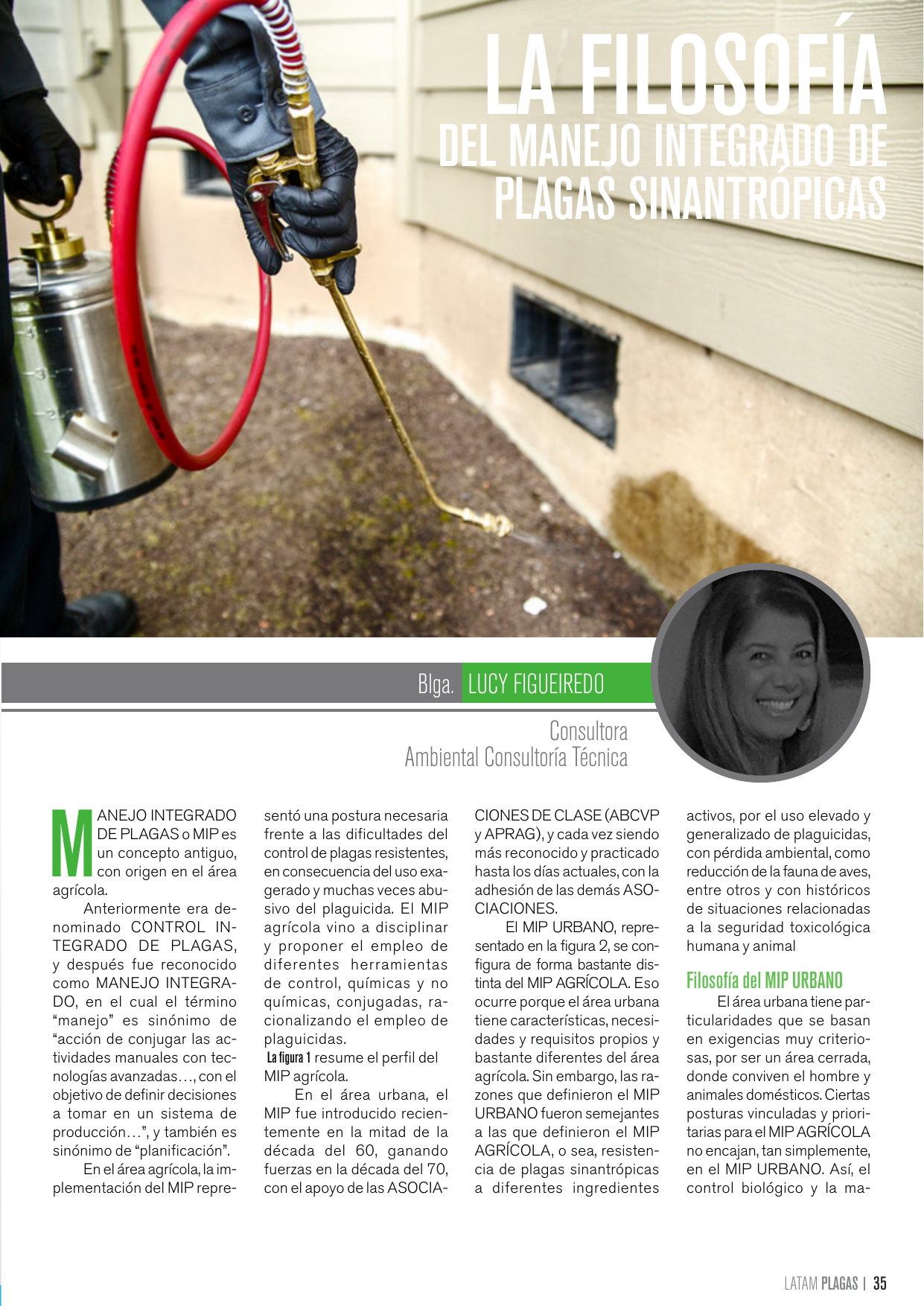
The philosophy of integrated synanthropic pest management
Integrated Pest Management or IPM is an old concept, originating in the agricultural area.
Technical summary
- Focus
- Integrated Pest Management or IPM is an old concept, originating in the agricultural area.
- Approach
- The article structures the analysis around Urban IPM Philosophy, Implementation and management of a GIP program and Environmental and pest dynamics.
- Use
- Useful for professionals who need context, diagnosis and operational decisions in integrated management.
Index
Integrated Pest Management or IPM is an old concept, originating in the agricultural area. Previously it was called Integrated Pest Control, and later it was recognized as Integrated Management, in which the term "management" is synonymous with "action of combining manual activities with advanced technologies..., with the objective of defining decisions to be made in a production system...", and is also synonymous with "planning".
In the agricultural area, the implementation of IPM represented a necessary stance in the face of the difficulties of controlling resistant pests, as a result of the exaggerated and often abusive use of the pesticide. Agricultural IPM came to discipline and propose the use of different control tools, chemical and non-chemical, combined, rationalizing the use of pesticides.
In the urban area, IPM was recently introduced in the mid-60s, gaining strength in the 70s, with the support of class associations (ABCVP and APRAG), and becoming increasingly recognized and practiced to the present day, with the support of other associations. Urban IPM is configured quite differently from agricultural IPM. This occurs because the urban area has its own characteristics, needs and requirements that are quite different from the agricultural area. However, the reasons that defined urban IPM were similar to those that defined agricultural IPM, that is, resistance of synanthropic pests to different active ingredients, due to the high and widespread use of pesticides, with environmental loss, such as a reduction in bird fauna, among others, and with historical situations related to human and animal toxicological safety.
Urban IPM Philosophy
The urban area has particularities that are based on very strict requirements, as it is a closed area, where man and domestic animals coexist. Certain linked and priority positions for agricultural IPM do not simply fit into urban IPM. Thus, biological control and genetic manipulation, just to name a few, are complicated positions in the urban area, but not totally impossible. Not only is the operational difficulty a fact, but also the acceptance of the population itself. The example of the “transgenic mosquito” may represent this difficulty.
In this way, urban IPM has a strong environmental management character, considering that the primary cause of pest infestation in the urban area is associated with the environment. The urban environment allows access through different entry points, has the force of attraction due to the supply of food and water, offers shelter in different cracks and gaps, which motivates infestations and reproduction of different pests, gradually more varied and more adapted to the human environment.
The environmental issue, as a cause of infestation by synanthropic pests, assumes such a fundamental role, to the point of the introduction of the expressions “environmental health” and “environmental control” in the segment, and these become part of the names of companies, whether manufacturers of pesticides, equipment and accessories, or service providers. Change the focus and change the focus.
Urban IPM becomes the practice, however some distortions arise and still exist. IPM is not a technique, it is not a methodology, it is not a fragment. IPM is a philosophy. It's a whole. It does not refer to just chemical techniques, nor just to non-chemical ones. It refers to the necessary model, case by case.
Starting from an everyday example, not eating fried foods does not represent a healthy eating or living program. It is inside, but it does not represent. A program involves much more, including a philosophy of life. As well as IPM. There are those who judge that filling gaps is the meaning of IPM. It is inside, but it is not. IPM is a sustainable program philosophy. It requires understanding and posture. IPM is a multiple strategy for the control of synanthropic pests, with a preventive nature, acting to reduce the possibilities of infestation. Infestation, if we think about hospitals and food areas, for example, already means “disasters”, with possibilities of food contamination, food infections and damage.
As said by Lucia Schüller, in V& P Magazine, Ed. 13, "Services evolved. Controlling pests became a much more complex task, involving data analysis, monitoring situations in the field. Today, controlling pests is much more similar to the scientific method than it was a few years ago." Ricardo Soares Matias, renowned researcher in the area of synanthropies, in the magazine V& P, Ed. 30, defines pest control in the urban area as GIP, which means Integrated Pest Management. Management, in this case, as Matias says, is a task that goes beyond management. It requires varied interpretations of different situations and actions.
Jair Rosa Duarte, in V& P Magazine, Ed. 34, whose theme, among many others, characterized him; In “Origin of Plagues” he talked about “the occupation of man and how the construction of urban areas generated great synanthropy and a great diversity of synanthropic animals,” as well as “new conditions created… favored animals with high potential to affect the health conditions of their synanthropic friends: man.” Thus, the concept of IPM is reinforced as a philosophy of life and work, with the personal connotation of IPM as Intelligent Pest Management.
Implementation and management of a GIP program
Considering that environmental control is the basis of the GIP, we can affirm that the first step is the careful inspection of the environment, to carry out a diagnosis, which will define: infesting pests, sensitivity of the premises, criticality of infestation, corrective and preventive measures related to the environment and sanitation.
From this stage, we move on to the treatment phase, which should include traps, blocking access to pests and chemical control. Chemical control should be as least invasive as possible, prioritizing punctual application techniques, biological insecticidal feeders, safe formulations, preferably water-based and high LD50, formulations with an impact or knock down (KD) effect or with a larger residual effect according to the characterization of the area and whether it is internal or external.
The management of results is based on continuous monitoring, at intervals equal to or less than monthly periods, accompanied by a spreadsheet with historical summaries of infestations and percentage reductions thereof. The client's participation is a relevant factor and a checklist of measures to correct the environment and block the accessibility of pests, as well as sanitation, must be delivered and requested by the client.
Environmental and pest dynamics
The appearance of pests has to do with critical, highly attractive, and often sensitive, high-attention environments, such as hospitals, food areas and health-related laboratories. Hospital infections, food contamination, problems related to the image of an establishment and many other health and legal issues can be linked to pests.
Environmental dynamics and infestation dynamics are associated and therefore there is a need for a correlation favorable to control. It is necessary to take measures that minimize these dynamics, in the sense of contributing to obtaining better results. Sanitization of the premises, storage and entry of goods, care when importing pests in infested packaging, etc., are parallel requirements that must be equally thought out and planned. External pest pressure may exceed the limits of the area over which the service is being provided.
Pesticide dynamics
On the other hand, the dynamics of the most modern pesticides and formulations present toxicological safety differentials of great importance, and that leave less residuality, for example, requiring greater monitoring of the client by the service provider. There may be a need for a change in chemical strategy, such as changes in active ingredients and formulations.
health agent
The synanthropic pest control professional fulfills the role of health agent, who is increasingly required to have professionalism and diversified technical knowledge about pests, environment, legislation, mode of action of chemical products, in addition to an interactive relationship with the client.
In the agricultural area, the acceptable level of infestation is directly related to the damage it causes, that is, to financial losses. In urban areas there is no way to define an acceptable limit, since the presence of pests is directly related to health, whether due to environmental contamination or food contamination, although the serious economic damage generated when, for example, rodents destroy bags in a supermarket, should also be considered. In certain situations, such as surgical and nursing facilities, the single acceptable and possible infestation level is zero.
Figure 2 summarizes the concepts mentioned here.