
Intervention on objects of heritage value damaged by insects
Heritage as an ecosystem. When we think of an old library, a historical archive or a natural science museum, we usually imagine them as static, silent spaces, oblivious to the noise of the outside world.
Technical summary
- Focus
- Heritage as an ecosystem When we think of an old library, a historical archive or a natural science museum, we usually imagine them as static, silent spaces, oblivious to the noise of the outside world.
- Approach
- The article structures the analysis around Heritage as an ecosystem, Decision making: what the entomologist's eye does not see and The actors of biodeterioration: identification and differential diagnosis.
- Use
- Useful for professionals who need context, diagnosis and operational decisions in edición 18.
Index
Heritage as an ecosystem
When we think of an old library, a historical archive or a natural science museum, we usually imagine them as static, silent spaces, oblivious to the noise of the outside world. However, from the perspective of applied entomology, these institutions are artificial ecosystems where materials of organic origin and a fauna specialized in their exploitation coexist—or fight with each other. The paradox is evident: the same collections that protect the memory of biodiversity become, if conservation conditions are poor, the ideal substrate for the development of new generations of insects. A 19th century herbarium, a leather binding or a polychrome wooden sculpture are not just “objects”: they are trophic resources for a community of arthropods that includes everything from xylophages to the most specialized detritivores. When we face a heritage piece colonized by insects, the conflict is always the same. On the work table rests an object that has survived decades—perhaps centuries—and that now houses an active population of some lepidopteran or coleopteran that feeds on that object. As a conservator, the first obligation is to the piece. But as a technician, it is not possible to dissociate its survival from the eradication of what is consuming it. In recent years, at BioRacional we have intervened in many pieces with active infestation: books, polychrome sculptures, textiles, old musical instruments, collections and furniture. This article is not a bibliographic review, but rather attempts to be a workshop chronicle, based on the methodology that we have applied, validated and, in many cases, adapted or corrected along the way. An object of heritage value does not allow trial and error. Each piece is a unique case, and each intervention must be documented for what it is: a clinical act on a non-replaceable patient. This article addresses the intervention on pieces of heritage value with active infestation. We propose an action model based on precise entomological diagnosis, the selection of harmless treatments for the substrate and the integration of these actions in a broader program of
Decision making: what the entomologist's eye does not see
Before any treatment, we are forced to answer an uncomfortable question: are we really facing an active infestation? For years we have received parts referred to as “urgent” that, upon close inspection, showed only historical damage. The smell of sawdust, the presence of exuviae and the exit holes are not enough. Evidence of active infestation is needed. For this, several methods can be used:
Inspection with binocular magnifying glass (10x-40x). Active holes have clean edges and sometimes a thin ring of compacted sawdust. Inactive holes are often blocked by environmental dust or have rounded edges. Adhesive paper test. A strip of low adhesion polyethylene film is gently applied to the surface. If shiny translucent particles remain - excrement or fresh sawdust - activity can be assumed in the last 72 hours. Controlled tapping on a white surface. If fine, shiny particles (fresh sawdust) fall, recent activity is assumed. Exposure to light stimulus. Anobium adults are negatively phototactile; If they hide their heads in the gallery when the light hits them, they are alive. Quarantine observation period. For small parts, we use transparent polyethylene bags for 72 hours. Condensation of moisture or movement within the container confirms the presence of active metabolism. Sound recording amplifying the eventual activity of xylophages with ultrasensitive microphones.
The actors of biodeterioration: identification and differential diagnosis
Main species present: It is crucial to highlight that knowledge of the biological cycle is not an academic question, but rather a tactical tool. Tricorynus herbarius has a greater susceptibility to anoxia during the first larval stages; Eggs, due to their chorionic protection and low metabolic rate, require longer exposures. Ignoring this fact leads to apparent successes: adults eliminated, but viable eggs that restart the infestation weeks later. Main species present:
Common Modified Atmosphere Treatment Methods
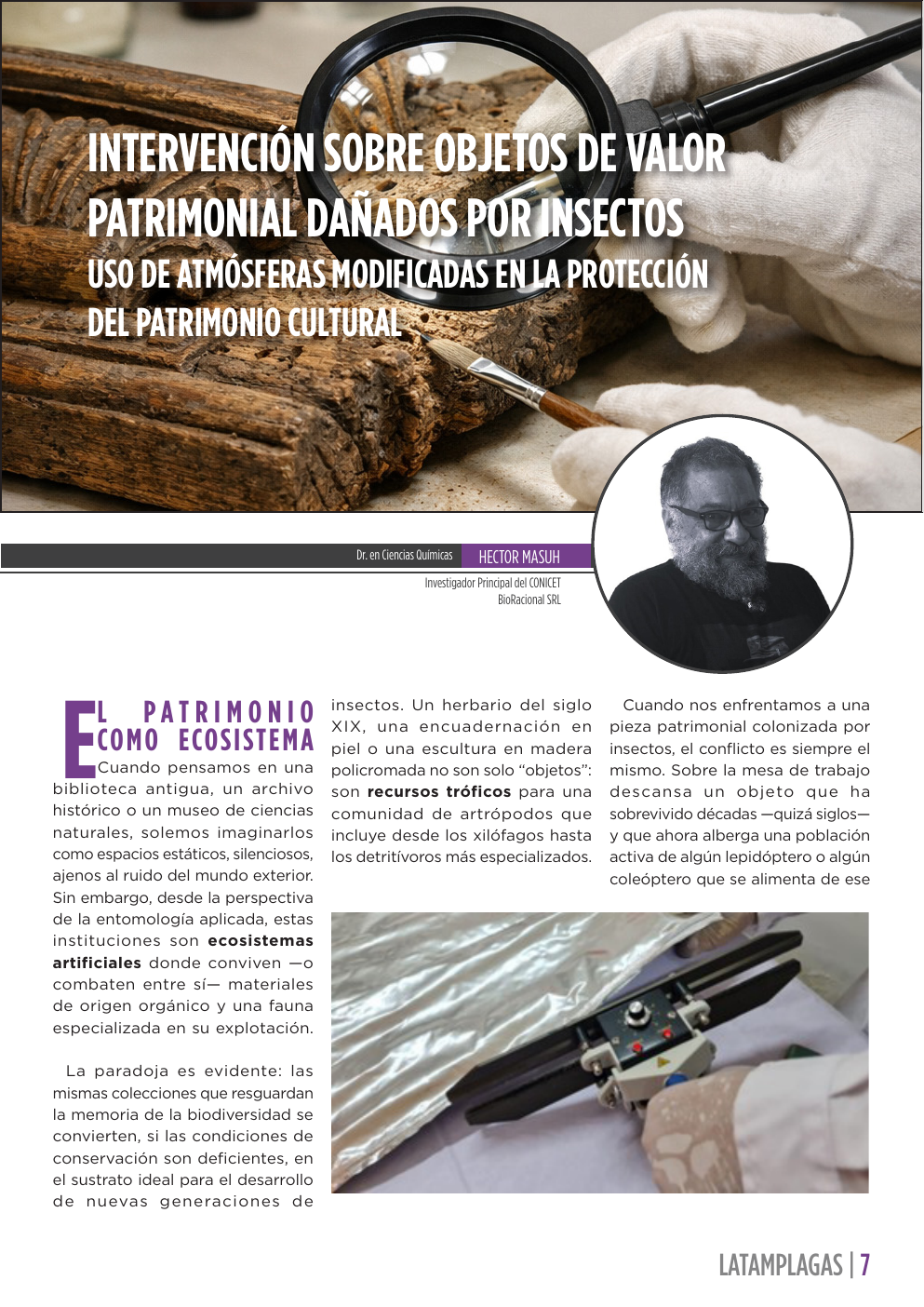
Within the scope of pest control in cultural heritage and stored goods, modified atmospheres constitute a family of physical methods that act by altering the gaseous composition of the insect's environment, causing its death by mechanisms that do not involve residual chemical toxicity. At BioRacional we distinguish several main approaches within this category, which constitute our standard of intervention due to their universal compatibility with sensitive materials. Anoxia with nitrogen (N₂). It consists of displacing oxygen from the air by injecting nitrogen until concentrations of less than 0.3% are reached. Nitrogen is an inert, colorless, tasteless gas that makes up 78% of the Earth's atmosphere. When purified from ambient air by membrane generators—or, failing that, supplied from high-pressure cylinders—it creates an environment where insects, their larvae and eggs cannot maintain aerobic respiration, dying from asphyxiation within a period that depends on the temperature, relative humidity and the biological stage of the pest. Its main advantage is its total chemical safety: it does not react with pigments, inks, adhesives or fibers, and it does not leave residues of any kind. Comparative studies support that, unlike other methods, nitrogen anoxia can be applied to any combination of materials without altering their macroscopic or molecular characteristics. However, there are some restrictions if the presence of certain molds that could thrive in nitrogen-rich atmospheres is suspected. Atmospheres enriched with carbon dioxide (CO₂). This method, widely used in the food industry and pest control in stored products such as grains and cereals, acts through a dual mechanism: on the one hand, CO₂ partially displaces oxygen, contributing to hypoxia; On the other hand, in high concentrations (generally greater than 60%), it has a narcotizing and acidifying effect on the insect's tissues, altering its acid-base balance and accelerating its death. It is particularly effective as a corrective treatment when rapid control of active infestations is required. However, in our experience and according to specialized literature, its application on cultural heritage should be evaluated with caution, especially in the presence of certain pigments or carbonated materials, where the high concentration of CO₂ could theoretically induce unwanted chemical reactions. Atmospheres with argon (Ar) and other noble gases. Argon, like nitrogen, is an inert gas that displaces oxygen by purely physical means. Some studies suggest that, due to its greater solubility in water and lipid tissues, it could interfere with key enzymes of insect metabolism, although this mechanism is not fully elucidated. In practice, its use is less frequent due to its higher cost and environmental impact. At BioRacional we routinely use argon, because it has certain special characteristics that make it superior to nitrogen, such as its density, its packaging with negligible oxygen levels and its zero reactivity. Scrolling Methods: Dynamic vs. static. A crucial aspect in the generation of modified atmospheres is the strategy used to achieve and maintain the lethal concentration of gases. In our practice we distinguish two fundamental modalities. The dynamic method, also known as “continuous purging” or “flow”, consists of a constant or intermittent injection of gas through the treatment chamber, compensating for possible losses due to permeability or small leaks in the confinement system. This approach is particularly useful for large format pieces or when flexible chambers with a certain degree of permeability are used, as it allows anoxic conditions to be maintained stably throughout the exposure period. The static method, on the other hand, involves a single initial oxygen displacement event, after which the system remains hermetically closed without additional gas input. For this method to be effective, a very high quality sealing with multi-layer barrier materials is required that prevents the diffusion of atmospheric oxygen into the interior. At BioRacional, for our standard high barrier bag treatments, we employ a variant of the static method enhanced with a precise calculation of the volume of gas required to achieve the target concentration in a single initial purge cycle. Oxygen sequestrants: a chemical alternative for anoxia. Along with methods based on gas injection, there is a radically different approach to generate anoxic conditions: the use of oxygen scavengers. These products, commercially known as Ageless®, RP System® or ZerO2®, generally consist of sachets containing zero-valent iron particles that, when reacting with atmospheric oxygen, oxidize to form stable ferric oxides, thus removing oxygen from the confined environment. This process reduces the oxygen concentration to below 0.1% within 24 to 72 hours. The main advantage of this method is its operational simplicity: it does not require generators or gas bottles, making it ideal for small parts, on-site interventions or institutions without specialized technical infrastructure. However, it has significant limitations: the amount of sequester required scales linearly with the volume of the chamber, and may be impractical for large pieces. Additionally, some sequestrants generate heat during the oxidation reaction, so they must be placed without direct contact with the part. Recent research has also detected emissions of organic acids from certain types of sequestrants, which makes it advisable to carefully evaluate their use with sensitive materials such as certain pigments, metals or carbonated surfaces. Critical consideration: airtightness as a common factor. Regardless of the gas selected and the displacement method used, all modified atmosphere methods share an unavoidable technical requirement: the need for airtight confinement. Whether using multi-layer high barrier bags (polyethylene-aluminum-polyethylene), rigid chambers or sealed flexible structures, the effectiveness of the treatment depends on maintaining the gas concentration throughout the exposure period. At BioRacional we have developed our own tightness verification protocols, including prior pressure tests and continuous monitoring with calibrated oxygen analyzers, which allow us to guarantee lethal conditions for the time required for each species and stage. In action: The establishment of a lethal atmosphere Essential components:
- Multi-layer barrier bags (polyethylene-aluminum-polyethylene). Simple polyethylene bags are of no use beyond their thickness: oxygen diffuses through them in less than 48 hours. A material is required that is poorly permeable to oxygen, with low OTR (Oxygen transmission rate) values.
- Thermoplastic sealant to achieve perfect sealing values.
- Vacuum pump: necessary to complete emptying/filling cycles of the system.
- High pressure gas cylinders, with their appropriate regulators for each type of gas.
- Oxygen analyzer. It is the critical point of the system. There are different recording and detection systems, each with its limitations: electrochemical cells, zirconium oxide sensors, paramagnetic and luminescent.
- Temperature and relative humidity data logger. Humidity is as critical as oxygen. If it drops below 35%, some cellulosic supports become brittle; At high values, dormant fungi can be activated. Now, how long must the anoxia situation be maintained? For years we used figures taken from manuals: 21 days at 25 °C, 30 days at 20 °C. But reality shows that times depend on variables that cannot always be controlled.
- Anobium punctatum eggs require, under standard conditions (24 °C, 50% RH, <0,3 % O₂), un mínimo de 22 días para perder completamente su viabilidad. A los 18 días, aún se observan emergencias puntuales.
- Stegobium paniceum is more sensitive: 16 days is enough, but it is better to keep the atmosphere for 21 for safety.
- Tineola bisselliella larvae are the most resistant. In an intervention on a tapestry, “NOT BECAUSE WE BELIEVE IT IS INFALLIBLE, BUT BECAUSE WE HAVE ACCUMULATED ENOUGH FAILURES WITH IT—AND WE HAVE DOCUMENTED THEM.”
TO TRY TO PREVENT THEM FROM BEING REPEATED.” “THE INSECT IS NOT THE PROBLEM; IT IS THE SYMPTOM.”
They required 38 days to certify total mortality. For this reason, when the presence of lepidoptera is identified, the treatment is extended to 35 days as standard. Limitations of treatment. What anoxia does not solve:
- Does not consolidate. A book with deep galleries remains fragile after treatment. The death of the insect does not recover the lost material.
- Does not prevent reinfestations. Does not leave residue; Its action is curative but not preventive.
- Does not remove stains. The excrement and secretions remain. Its elimination is the responsibility of restoration, not of applied entomology. What anoxia does guarantee (if done well):
- Zero toxic waste.
- Zero chemical interactions with pigments, inks or adhesives.
- Zero dimensional alterations if the relative humidity is controlled.
Conclusions
Fifteen years ago, anoxia represented for BioRacional an alternative of enormous complexity compared to other established methods. Today it represents our only means of intervention. Not because we believe it is infallible, but because we have accumulated enough failures with it—and we have documented them—to try to prevent them from happening again. Each piece we deal with requires us to adjust some parameter. Each species reminds us that biology is not governed by manuals. But every time we open a bag after 28 days and verify that our biological indicators have died, that the piece is intact, that the customer can handle it without protective equipment, we confirm that we made the right decision and that today we have positioned ourselves as references not only in the country, but in other countries in Latin America, where we have already been invited to participate. We maintain a fluid exchange with members of Museum Pests, also giving local training workshops to members of national museums. The insect is not the problem; is the symptom. Our work does not end when the last adult dies from anoxia. It ends when we understand why it came and how to prevent it from coming back.