
Residual insecticides: an efficient alternative in IPM
Today, through the latest events that have transformed the lives of every person on the planet, we have begun to raise awareness of the impact of the rapid spread of diseases transmitted by pests, viruses and...
Technical summary
- Focus
- Today, through the latest events that have transformed the lives of every person on the planet, we have begun to raise awareness of the impact of the rapid spread of diseases transmitted by pests, viruses and bacteria due to...
- Approach
- It brings together technical criteria linked to Edición 11, insecticidas residuales and latam plagas.
- Use
- Useful for professionals who need context, diagnosis and operational decisions in integrated management.
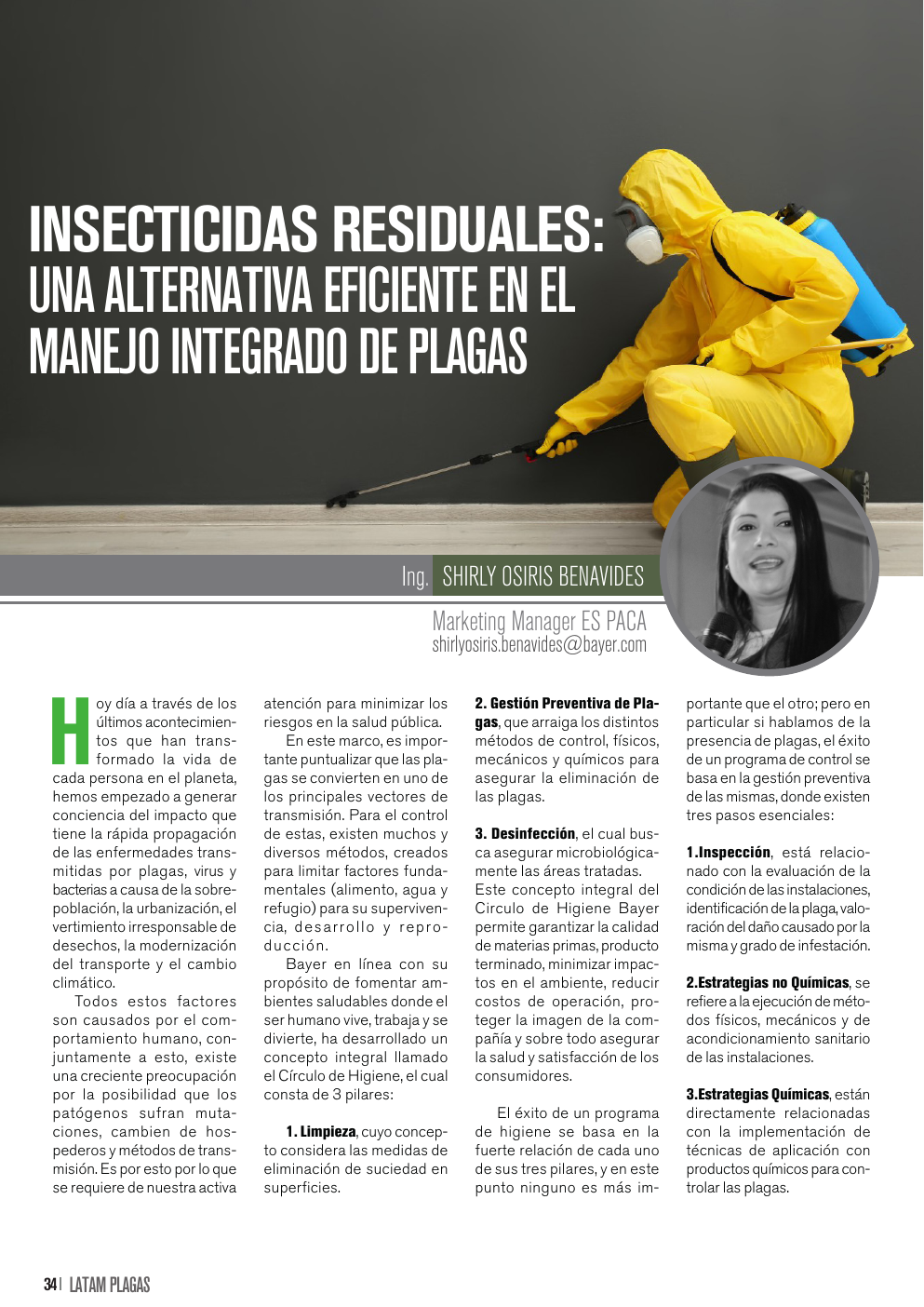
Today, through the latest events that have transformed the lives of every person on the planet, we have begun to raise awareness of the impact of the rapid spread of diseases transmitted by pests, viruses and bacteria due to overpopulation, urbanization, irresponsible dumping of waste, modernization of transportation and climate change. All of these factors are caused by human behavior. Along with this, there is growing concern about the possibility that pathogens may undergo mutations, change hosts and transmission methods. This is why our active
attention to minimize public health risks. In this framework, it is important to point out that pests become one of the main transmission vectors. To control these, there are many and diverse methods, created to limit fundamental factors (food, water and shelter) for their survival, development and reproduction. Bayer, in line with its purpose of promoting healthy environments where human beings live, work and have fun, has developed a comprehensive concept called the Hygiene Circle, which consists of 3 pillars: 1. Cleaning, whose concept considers measures to eliminate dirt on surfaces.
2. Preventive Pest Management, which incorporates different physical, mechanical and chemical control methods to ensure the elimination of pests. 3. Disinfection, which seeks to microbiologically secure the treated areas. This comprehensive concept of the Bayer Hygiene Circle allows us to guarantee the quality of raw materials and finished products, minimize impacts on the environment, reduce operating costs, protect the company's image and, above all, ensure the health and satisfaction of consumers. The success of a hygiene program is based on the strong relationship of each of its three pillars, and at this point none is more important than the other; But in particular if we talk about the presence of pests, the success of a control program is based on their preventive management, where there are three essential steps: 1. Inspection, is related to the evaluation of the condition of the facilities, identification of the pest, assessment of the damage caused by it and degree of infestation. 2. Non-Chemical Strategies, refers to the execution of physical, mechanical and sanitary conditioning methods of the facilities. 3. Chemical Strategies are directly related to the implementation of application techniques with chemical products to control pests.
And it is here, at this stage where a big question arises: What is the best insecticide to control pests? The answer is as diverse as insecticides exist today. However, some basic rules are defined to make an adequate, effective and safe selection. When selecting an insecticide, the inspection stage is essential to define what is really needed. Through this process it is possible to identify the type and life phase of the insect, with which we can choose the chemical group and active ingredient that has the best biocide spectrum on the type of pest. Based on this, a very important step follows: defining the formulation of the pesticide product to be used. The formulation of a pesticide is the mixture of one or more active ingredients, inert ingredients and diluents, the purpose of which is to give stability to the active ingredient and/or make it useful and effective. There are different types of formulations such as: solids, aerosols, baits, water-soluble, gases, liquids, among others. Within the liquid formulations there is especially a formulation with characteristics that favor pest control over long periods of time. The Suspension Concentrate (SC) formulation is a mixture of a solid substance that is dispersed in a liquid substance. This type of formulations has many advantages, however, the most relevant in this type of suspensions is the long-acting effect, that is, the ability of the pesticide to
adhere to a surface for a considerable time, preserving its activity against the pest before its degradation or inactivation. Market trends and current regulations require the safe use of pesticides, fewer applications and minimizing the possibility of insect resistance due to indiscriminate use or misuse of pesticides, however, the development of new insecticides and new molecules is increasingly difficult and expensive. Bayer, as a research and development company, has the mission of providing solutions to maintain food safety and the safety of humans and animals. For this reason, in response to the needs of quality, effectiveness and safety in the service demanded by clients who use the pest control service, it brings to the market a new control alternative, a new product called Temprid® SC. Temprid® SC is a dual action insecticide in concentrated suspension; It is the result of the combination of two active ingredients that synergize, potentiating its insecticidal effect. The innovative Temprid® SC formula has a 2-in-1 effect, it can be used on inert surfaces and vegetation with excellent residuality, acting by contact and systemically. The synergy of Beta-cyfluthrin with Imidacloprid causes the insect to be controlled on the nervous system, in two different ways and at the same time; Imidacloprid acts on the receptors
nicotinics of the insect causing the complete blockage of nerve impulses and Beta-cyfluthrin works at the level of the sodium and potassium channels, increasing the relative potency and generating a knockdown and lethal effect.
Spectrum of Action and Efficacy Temprid® SC is effective against scorpions, spiders, beetles, cockroaches, bed bugs, ants and other pests that are difficult to control with other insecticides. It is widely recommended for the control of the following pests: Temprid® SC acts effectively on pests that are difficult to control such as ants, by
form a residual barrier against workers and eliminate honeydew-producing insects, such as aphids, which provide food to the colony. Below are some results of tests with Temprid® SC for the control of cockroaches, flies, ant and crickets on different surfaces. With the exception of pests, Temprid® SC is practically undetectable in its application, which allows it to be applied without concern, forming a protective barrier indoors and outdoors and on all types of surfaces, maintaining its effectiveness against pests. It can be applied in restaurants, bakeries, hotels, airports, theaters, food and chemical industries, rural and livestock facilities, shopping centers, meat processing plants, means of transportation and residences, among others. The effectiveness and prolonged action of Temprid® SC allow the pest control professional to offer a better guarantee of their services, which includes fewer applications, reduction of operating costs and complaints, establishing greater trust and satisfaction among their clients, thus increasing business opportunities and gaining reputation. Temprid® SC has not only demonstrated its effectiveness in the control of urban pests but also in pests that have a high economic and productive impact in the livestock and poultry industry, where Alphitobius diaperinus can cause structural damage affecting walls, ceilings, coatings, having a direct impact on birds due to reduced weight and productivity, and vectors of avian diseases such as Newcastle disease, enzootic infectious bursalitis, avian influenza, among others. Likewise, they are transmitters of many microorganisms, including pathogens such as Streptococcus spp. , Escherichia coli, Corynebacterium spp. , Staphylococcus aureus, Salmonella typhimurium. This invader of bird houses has a high reproduction rate, an adult can lay between 800 and up to 2,000 eggs. By predilection they are found in humid and warm areas, so they move in large groups between layers of the birds' bedding and under the feeders. When there are no animals, they migrate to the walls and ceilings very quickly. Although it is not possible to obtain 100% control, with the appropriate methodology it is possible to break the biological cycle of this pest and keep it under control. For this, proper water management is recommended, avoiding losses and excess humidity in the litter, avoiding excessive food spills and carrying out chemical control using a product that has activity on larvae and adults, which must be applied to beds, perimeter of the house, feeder lines, beams and lower part of the walls. If the infestation is severe, the treatment carried out during the preparation of the barn or shed will not be sufficient, that is, before the entry of the animals, an application should be considered with birds present in specific places where there is the greatest presence of Alphitobius (under feeders and lower part of the walls). It is recommended
carry out monitoring from the third week of application. Bayer's Temprid® SC is an excellent alternative for controlling this pest. In tests carried out by Bayer to evaluate the effectiveness, it was found that it is a product suitable for
control both in the larval and adult stages. In trials carried out in which the effectiveness of some products from Bayer's portfolio was evaluated, Temprid® SC showed better performance, showing an efficacy between 90% and 97.5% in Alphitobius diaperinus in the larval and adult stages respectively.