
IPM INFO: units of measurement and nomenclature of living beings
Knowing the units of measurement has, among other advantages, making pest control services more precise as well as more productive by avoiding waste, better understanding the recommendations of pesticide...
Technical summary
- Focus
- Knowing the units of measurement has, among other advantages, making pest control services more precise as well as more productive by avoiding waste, better understanding the recommendations of pesticide manufacturers and...
- Approach
- It brings together technical criteria linked to Edición 15, info mip and latam plagas.
- Use
- Useful for professionals who need context, diagnosis and operational decisions in edición 15.
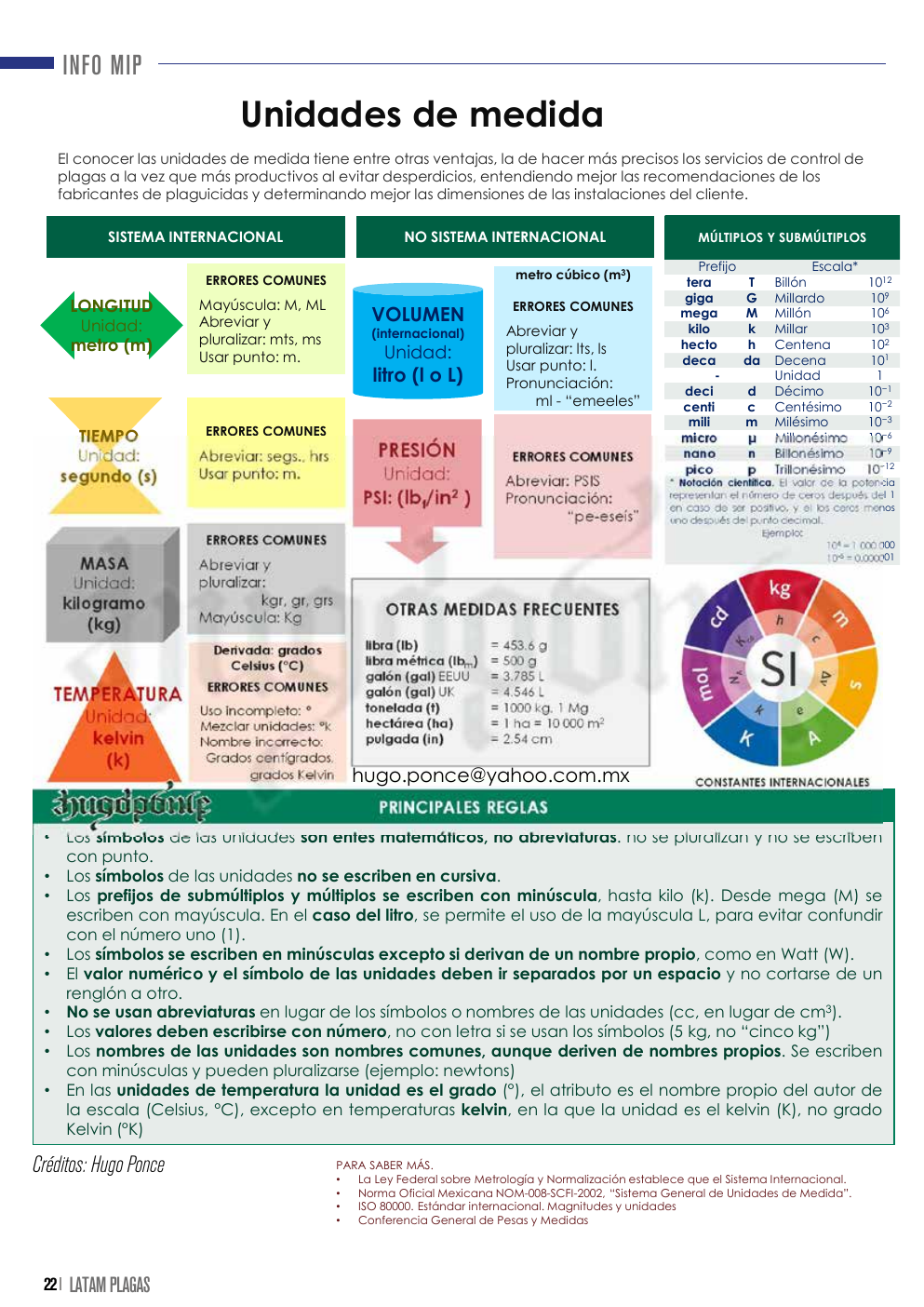
Knowing the units of measurement has, among other advantages, making pest control services more precise as well as more productive by avoiding waste, better understanding the recommendations of pesticide manufacturers and better determining the dimensions of the client's facilities. INTERNATIONAL SYSTEM NO INTERNATIONAL SYSTEM cubic meter (m3) COMMON ERRORS LENGTH Unit: meter (m) TIME Unit: second (s) Capital letter: M, ML Abbreviate and pluralize: mts, ms Use full stop: m. COMMON ERRORS Abbreviate: secs. , hrs Use point: m. VOLUME (international) Unit: liter (l or L) PRESSURE Unit: PSI: (lbf/in2 ) COMMON ERRORS Abbreviate and pluralize: lts, ls Use period: l. Pronunciation: ml – “emeeles” COMMON ERRORS Abbreviate: PSIS Pronunciation: “pe-eseís” COMMON ERRORS MASS Unit: kilogram (kg) Abbreviate and pluralize: kgr, gr, grs Capital letter: Kg Derivative: degrees Celsius (°C) TEMPERATURE Unit: kelvin (k) COMMON ERRORS Incomplete use: ° Mix units: °k Incorrect name: Degrees Centigrade, Degrees Kelvin MULTIPLE AND SUBMULTIPLE Prefix tera Tgiga Gmega Mkilo k hecto h deca da deci d centi c mili m micro µ nano n pico p Scale* Billion Billion Million Thousand Hundred Ten Unit Tenth 10−1 Hundredth 10−2 Thousandth 10−3 Millionth 10−6 Billionth 10−9 Trillionth 10−12 * Scientific notation. The power value represents the number of zeros after 1 if positive, and the zeros minus one after the decimal point. Example: 106 = 1,000,000 10-6 = 0. 000001 OTHER FREQUENT MEASUREMENTS pound (lb) metric pound (lbm) gallon (gal) US gallon (gal) UK ton (t) hectare (ha) inch (in) = 453. 6 g = 500 g = 3. 785 L = 4. 546 L = 1000 kg, 1 Mg = 1 ha = 10,000 m2 = 2.54 cm hugo. ponce@yahoo. com. mx INTERNATIONAL CONSTANTS MAIN RULES
- Unit symbols are mathematical entities, not abbreviations. They are not pluralized and are not written with a period.
- Unit symbols are not italicized.
- Prefixes of submultiples and multiples are written with lower case, up to kilo (k). Since mega (M) they are written with a capital letter. In the case of the liter, the use of the capital letter L is allowed, to avoid confusion with the number one (1).
- Symbols are written in lowercase except if they are derived from a proper noun, as in Watt (W).
- The numerical value and the unit symbol must be separated by a space and not cut from one line to another.
- No abbreviations are used in place of unit symbols or names (cc, instead of cm3).
- Values must be written as a number, not a letter if symbols are used (5 kg, not “five kg”)
- The names of the units are common names, although they are derived from proper names. They are written with lowercase letters and can be pluralized (example: newtons)
- In temperature units the unit is the degree (°), the attribute is the name of the author of the scale (Celsius, °C), except in kelvin temperatures, in which the unit is the kelvin (K), not the degree Kelvin (°K) Credits: Hugo Ponce TO LEARN MORE.
- The Federal Law on Metrology and Standardization establishes that the International System.
- Official Mexican Standard NOM-008-SCFI-2002, “General System of Measurement Units”.
- ISO 80000. International standard. Magnitudes and units
- General Conference on Weights and Measures Nomenclature of living beings Nomina si nescis, perit et cognitio rerum. Linnaeus (If you ignore the name of things, what you know about them also disappears) BINOMINAL SYSTEM Proposed by Carl von Linné (Carl N. Linnæus) in 1735 to 1758 EXTENSIONS Genus (subgenus) species subspecies Author Blatta sp – Unidentified species of Blatta Blatta spp – All species of Blatta Rattus rattus ssp – The subspecies of R. rattus PRONUNCIATION (VULGAR LATIN) hugo. ponce@yahoo. com. mx
- Genus and species (sometimes subspecies is added)
- In italics or underlined
- All lowercase, except first letter of the genus. Complete genus and species are always written in the first mention. The genus may be abbreviated in subsequent mentions. Example: Mus musculus...blah, blah, blah... M. musculus SUFFIX OF SOME SUPRASPECIFIC TAXONOMIC CATAGORIES KINGDOM MIPe Each town or person can have a perception of some living being. The first step to understanding it is almost always to name it. The name someone uses for some insect, for example, will be different from the name someone else uses. If at any time they talk to each other about the same insect, they will think that one is talking about a different one than the other. It is because of situations like this that it is necessary to use the same name for the same organism anywhere in the world. That is the objective of the
- Two syllable words.
- Words of three or more syllables if the penultimate syllable is long (if it ends in a long vowel, diphthong or consonant) ESDRÚJULAS. Only in words of three or more syllables with the penultimate syllable short. Family Tribe ae -eae -ini Examples: Sitophilus orizae – Sitófilus orize Although these entities are not considered living beings, to understand them they have also been classified and, of course, named.
BIOLOGICAL NOMENCLATURE. Blattella germanica Chiripas Jates Chiménes Juanes Tecuejos Cuitas Carpiotas Chulupis INFO PLANTAE PLANTS Phyllum PROTISTA “PROTOZOA” FUNGI FUNGI -phyta ANIMALIA ANIMALS -mycota C l as e -opsida -phyceae -mycetes Subclass -idae -phycidae -mycetidae Order -ales Suborder -ineae Superfamily BACTERIA BACTERIA -acea -oidea -aceae -idae Subfamily -oideae -inae -eae, ae /e/ open ll /l/ c /k/ Ll /y/ ch /k/ ph /f/ eae /e/ open que /kue/ oe /e/ open rh /rr/ g /ga/, /gue/ t /t/, /c/ gn /ñ/ th /t/ strong h silent i /i/ +consonant j /i/ /y/ +vowel or diphthong: ü /i/ consonant+ /y/ y /i/ x /ks/ EXCEPTIONS. When the name derives from a proper name or non-Latinized word. SERIOUS. Most:
ACCORDING TO ICTV CLASSIFICATION. They try to follow models similar to those of living beings, adding the suffix –virus to the genus name. ACCORDING TO BALTIMORE CLASSIFICATION. Based on classifying viruses according to their genome and they receive their name according to the type of DNA or RNA they have. HOW ARE THE NAMES OF LIVING THINGS ASSIGNED? Ideally, the names are intended to be descriptive of the organisms, in some morphological aspect, habits or other distinctive characteristic, known at the time of their description. For example, Ctenocephalides felis was so named because it was believed that its host was cats, but today it is known that they parasitize other hosts even more than said feline. Blattella germanica was called that when cockroaches were still grouped with beetles, its name means small insect that flees from light, the name of the species derives from specimens from a collection in the Danish German territory of Schleswig (today Germany). Something similar happened with Rattus norvegicus, which is not native to Norway but China. Currently they are usually dedicated to people, places or, sometimes, to moments or personal aspects of the author of the name. TO LEARN MORE. International Union of Biological Science (IUBS) Credits: Hugo Ponce International Code of Zoological Nomenclature International Code of Nomenclature of Bacteria International Code of Botanical Nomenclature International Code of Nomenclature of Viruses