Importance of inspections in integrated rodent management
The concept of Integrated Rodent Management involves several steps or stages that must be completed in order to ensure adequate control, and be certain that a good job is being done at the field level.
Technical summary
- Focus
- The concept of Integrated Rodent Management involves several steps or stages that must be completed in order to ensure adequate control, and be certain that a good job is being done at the field level.
- Approach
- It brings together technical criteria linked to Edición 15, inspección and latam plagas.
- Use
- Useful for professionals who need context, diagnosis and operational decisions in integrated management.
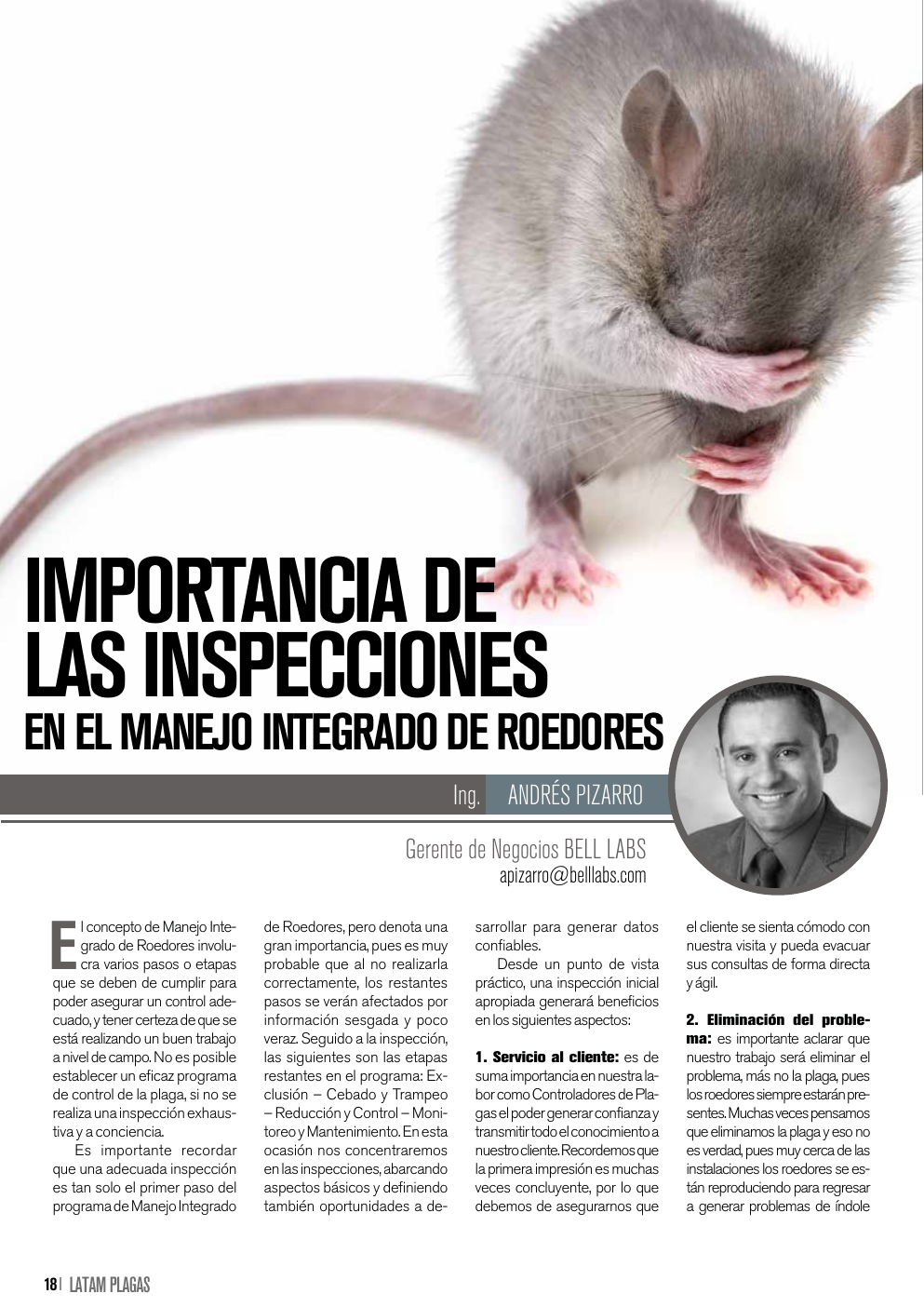
The concept of Integrated Rodent Management involves several steps or stages that must be completed in order to ensure adequate control, and be certain that a good job is being done at the field level. It is not possible to establish an effective pest control program if a thorough and thorough inspection is not carried out. It is important to remember that an adequate inspection is only the first step of the Integrated Rodent Management program, but it is of great importance, since it is very likely that if it is not carried out correctly, the remaining steps will be affected by biased and untrue information. Following the inspection, the following are the remaining stages in the program: Exclusion – Baiting and Trapping – Reduction and Control – Monitoring and Maintenance. On this occasion we will focus on inspections, covering basic aspects and also defining opportunities to develop to generate reliable data. From a practical point of view, a proper initial inspection will generate benefits in the following aspects: 1. Customer service: It is of utmost importance in our work as Pest Management Professionals to be able to generate trust and transmit all the knowledge to our client. Let us remember that the first impression is often conclusive, so we must ensure that the client feels comfortable with our visit and can answer their questions directly and quickly. 2. Elimination of the problem: it is important to clarify that our job will be to eliminate the problem, but not the pest, since rodents will always be present. Many times we think that we have eliminated the pest and that is not true, because very close to the facilities the rodents are reproducing to return to generate health and structural problems. In other words, we can control the problem and for that we must use all available tools (toxic and non-toxic). 3. Prevention of future problems: by generating the necessary truthful information in a first inspection, we will be able to indicate the steps to follow to avoid major problems in the short to medium term. At the end of the day what is sought is for the solution to the problem to be sustainable over time. 4. Overall profitability: We must not forget that the primary purpose is to prevent rodents from continuing to generate losses due to contamination, structural damage, effects due to disease transmission, etc. If we can ensure that our client sees measurable results in their profitability (associated with the decrease in population), we can be sure that we are doing our job well. Likewise, this will generate customer satisfaction, and for our Pest Control company this will also generate profitability and the opportunity to grow with said account. Referring to the tools for an adequate inspection, some of the most used are detailed below: – Flashlight – Black light – UV – Towels – Glasses – Respirator / mask – Gloves – Cell phone / camera – Ruler -Communication with your client / account Personally, I have always considered that communication with our client can be an excellent tool, since an informed client will be a client that is normally satisfied with the service. Direct communication is vital during the inspection, as it can eventually give us the opportunity to resolve some problems at the same time, or failing that, solve them by presenting our integrated rodent management program. OBJECTIVES OF INSPECTIONS There are many objectives that can arise at the time of an inspection, but from my perspective I summarize it in four main objectives: 1. Invest as much time as necessary: it is not possible to carry out a good inspection if we do not receive authorization to carry out our work with some freedom. This takes on greater importance in an initial inspection, since we do not know what we are going to face and we must have enough time to explore both at ground level and at roof level, in the surroundings of the facilities and, if possible, evaluate what is happening in the first control perimeter (adjacent to neighboring land). This important aspect must be negotiated prior to the visit. 2. Identify key factors that help solve the problem: Many times the identification of these factors is relatively simple or obvious, but not all cases are the same, and we can often encounter complicated situations where greater experience and finesse are required when generating the information required for the program. 3. Educate the client during the inspection: this is an aspect that not all Pest Management Professionals keep in mind, but I consider it extremely important because this could be the difference in whether the program is successful or whether the recommendations that we will make in the program are ultimately not followed. Suddenly we may think that it is not necessary to do it or that it will be tedious, but believe me, if you do it you will be a step forward in the implementation of your program and, therefore, in controlling the rodent infestation in the account. 4. Establish clear needs and set realistic goals: you must talk to the client to know their expectations and at the same time it is vital on our part not to generate false expectations. For example, we cannot tell the client that we will control the rodent infestation in a week, because we cannot be sure of that. There are cases where we can control in an accelerated manner, but NOT all cases are the same. We must remember that rodents adapt very easily to different circumstances, so it is often necessary to modify the control program initially established. FACTORS TO IDENTIFY IN AN INSPECTION There are many factors that we can identify in an inspection, but on this occasion we will focus on the main ones that are frequently found: Sebum: sebum is nothing more than a combination of the fat present in the dermis of the rodent, in combination with its dirt. Sebum creates marks on the rodent's passage routes, so it should be an important aspect to take into consideration during the inspection. These marks can normally be seen near pipes, cables, corners, and places where there is clearly identifiable structural damage. Gnawing: Rodents gnaw on virtually everything they encounter. It is part of their biology, since their incisors grow on average 2.27 cm per month (in rats), so they must constantly wear them down. On the other hand, rats can bite through: plastic, brick, copper, wood, cement, lead, aluminum, asbestos, and even steel, so it is quite likely that we will be able to identify such damage in our inspection. Likewise, it is important to emphasize that rodents frequently gnaw on electrical cables, which creates fire risks. Excrement: the excrement that we can identify in inspections are indicators of several aspects such as the direction of movement of the rodents, the size of the colony (s), the species present at the problem site, and whether the rodents are reproducing (among many others). In general terms, we can identify the feces of synanthropic rodents with some basic characteristics: Norway Rat – they are larger and rounder, Roof Rat – they are more elongated and pointed, House Mouse – they are the smallest and elongated. It is important to emphasize that in some cases a combination of two or even more species will occur in a single point of infestation, so it is possible to observe a mixture of all types of excrement in said place. Urine: Urine samples are a clear indicator of the rodent's passage route, and it is clearly identifiable by the strong smell of ammonia at certain points of the inspection (“hot spots”). Urine (like excrement) is a source of contamination and efforts should be made to eliminate the problem as soon as possible (remember that rodents are transmitters of more than 50 infectious agents). Particularly contamination with urine is a complex issue, since, to cite an example, the House Mouse can produce up to 5.6 ml of urine per day, distributing it in many distant points and generating even more dissemination of the contamination. In general, inspection is a vital step and as we review in this article, it should be taken with the seriousness of the case. It is clear that the primary objective will always be to reduce the infestation of the rodent pest, but to achieve this it is unlikely to be successful if a good inspection is not carried out, which generates the necessary information for the development of the Integrated Rodent Management program. A practical tip is to follow the steps detailed in this article, and work consciously to identify all the factors that give us an opportunity to control the pest. In conclusion, rodents are a pest that is constantly adapting and has an impressive capacity to evolve quickly, so we as Pest Management Professionals must also be agents of change and be dynamic when offering our services. And let us never forget that rodents consume what human beings throw away, so it is a matter of raising awareness and being able to convey this aspect to our clients, so that everyone is on the same page.