
Identification of scorpions of importance in Argentina
400 million years ago there were giant scorpions in the seas, the Eurypterids. As time went by, they colonized the land and decreased in size, but they obtained a lethal poison to obtain their prey and feed.
Technical summary
- Focus
- 400 million years ago there were giant scorpions in the seas, the Eurypterids.
- Approach
- It brings together technical criteria linked to Edición 2, argentina and escorpiones.
- Use
- Useful for professionals who need context, diagnosis and operational decisions in edición 2.
400 million years ago there were giant scorpions in the seas, the Eurypterids. As time went by, they colonized the land and decreased in size, but they obtained a lethal poison to obtain their prey and feed. They are distributed throughout the world except at the poles and in high mountains.
To situate ourselves in the taxonomy of scorpions we can say that they belong to the Phylum Arthropoda, Subphylum Chelicerata, Class Arachnida, Order Escorpionida and Family Buthydae.
Arachnids are characterized by having their body divided into two parts: cephalothorax and abdomen. They have articulated thoracic appendages called chelicerae and other pedipalps, as well as four pairs of legs. Within the Arachnida class we can find spiders and scorpions, individuals that are characterized by having venom that they use to immobilize their prey.
When we talk about scorpions or scorpions we are talking about the same individual; It does not correspond to different sizes or danger. Around 1,500 species of scorpions are recognized and in the world only few are truly dangerous to humans. These are from the Buthydae family, a family that is recognized by the following diagnostic characters: most species have a triangular sternum, as well as a subacular process below the stinger, which can be acute, rhomboid or pyramidal; They also have elongated hairs called trichobothriae on the tibias of the pedipalps, which they use to recognize the vibrations of their prey.
To recognize a scorpion we can see that it has four pairs of legs and two pedipalps that are larger. In its oral opening it has two chelicerae that it uses to feed along with the pedipalps. In its caudal part we observe an expansion of the abdomen, the tail, ending in a nail or spike, the telson, connected to a poison gland.
Both males and females have venom glands, which they use to immobilize their prey. It is made up of water, salts, small molecules, peptides and proteins. Peptide toxins are the most active compounds in the venom.
Scorpions are known to produce venom to immobilize their victims, for food, or to defend themselves. It takes three weeks after a bite to replace the venom. To avoid this period of helplessness they also produce a pre-poison with a different chemistry. This pre-venom is easier for the scorpion to produce and more effective at paralyzing its prey. Scorpions use this faster, more efficient pre-venom at first for defensive maneuvers and, if the threat persists, switch to the more potent venom. Venom is simply a very successful tool for immobilizing its prey and warding off predators.
In Argentina there is a species that has poison enough to threaten human life, and it is known as Tityus trivittatus. The others can threaten human life through allergic reactions, such as possible anaphylactic shock. The distribution of Tityus trivittatus It includes Buenos Aires, Entre Ríos, Santa Fe, Córdoba, La Rioja, Santiago del Estero, Tucumán, Chaco and Corrientes.
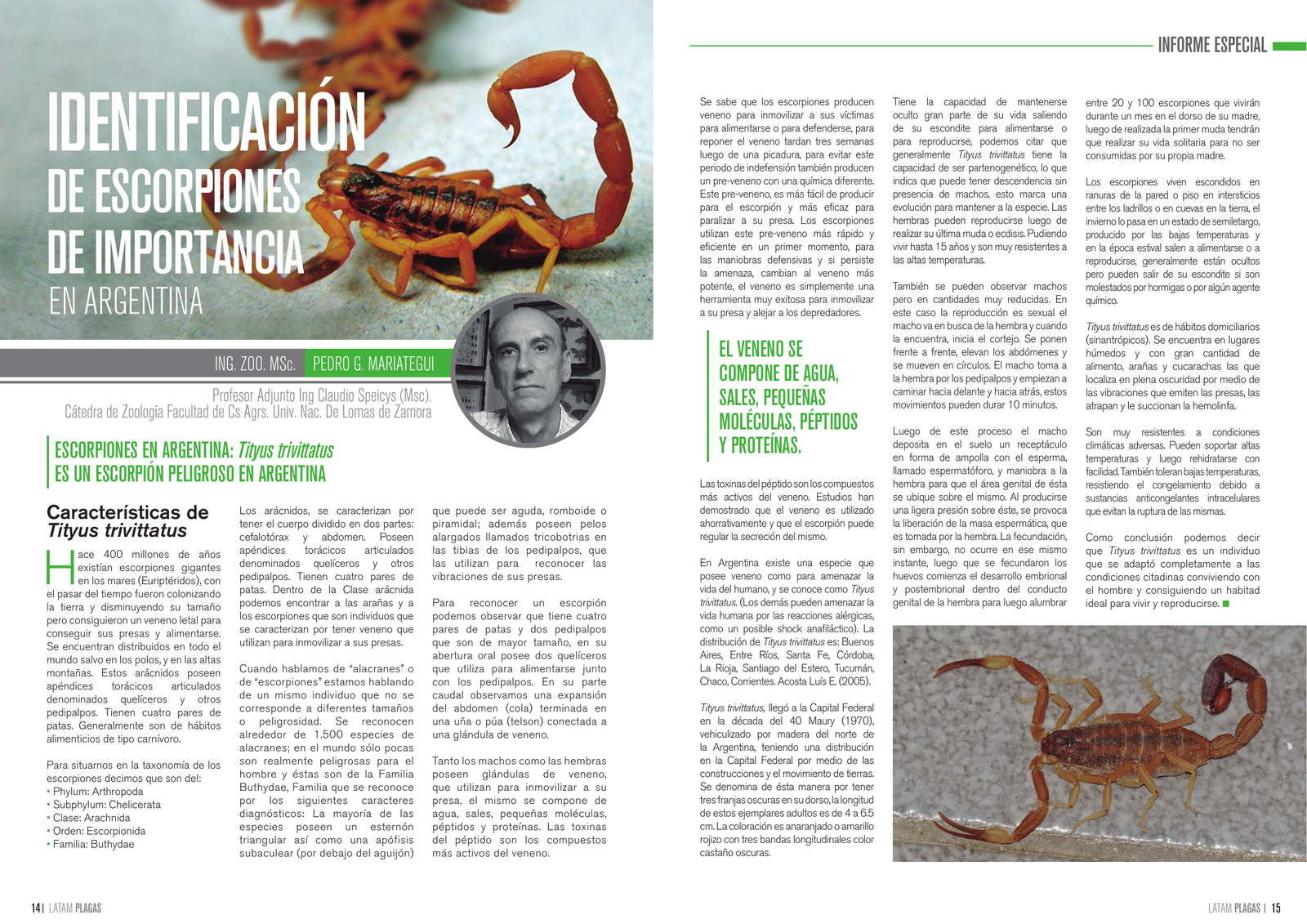
Tityus trivittatus It arrived to the Federal Capital in the 1940s, transported by wood from northern Argentina, having a distribution in the Federal Capital through construction and earthworks. It is named this way because it has three dark stripes on its back. The length of these adult specimens is 4 to 6.5 centimeters and the color is orange or reddish yellow with three dark brown longitudinal bands.
It has the ability to remain hidden for much of its life, coming out of hiding to feed or reproduce. Generally Tityus trivittatus It has the ability to be parthenogenetic, which indicates that it can have offspring without the presence of males. This marks an evolution to maintain the species. Females can reproduce after making their last molt or ecdysis, and can live up to 15 years and are very resistant to high temperatures.
Males can also be seen, but in very small numbers. In this case, reproduction is sexual: the male goes in search of the female and when he finds her, he begins courtship. They face each other, raise their abdomens and move in circles. The male takes the female by the pedipalps and they begin to walk back and forth. These movements can last 10 minutes. After this process, the male deposits a blister-shaped receptacle with the sperm, called spermatophore, on the ground and maneuvers the female so that her genital area is located on it. When slight pressure is produced on it, the sperm mass is released, which is taken by the female. Fertilization, however, does not occur at that same moment; After the eggs have been fertilized, embryonic and post-embryonic development begins within the genital duct of the female to then give birth to between 20 and 100 scorpions that will live for a month on the back of their mother. After the first molt is made, they will have to live their solitary life to avoid being consumed by their own mother.
Scorpions live hidden in grooves in the wall or floor, in gaps between bricks or in caves in the ground. They spend the winter in a semi-dormant state caused by low temperatures and in the summer they go out to feed or reproduce. They are generally hidden, but can come out of hiding if disturbed by ants or a chemical agent.
Tityus trivittatus It has domiciliary, synanthropic habits. It is found in humid places with a large amount of food, spiders and cockroaches, which it locates in complete darkness through the vibrations emitted by the prey. It traps them and sucks their hemolymph.
They are very resistant to adverse weather conditions. They can withstand high temperatures and then rehydrate easily. They also tolerate low temperatures, resisting freezing due to intracellular antifreeze substances that prevent their rupture.
In conclusion we can say that Tityus trivittatus It is an individual that completely adapted to city conditions, coexisting with man and achieving an ideal habitat to live and reproduce.