
Pharaoh ant: Monomorium pharaonis
Pharaoh ants are very small and yellow. Its thorax is typically darker, which helps locate this ant.
Technical summary
- Focus
- Its thorax is typically darker, which helps locate this ant.
- Approach
- The article structures the analysis around Main features, Customs and Biological data.
- Use
- Useful for professionals who need context, diagnosis and operational decisions in edición 5.
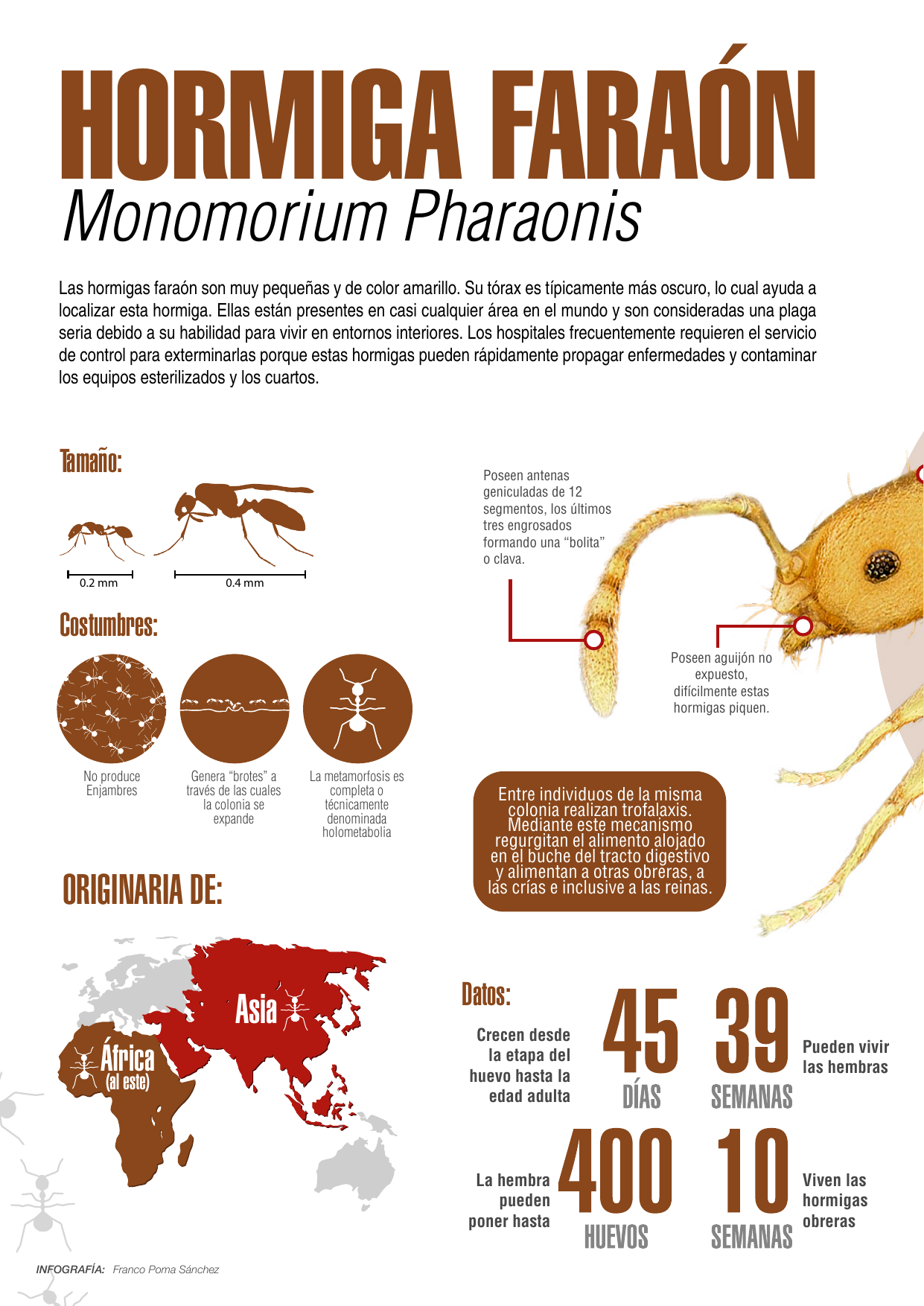
Pharaoh ants are very small and yellow. Its thorax is typically darker, which helps locate this ant. They are present in almost any area of the world and are considered a serious pest due to their ability to live in indoor environments. Hospitals often require control services to exterminate them because these ants can quickly spread disease and contaminate sterilized equipment and rooms.
Main features
- Size: between 0.2 mm and 0.4 mm depending on stage and caste.
- Antennas: geniculate with 12 segments, the last three thickened forming a “little ball” or club.
- Sting: not exposed; These ants hardly bite.
Customs
- They do not produce swarms.
- They generate “buds” through which the colony expands.
- The metamorphosis is complete, technically called holometaboly.
- Between individuals from the same colony they perform trophallaxis. Through this mechanism they regurgitate the food lodged in the crop of the digestive tract and feed other workers, the offspring and even the queens.
Origin: East Africa and Asia.
Biological data
- They grow from the egg stage to adulthood in approximately 45 days.
- Females can live up to 39 weeks.
- The female can lay up to 400 eggs.
- Worker ants live around 10 weeks.
Life cycle
- Eggs: 5 to 6 days.
- Larva: 22 to 24 days.
- Pupa: 11 to 15 days.
- Adult: final stage of the cycle.
Morphologically they are recognized by being small and light brown or yellowish in color. They lack dorsal spines at the level of the thorax and their abdominal petiole is formed by two clearly visible segments.
Anthills are characterized by having numerous queens. The workers are identical to each other and are called monomorphic. They are omnivores, although they prefer liquid sugary substances, honey, syrup, jellies and sweets, or solid ones, such as sugar, cookies and alfajores.
Source: https://www.ento.psu.edu/extension/factsheets/es/es-german-cockroaches