
ticks
At the moment, in our country, there is a social alarm completely founded by the appearance in the press of continuous reviews about ticks and the consequences caused by their bites, since they are capable of...
Technical summary
- Focus
- At the moment, in our country, there is a social alarm completely founded by the appearance in the press of continuous reviews about ticks and the consequences caused by their bites, since they are capable of transmitting a...
- Approach
- It brings together technical criteria linked to Edición 13, garrapatas and latam plagas.
- Use
- Useful for professionals who need context, diagnosis and operational decisions in public health and vectors.
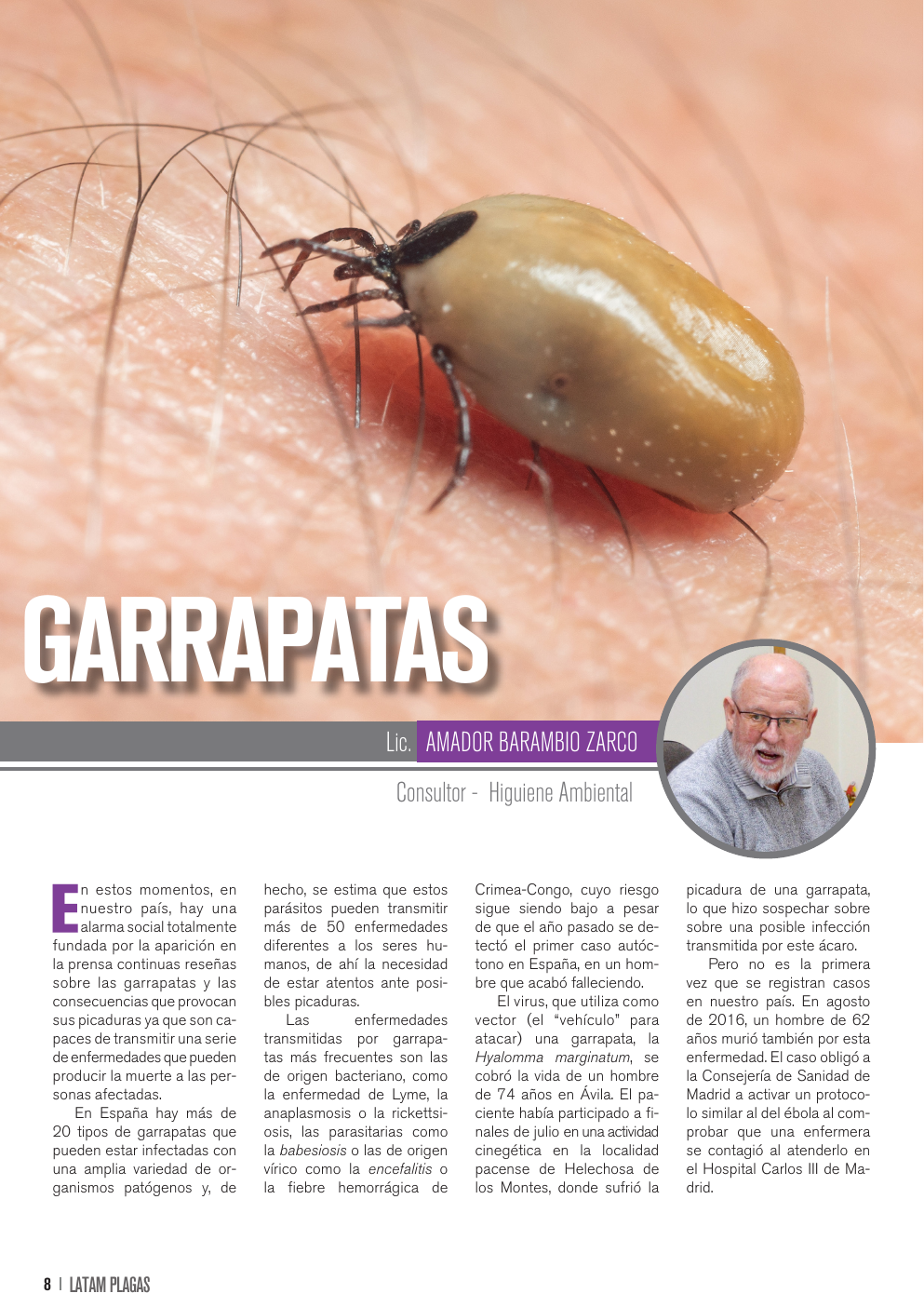
At the moment, in our country, there is a social alarm completely founded by the appearance in the press of continuous reviews about ticks and the consequences caused by their bites, since they are capable of transmitting a series of diseases that can cause death to the affected people. In Spain there are more than 20 types of ticks that can be infected with a wide variety of pathogenic organisms and, in fact, it is estimated that these parasites can transmit more than 50 different diseases to humans, hence the need to be alert to possible bites. The most common diseases transmitted by ticks are those of bacterial origin, such as Lyme disease, anaplasmosis or rickettsiosis, parasitic diseases such as babesiosis or those of viral origin such as encephalitis or Crimean-Congo haemorrhagic fever, the risk of which remains low despite the fact that last year the first indigenous case was detected in Spain, in a man who ended up dying. The virus, which uses a tick, Hyalomma marginatum, as a vector (the “vehicle” to attack), claimed the life of a 74-year-old man in Ávila. At the end of July, the patient had participated in a hunting activity in the Badajoz town of Helechosa de los Montes, where he suffered a tick bite, which raised suspicions about a possible infection transmitted by this mite. But it is not the first time that cases have been recorded in our country. In August 2016, a 62-year-old man also died from this disease. The case forced the Madrid Health Department to activate a protocol similar to that of Ebola when it verified that a nurse was infected while treating him at the Carlos III Hospital in Madrid. As a result of that death, the Ministry of Health began a study to identify the presence of the Crimea-Congo virus in Spain and, according to the data presented, hundreds of infected ticks have been detected in Madrid, Castilla y León, Extremadura and Castilla-La Mancha, after more than 9,500 of the 'Hyalomma' genus were analyzed. Researcher Horacio Gil, from the National Microbiology Center of the Carlos III Health Institute, has acknowledged that the study revealed an extension of the virus "wider than expected" in Spain, although, despite this, the risk of contagion to humans remains low. Other pathologies transmitted by ticks such as Lyme disease are more frequent, with about 70,000 new cases each year in Europe, and although there are no official records in Spain, it is estimated that there could be about two cases per 100,000 inhabitants. This pathology is caused by the 'Borrelia' bacteria and is transmitted by ticks of the Ixodes genus, which can also cause rickettsiosis, which is less common, with about 0.56 cases per 100,000 inhabitants in Spain. Despite this low incidence, health authorities have recognized that seroprevalence studies carried out in different regions have detected the presence of antibodies against these bacteria in up to 14 percent of the population analyzed, which reveals that "they may have been exposed to this microorganism." The problem with all these pathologies is that they do not always cause symptoms and, when they do, they produce non-specific clinical symptoms, which makes their diagnosis and treatment difficult. "Patients do not know that they have been bitten by a tick," the experts have acknowledged. LET'S KNOW A LITTLE ABOUT THESE ARTHROPODS: They are of the order Acarina, the same one to which mites belong, but much larger than these, and can be identified with the naked eye without the need for a microscope, since they measure 10 to 15 mm. but they can measure up to 3 cm. when they are full of blood. There are two different families: Ixodidae (Hard ticks). They have a dorsal shield that differentiates them from those with soft bodies; They lay only once among 2,000 to 10,000 eggs, eating a single meal before deposition, and then die. The male dies after mating on the host. Argasidae (Soft ticks). Although they prefer warm climates, they can live in other types of climates. They usually come out at night and suck blood several times, hiding in cracks or crevices during the day. Its oviposition is about 2000 eggs. Its body does not have a shield, presenting roughness. Ticks are temporary parasites that feed exclusively on the blood of vertebrates. In its development cycle, there are 3 phases: larva (3 pairs of legs), nymph (4 pairs of legs) and adult. To move from one stage to another they must feed on blood, the only time in which they have contact with the host and which lasts between 3 and 10 days, and in some cases up to several months. They detect their host through a sensory organ on their legs and once there they move looking for areas with less hair density such as the abdomen, face or ears. BIOLOGICAL CYCLE AND DISTRIBUTION Eggs are laid on the ground, in areas of dense vegetation. These eggs hatch in 2 weeks under adequate humidity and temperature conditions and up to several months if conditions are not favorable for the development of arthropods. Depending on the species of tick, they can lay up to 10,000 eggs. The larvae that emerge from the eggs move in search of their first host, which is generally a bird or rodent. As it is not easy for them to find a host, they can spend long periods of time without feeding, even up to more than a year. After a few days feeding, it returns to the ground where it molts into the next stage, the nymph, which will return to look for another host. To become adults they must return to the ground. Adults usually mate on the host animal, but egg laying occurs on the ground. During the winter, the males die and the females remain inactive until spawning in spring. Adults spend a large part of their life waiting for a host that they can detect by vibrations, by their shadow or by the Carbon Dioxide emitted in respiration, which is why we can find them on the tips of herbs and plants for grazing by herbivorous animals, and on the leaves of plants. They feed on mammals, birds, reptiles and amphibians. Its mouth is perfectly formed to perform three functions, such as sucking, stinging and biting. It is thanks to its hispostome with well-developed teeth that it can attach itself to the host, first breaking the skin, then inserting its hypostome and fixing itself with the hooks. Its fixation in the host is so solid that we will need ether or oily substances such as fat, oil, Vaseline, etc. for it to release, as its airways become plugged, still needing about 15 minutes to completely detach. Use fine-tipped tweezers, not any other inappropriate utensil, since there is a great risk of not removing the entire animal, which could cause inflammation. As it is not easy for them to find a host, they can spend long periods of time without feeding, even up to more than a year. When it finds it, it sucks blood and becomes an adult. This last nymph is very similar to the adult except that it does not have a genital opening. Adults spend a large part of their lives waiting for a host that they can detect by vibrations, by their shadow or by the Carbon Dioxide emitted in respiration, which is why we can find them on the tips of herbs and plants for grazing by herbivorous animals, and on the leaves of plants. They feed on mammals, birds, reptiles and amphibians. The distribution of these parasites is worldwide. They can survive temperatures of -15º under snow that acts as a protective blanket. Low humidity significantly reduces the viability of the eggs. The most common species in our country are Ixodes ricinus, Dermacentor marginatus, Rhipicephalus sanguineus and Hyaloma marginatum. There are many diseases of varying severity that ticks can transmit, such as borreliosis (Lyme disease), rickettsiosis (button fever) or erchlichiosis. IMPORTANCE IN PUBLIC HEALTH The diseases they transmit are the following: colder areas of Asturias and Cantabria. However, in Sweden its presence has increased substantially since the mid-1980s due to the increase in global temperatures. Button fever is an infectious disease caused by Rickettsia that begins with sudden fever, photophobia, joint pain, myalgia and malaise. Lyme disease is caused by the bacteria Borrelia bugdorferi which is characterized by a skin rash and continues with fever, chills, headaches, fatigue and muscle aches. In a later stage it can lead to arthritis and nervous system problems, even producing ALS. The tick can also produce paralysis of the host by inoculating it with a neurotoxin. It is a very rare disease, but with fatal consequences. It generally affects children under 10 years of age and can cause death due to respiratory paralysis. It begins with weakness of the lower extremities and ascends symmetrically to involve the trunk, arms and head. The symptoms disappear with the removal of the tick. We must not also forget the pain caused by their bite and the subsequent complications that may arise. In Galicia and, in general, throughout the Atlantic and Cantabrian coast, it is the area of Spain where the highest number of cases of allergy to red meat have been recorded, a reaction that occurs after a tick bite and that has multiplied in the United States in recent years. The risk is real and is not associated with a single species of tick, although some authors point to the species Amblyomma americanum. The particularity of this allergy, in addition to its cause, is that the body's reaction time is not immediate, but rather occurs a few hours after ingesting the food. The Spanish Society of Allergology and Clinical Immunology (SEAIC) assures that it is a type of allergy that can occur in almost the entire country, although in the northwest is where more cases have been described, while in the Mediterranean area it is less common. – Weed typhus. – Mediterranean exanthematous typhus. – Central European encephalitis. – Hispanic-African relapsing fever. – Ume disease. – Lyme disease. – Rickettsiosis. – Tularemia. – Recurrent fevers, etc. In Spain the most common diseases are button fever and Lyme disease. Rhipicephalus sanguineus is the most common dog tick implicated in the transmission of spotted fever and Ixodes ricinus in Lyme disease. This last species is very sensitive to climate warming and is expected to surely disappear from our country, although relict populations could remain in the PREVENTION There is a connection between diseases transmitted by ticks and the individual's profession or place of residence. The risk group most likely to be infected are people who work in parks and gardens or in recreational areas, as well as those hunters and hikers who move through wild terrain where livestock or wild animals circulate. It is important to carry out a visual search for the presence of these parasites in our body after having stayed in a risk area. Early detection is essential to prevent the spread of diseases. In 48 – 72 hours the nymphs; that they have more infective capacity than adults; can transmit infectious agents to the host. It is best to prevent its appearance by using one or more antiparasitic products on the environment and on the dog. Fenvalerate is not harmful to the environment and can be used for outdoor enclosures used by the animal. Inside the house, special attention must be paid to windows and doors where juvenile forms of ticks can accumulate. Fipronil is effective in dogs in its various presentations: pipettes, sprays, etc. It begins to take effect 48 hours after application and protects against reinfestation for 5 weeks. Amitraz collars are also useful on dogs with some aquatic activity. Ticks are located on dogs most frequently on the head, ears, neck and legs. To extract them, you must follow the following instructions:
- Use fine-tipped tweezers to grab the tick near its head or mouth, being careful to wear gloves.
- Pull the parasite out with a slow, firm motion, do not crush or tear it.
- Later wash area with soap and water. WHAT PRECAUTIONS TO TAKE AGAINST TICKS?
- Avoid wooded areas or areas covered with grass and bushes, especially in May, June and July.
- Wear light-colored clothing so you can see any ticks that attach to you.
- Wear long pants and a long-sleeved shirt, as well as shoes that cover the entire foot.
- Tuck the pants into the tights or socks, or into the shoes, and the shirt into the pants.
- Wear a hat for additional protection.
- Spray an insect repellent on clothing and exposed skin.
- Walk in the center of the paths to avoid bushes and grass.
- Remove clothing and wash and dry at high temperatures after being outdoors.
- Carefully examine the body for ticks after outdoor activities. BIBLIOGRAPHY
- ANECPLA. 2003. Urban pest control: Procedure manual. National Association of Pest Control Companies.
- Bonnefoy, X. et al. 2008. The public health significance of urban pests. Chartered Institute of Environmental Health, London.
- Army General Staff. 1994. Guidelines. Veterinary disinfection, disinfestation and deratization material (DDD.) OR6-602. Internal document, Printing Office of the Army Geographic Service, Madrid.
- Estrada Peña, A. 1994. Ticks in Spain: introduction. Ministry of Health and Social Welfare, Junta de Castilla y León, Valladolid.
- Lucientes, J. 2014. Module 2. Control of Invertebrates Not Insects. In: Selfa J. (Dir), Animal Pest Control in Urban Environment, 3rd edition, Universitat de València, Distance Postgraduate Training, University Professional Specialization Diploma, Ed. Alfa Delta Digital, S. L, Valencia.
- Mourier, H., O. Winding & E. Sunesen. 1979. Guide to parasitic animals in our homes. Omega Publishing House, Barcelona.
- Mullen, G. R. & L. A. Durden (Eds). 2009. Medical and Veterinary Entomology. Second Edition, Academic Press, San Diego (California).
- Smith, E. H. & R. C. Whitman. 2003. NPMA Field Guide to Structural Pests. National Pest Management Association & BASF, Durham, USA. http: //argosportalveterinaria. com/ http: //phil. cdc. gov/phil/details. asp https: //www. abc. es/sociedad/abci-ticks-can-transmit-more-50-different-human-diseases-201704251507_news. html https: //www. abc. es/sociedad/abci-hemorrhagic-fever-crimea-congo-and-other-exotic-diseases-come-spain-to-stay-201808100249_ news. html http: //madridsalud. en/ticks/ https: //www. lavozdegalicia. es/news/society/2018/12/19/red-meat-allergies-increase-cause-tick-bite/0003_201812G19P25992. htm