
Bug out! Aedes aegypti and repellents
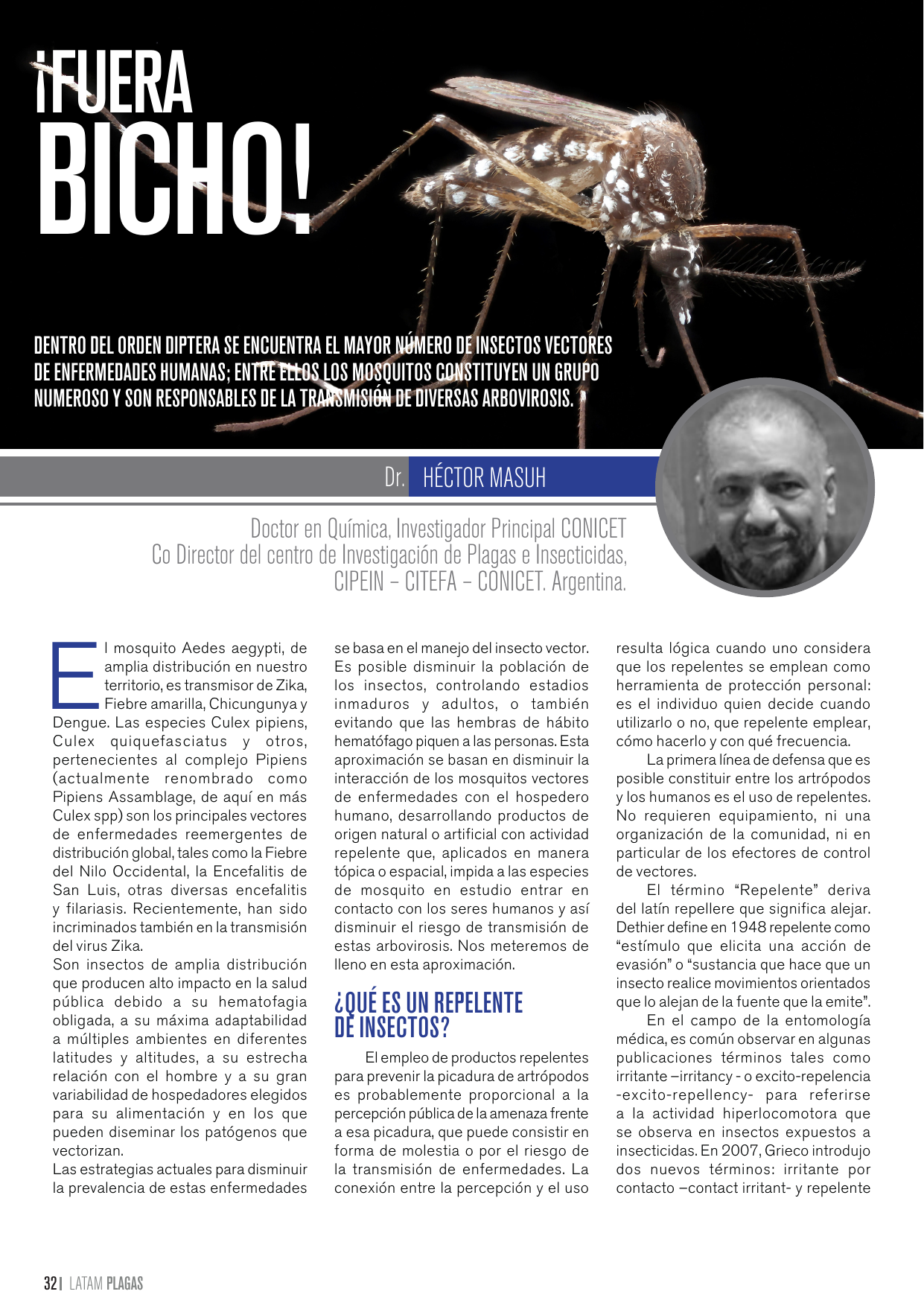
Within the order Diptera there is the largest number of insect vectors of human diseases; Among them, mosquitoes constitute a large group and are responsible for the transmission of various arboviruses..
Technical summary
- Focus
- Within the order Diptera there is the largest number of insect vectors of human diseases; Among them, mosquitoes constitute a large group and are responsible for the transmission of various arboviruses.
- Approach
- The article structures the analysis around What is an insect repellent?, What type of repellents are available in our environment? and Conventional synthetic repellents.
- Use
- Useful for professionals who need context, diagnosis and operational decisions in public health and vectors.
Index
Within the order Diptera there is the largest number of insect vectors of human diseases; Among them, mosquitoes constitute a large group and are responsible for the transmission of various arboviruses.
The mosquito Aedes aegypti, widely distributed in our territory, is a transmitter of Zika, Yellow Fever, Chikungunya and Dengue. The species Culex pipiens, Culex quinquefasciatus and others, belonging to the Pipiens complex, currently renamed Pipiens Assemblage, are the main vectors of re-emerging diseases with global distribution, such as West Nile Fever, St. Louis Encephalitis, various other encephalitis and filariasis. Recently, they have also been incriminated in the transmission of the Zika virus.
They are widely distributed insects that produce a high impact on public health due to their obligate hematophagy, their maximum adaptability to multiple environments at different latitudes and altitudes, their close relationship with humans and their great variability of hosts chosen for their feeding and in which they can disseminate the pathogens they vector.
Current strategies to reduce the prevalence of these diseases are based on the management of the insect vector. It is possible to reduce the population of insects, controlling immature and adult stages, or also preventing females with a blood-sucking habit from biting people. This approach is based on reducing the interaction of disease vector mosquitoes with the human host, developing products of natural or artificial origin with repellent activity that, applied topically or spatially, prevent the mosquito species under study from coming into contact with humans and thus reduce the risk of transmission of these arboviruses.
What is an insect repellent?
The use of repellent products to prevent arthropod bites is probably proportional to the public perception of the threat of said bite, which may be in the form of annoyance or the risk of disease transmission. The connection between perception and use is logical when one considers that repellents are used as a personal protection tool: it is the individual who decides when to use it or not, what repellent to use, how to do it and how often.
The first line of defense that can be established between arthropods and humans is the use of repellents. They do not require equipment, nor a community organization, nor particularly vector control effectors.
The term “repellent” derives from Latin repellere, which means to move away. In 1948, Dethier defined repellent as “a stimulus that elicits an evasive action” or “a substance that causes an insect to make oriented movements that distance it from the source that emits it.”
In the field of medical entomology, it is common to observe in some publications terms such as irritant or excito-repellent to refer to the hyperlocomotor activity observed in insects exposed to insecticides. In 2007, Grieco introduced two new terms, contact irritant and spatial repellent, to refer to those chemical compounds that cause an insect to move away from the source of the stimulus, through touch or smell respectively.
The mode of action of repellents is still a controversial issue. However, electrophysiological studies and molecular approaches have meant a great advance in the knowledge of how repellent substances exert their action. For example, DEET masks the response of olfactory receptors to attractants. This idea is supported by the observation that DEET decreases sensitivity to both lactic acid, a component of human sweat, and ethyl propionate, an oviposition attractant.
Chemical or synthetic repellents are recognized as the most effective in terms of activity and duration. Some of them are absorbed and reach the blood, although adverse reactions are rare.
An ideal repellent should be effective, long-lasting and repel a wide spectrum of insects; safe, non-toxic, non-irritating and low absorption; with good cosmetic conditions, colorless, odorless and pleasant to the skin; compatible with other materials, which is not a solvent for plastics; and easy to formulate, with good solubility, high stability and no corrosiveness. No repellent available has all of these properties, although there are different products that have some of these characteristics.
What type of repellents are available in our environment?
According to different international organizations, topical insect repellents can be classified into categories: conventional synthetic repellents, repellents of biological origin and space repellents.
Conventional synthetic repellents
DEET (NN, diethyl-3-methylbenzamide or NN, diethyl-m-toluamide)
N,N-diethyl-m-toluamide, the active ingredient in most commercial repellents, is a molecule used for several years around the world against blood-sucking insects. It is the reference standard for repellents recommended by the WHO. It is effective for most species of insects and arachnids.
However, its use has some disadvantages: unpleasant odor, penetration through the skin and even potentially carcinogenic effects have been reported, resulting in extreme conditions under excessive use. In addition, DEET reacts with certain plastics and synthetic rubbers, attacking them considerably.
Despite its great effectiveness, alternative repellents to DEET are being sought, given that data has been reported that raises doubts about its toxicological safety. DEET has been blamed for causing encephalopathies in children and neurotoxicity; However, these events are rare and were generally linked to excessive or misuse of DEET.
Icaridin (carboxylated hydroxyethyl isobutyl piperidine)
It is a derivative of pepper, used in concentrations ranging between 10 and 20%, which is active against ticks, mosquitoes and flies. Specifically, in some studies using concentrations equal to or greater than 20%, it has been observed that it presents protection against mosquito species of the genera Aedes, Culex and Anopheles for 6 hours.
It has a very low toxicity, is not greasy and the smell is not unpleasant. Does not damage plastics or fabrics.
Repellents of biological origin
Citronella
It is a plant-based essential oil found in many plant-based insect repellents. Citronella oil is extracted from plants Cymbopogon nardus and Cymbopogon winterianus. The exact mechanism by which repellent activity occurs is unknown.
In general, citronella-based repellents provide considerably less protection time than repellents with DEET; therefore, they require more frequent applications to maintain effectiveness. Citronella oil is not very toxic and its topical application does not usually cause adverse reactions. In our environment, citronella is normally sold in association with other more effective repellents.
Citriodiol or PMD (p-methane-3,8 diol)
It is obtained from a variety of Eucalyptus (Eucalyptus citriodora) that generates a chemical compound with repellent capacity. There are studies that show that preparations with 20% citriodiol could be equivalent in effectiveness and duration of action to 20% DEET preparations.
Some formulations in concentrations of 30% offer protection against mosquito species of the genera Aedes, Culex and Anopheles for 4 to 6 hours. This compound is a good repellent for many insects and arachnids: mosquitoes, flies, lice, fleas and ticks. It has a pleasant smell, does not present significant adverse effects, but can cause eye irritation.
In general, topical or spatial formulation of repellent substances of natural origin is possible, with proven effectiveness measured in repellent capacity and residuality comparable to synthetic repellents currently formulated on the market. These substances may be formulated as blend of components or enriched in those compounds that demonstrate greater activity. Many of these oils also come from species of Eucalyptus.
The chemical composition of the components of essential oils of plant species presents marked differences not only between species, but also according to the conditions where the plant develops, the time of year, the growing conditions. stress to which the plant has been subjected and the attack by xylophagous species, among other factors.
IR3535
IR3535, ethyl 3-N-butyl-n-acetyl aminopropionate, is a synthetic insect repellent that is additionally classified as a biopesticide by the EPA. The agency has classified IR3535 as a biochemical substance based on the fact that it is functionally identical to beta alanine: both repel insects and the end groups of IR3535 are not likely to contribute to toxicity.
IR3535 is active against mosquitoes, ticks and biting flies. There are studies that show protection of 70 to 90 minutes against species of Aedes in concentrations greater than 20% and between three and a half to six and a half hours against species of the genus Culex. Protection against ticks has been established to last between 30 minutes and 4 hours at a concentration of 7.5%.
It should be noted that for species of Anopheles, mosquito that transmits malaria, the protection time is about 3 hours. This means that it is not recommended in malaria endemic areas. The toxicity of this repellent is minimal and only mild skin reactions have been reported so far. It should be noted that it is an eye irritant.
Space repellents
Space repellents are substances that in the gas phase prevent human-vector contact by altering the normal behavior patterns of the vector in a designated area, safe zone, making the space unsuitable for the insect. This deters the vector from entering a space occupied by a potential human host, reducing encounters between humans and vectors, eliminating or minimizing the likelihood of pathogen transmission to insects or humans.
Transmission of a disease could be reduced because mosquitoes are forced to seek non-human hosts that are not reservoirs of the pathogen and/or their feeding, reproduction and survival rates are affected, since human hosts are difficult to access and alternative blood sources are not available.
Among the most used space repellents are some insecticides, such as allethrin, and plant derivatives, essential oils, such as Citronella sp. and Cymbopogon sp., or its components, for example eugenol.
This repellent capacity can also be used in combined strategies with attractant traps. The term push-pull, push-pull, was defined as a strategy for insect pest control by Pyke in 1987 in Australia, who investigated the use of repellent and attractant stimuli to manipulate the distribution of Helicoverpa spp. in cotton, thus reducing the use of insecticides.
The objective of the strategies push-pull is to direct the movement and control the distribution and abundance of a pest insect. The vector is repelled away from the resource using a stimulus that masks the attractiveness of the host or the repellent. Simultaneously, the vector is attracted using a very “visible” and attractive stimulus to other areas such as traps, where it concentrates, facilitating its elimination. In the case of mosquitoes, other preferred hosts or repellents of natural origin can be used as stimuli that protect humans and, as attracting stimuli, compounds from human sweat or pheromones.
We will talk about attractants and other behavior modifiers in future issues.