
Will it be possible to get ahead of the sandflies that vector leishmaniasis?
Leishmaniasis is a disease already endemic in nearly 100 countries located in areas with tropical or subtropical climates, both in Africa, Europe and Asia, as well as more recently in America.
Technical summary
- Focus
- Leishmaniasis is a disease already endemic in nearly 100 countries located in areas with tropical or subtropical climates, both in Africa, Europe and Asia, as well as more recently in America.
- Approach
- It brings together technical criteria linked to Edición 11, flebótomos and latam plagas.
- Use
- Useful for professionals who need context, diagnosis and operational decisions in public health and vectors.
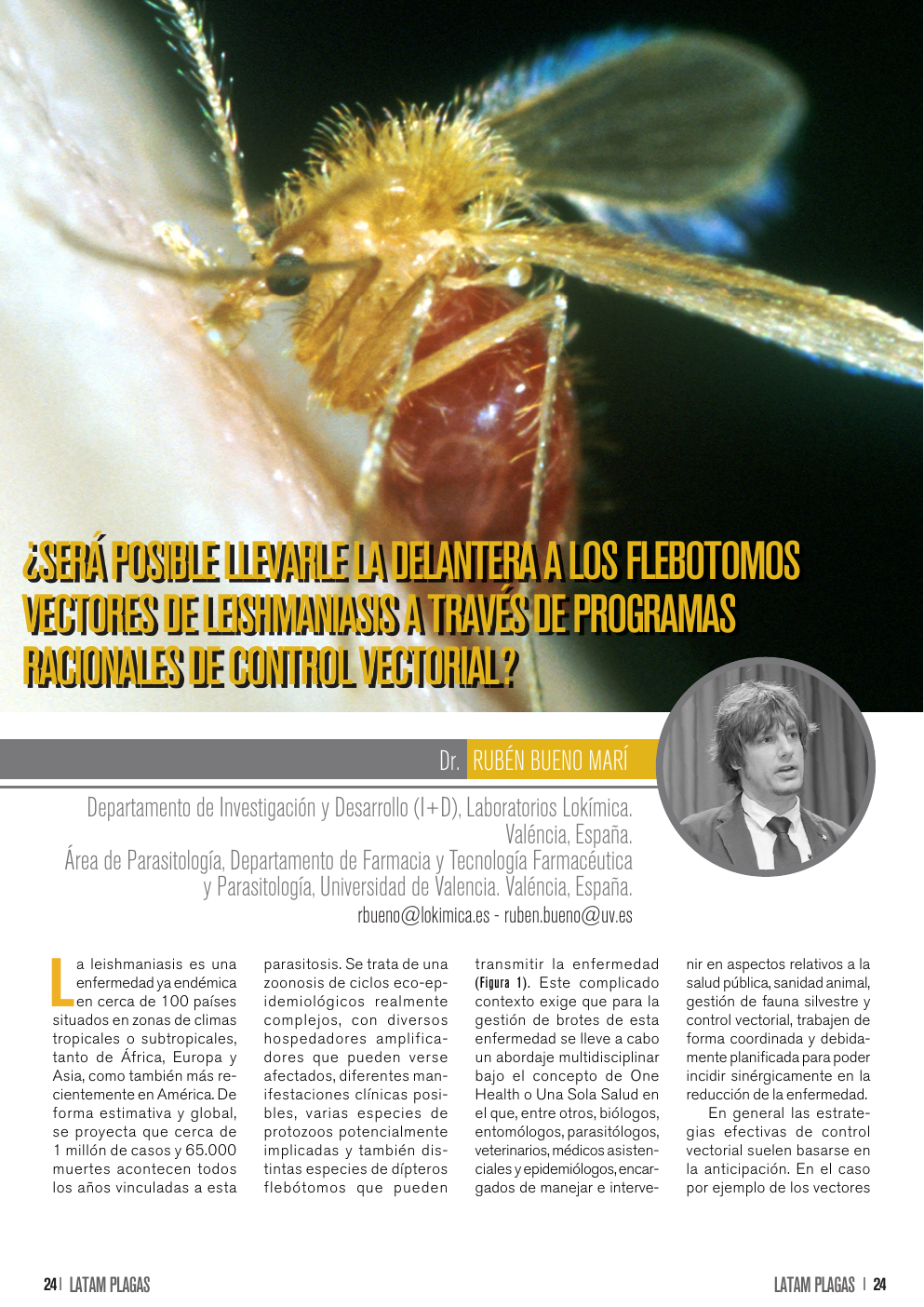
Leishmaniasis is a disease already endemic in nearly 100 countries located in areas with tropical or subtropical climates, both in Africa, Europe and Asia, as well as more recently in America. In an estimated and global way, it is projected that close to 1 million cases and 65,000 deaths occur every year linked to this
parasitosis. It is a zoonosis with truly complex eco-epidemiological cycles, with various amplifying hosts that may be affected, different possible clinical manifestations, several species of protozoa potentially involved and also different species of sandflies that may be affected.
transmit the disease (Figure 1). This complicated context requires that for the management of outbreaks of this disease, a multidisciplinary approach be carried out under the concept of One Health or One Health in which, among others, biologists, entomologists, parasitologists, veterinarians, healthcare doctors and epidemiologists, in charge of managing and intervening in aspects related to public health, animal health, wildlife management and vector control, work in a coordinated and properly planned manner to be able to synergistically influence the reduction of the disease. In general, effective vector control strategies are usually based on anticipation. In the case, for example, of the most relevant biological transmission vectors on the planet, culicid mosquitoes, the correct identification of the main breeding sites in a specific territory and the possibility of carrying out preventive larvicidal actions that reduce the emergence of adults, are the main premise for success. The “simple” association between stagnant water collections and the possible presence of mosquito larvae facilitates preventive interventions against preimaginal forms. However, in the case of leishmaniasis vectors, the situation is not so simple. The diptera of the phlebotominae subfamily do not develop their larval phase in collections of stagnant water, but in microhabitats in which organic matter, humidity and, preferably, in conditions of darkness or low degree of humidity are abundant.
direct sunshine (Figure 2). Consequently, the multitude of possible breeding sites for these nematoceran diptera includes areas with accumulation of leaf litter in parks and gardens, landfills, urban sanitation networks, animal burrows, mudflats with abundant vegetation, woodsheds, wall mechanics and other types of human constructions, among many others. This context makes it impossible to reproduce the design and execution of control plans in the image and similarity of culicid mosquitoes, because there are no tools for precise identification of breeding sites, nor for evaluation of their different productivity for larval proliferation, nor even chemical or biological formulations specifically designed for their preimaginal control in the habitats previously described.
All of this means that, when we refer to strategies to combat leishmaniasis based on vector control, we essentially focus on 3 types of interventions: 1) Environmental management: environmental management actions that reduce the vulnerability of the territory with regard to the possible proliferation of sandflies, such as destruction and modification of habitats, environmental sanitation actions such as clearing and removal of waste or substrates that facilitate the nesting of the vector, physical barriers to prevent the emergence of sandflies such as sealing storm drains and wells that connect to sanitation networks, etc. 2) Information to citizens about self-protection measures:
Reducing risks of contact between vector-domestic reservoirs-people is also the responsibility of citizens, through sanitation and adoption of codes of good environmental practices in their domestic garden spaces, as well as the use of physical barriers such as mosquito nets (less than 2mm in size, due to the small size of adult sandflies) or chemicals such as environmental and/or topical repellents. 3) Direct vector control measures (Figure 3): without a doubt, in this section there is a lot of scientific-technical work to do in the search for tools and strategies for direct control of sandflies that are more effective than the current ones. As previously mentioned, the very biology of these diptera makes it difficult to implement environmental interventions that cause a clear and rapid disruption of their natural biological cycles, as is the case with other nematoceran diptera of health interest in which we can actually cut off the reproductive cycle in their larval phase thanks to well-planned surveillance and control campaigns, as would be the case of culicids or simulids. However, and although the path to travel in the search for more effective direct control tools is still long, it is also true that there are many starting studies. From novel attractive baits that encourage the dispersal of biolarvicides such as Bacillus sphaericus to breeding sites such as
burrows where significant larval mortality can be induced, to the use of modern systemic insecticides applied directly to reservoirs. There are also studies of direct application of Insecticide Growth Regulators (IGR's) in shelters that serve as sandfly larval nurseries with promising results. The traditional residual and spatial applications of insecticides are also not exempt from being part of this list of direct control strategies to be tested and promoted. Some authors maintain that the reduction of residual applications, understood as the use of highly residual insecticides directly on surfaces where vectors rest or shelter (essentially indoors, on walls, ceilings or other structures), in many territories due to the end of the antimalarial fight has been able to play a relevant role in the re-emergence of leishmaniasis. However, this statement cannot be sustained in many other territories, where substantial changes have not occurred or where malaria and leishmaniasis even coexist today. There are quite a few works that analyze the effect of residual applications with organochlorines, organophosphates and pyrethroids. If we stick to the latter, as they are the only adulticides that are being authorized in many countries for the control of flying insects due to their lower ecotoxicological impact, we can find evidence of optimal population reduction results from applying Figure 3. Different types of insecticidal applications that can be used to control sandflies: A) Residual application indoors on resting and shelter surfaces, B) Spatial application using the Ultra Low Volume technique (ULV), C) Spatial application through the use of the thermofogging technique, D) Direct spraying of insecticide in burrows (adult shelter and sandfly larvae breeding ground). Image sources: A) Jessica Scranton/AIRS March 2017, B) FMC Corp., C) Government of Peru, D) National Park Service (NPS) USA.
residual interventions inside homes, but very inconsistent results in other residual interventions in other habitats such as burrows (where an eviction effect that increases flight and biting activity in the first days is usually common). At this point, it is worth remembering that environmental variables such as high temperatures, solar radiation or the accumulation of dust and organic matter significantly reduce the effectiveness of residual pyrethroids. Regarding spatial or volumetric applications, in this case what is sought is a wide dispersion of the insecticide in small microdroplets or mist (Ultra Low Volume-ULV applications or mists) to increase the intervention surface in order to intercept a greater number of insects, although the residuality is relatively low. This type of applications
They have also been part of several anti-phlebotomin programs, once again, with very variable and inconclusive results. In short, it is important that institutions favor and promote basic and applied research projects in the vector control of these dipterans of such great health importance. Climate change, urban growth, poor land management and evidence of adaptation of the parasite to more and more synanthropic reservoirs, lead to the problems of leishmaniasis and our interaction with sandflies becoming more and more intense. In this context, and with the known phenomena of resistance to both certain antiparasitic drugs and insecticides, the development of effective vector control programs is absolutely essential to combat the disease.
Bibliographical references Claborn, DM. 2010. The biology and control of Leishmaniasis vectors. Journal of Global Infectious Diseases, 2 (2): 127134. Coleman, RE, et al. 2004. Prevention and control of leishmanisis during Operation Iraqi Freedom. Wing Beats, 15: 10-16. Iriso, A, et al. 2017. Vector control. In: Leishmaniasis outbreak in Fuenlabrada and other municipalities of the Community of Madrid: the role of hares and rabbits as reservoirs. 177-190. Robert, L.L., et al. 1997. Phlebotomine sand fly control using bait-fed adults to carry the larvicide Bacillus sphaericus to the larval habitat. Journal of American Mosquito Control Association, 13: 140144.