
The extinction of cockroaches and the new normal
It has been said that cockroaches could survive an atomic catastrophe, one of the many myths about these insects, along with the fact that they can live without a head, that they have not changed since their origin...
Technical summary
- Focus
- It has been said that cockroaches could survive an atomic catastrophe, one of the many myths about these insects, along with the fact that they can live without a head, that they have not changed since their origin or that...
- Approach
- It brings together technical criteria linked to Edición 10, control de plagas and cucarachas.
- Use
- Useful for professionals who need context, diagnosis and operational decisions in urban pests.
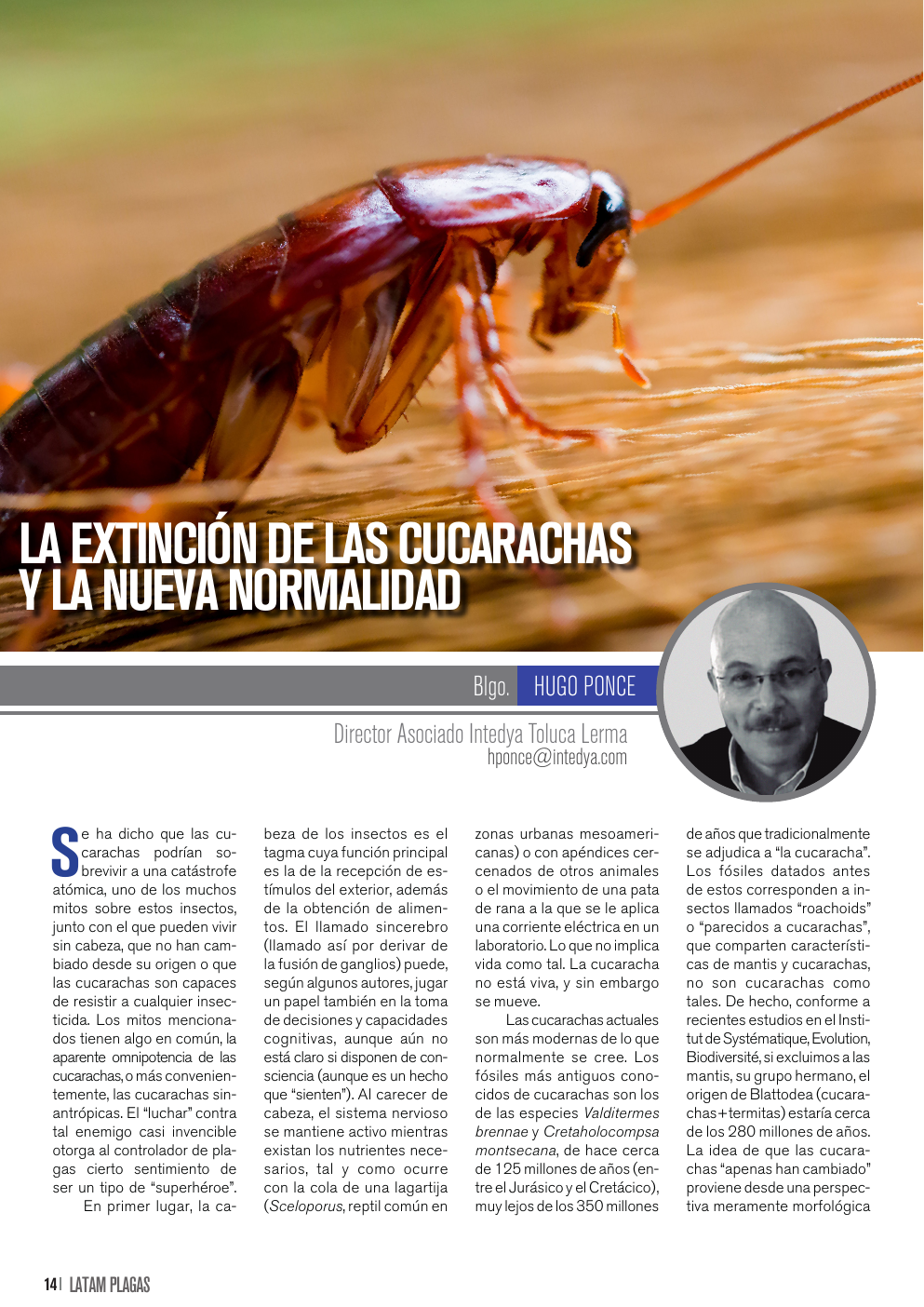
It has been said that cockroaches could survive an atomic catastrophe, one of the many myths about these insects, along with the fact that they can live without a head, that they have not changed since their origin or that cockroaches are capable of resisting any insecticide. The myths mentioned have something in common, the apparent omnipotence of cockroaches, or more conveniently, synanthropic cockroaches. “Fighting” such an almost invincible enemy gives the Pest Management Professional a certain feeling of being a type of “superhero”. Firstly, the head of insects is the tagma whose main function is to receive stimuli from the outside, in addition to obtaining food. The so-called sincerebrum (so called because it derives from the fusion of ganglia) can, according to some authors, also play a role in decision-making and cognitive abilities, although it is not yet clear if they have consciousness (although it is a fact that they “feel”). Lacking a head, the nervous system remains active as long as the necessary nutrients exist, as occurs with the tail of a lizard (Sceloporus, a common reptile in
urban Mesoamerican areas) or with appendages severed from other animals or the movement of a frog leg to which an electric current is applied in a laboratory. Which does not imply life as such. The cockroach is not alive, and yet it moves. Today's cockroaches are more modern than is generally believed. The oldest known fossils of cockroaches are those of the species Valditermes brennae and Cretaholocompsa montsecana, from about 125 million years ago (between the Jurassic and Cretaceous), far from the 350 million years traditionally attributed to “the cockroach.” The fossils dated before these correspond to insects called “roachoids” or “cockroach-like”, which share characteristics of mantises and cockroaches, they are not cockroaches as such. In fact, according to recent studies at the Institut de Systématique, Evolution, Biodiversité, if we exclude mantids, their sister group, the origin of Blattodea (cockroaches+termites) would be close to 280 million years ago. The idea that cockroaches “have barely changed” comes from a purely morphological and appreciative perspective. Today, molecular biology has made it possible to demonstrate the changing path of the history of these insects and that, over so long, numerous species have disappeared and appeared. Yes, many species of cockroaches have become extinct.
The insecticides reported in cockroaches are enzymatic detoxification, target site insensitivity, reduction of cuticular penetration, and behaviors such as aversion. Resistance to more than one class of insecticides, or multiple resistance, is also common, but
tion of insects, the almost absence of competitors and predators and the low gene flow between populations, reinforced by the poor understanding of rotation and little application of alternative and complementary methods to chemicals. The worst of the resistances is the one that
The question is whether they would really be the only inhabitants of the planet. First we must understand what the negative effects of ionizing radiation on organs and tissues are, which, as with toxic ones, depends on the dose, received or absorbed, and its potential to cause
IT HAS BEEN SAID THAT COCKROACHES COULD SURVIVE AN ATOMIC CATASTROPHE, ONE OF THE MANY MYTHS ABOUT THESE INSECTS, ALONG WITH THE WHICH THEY CAN LIVE WITHOUT A HEAD, THAT THEY HAVE NOT CHANGED SINCE THEIR ORIGIN OR THAT COCKROACHES ARE ABLE TO RESIST ANY INSECTICIDE. Resistance to pesticides is also an argument frequently used in pest control. The entrenched habits of pest control based on the use of pesticides and application frequency schedules reinforce the argument that “cockroaches are getting stronger.” The resistance mechanisms
It is different from crossed resistance, which occurs to the same mode of action. This is not a phenomenon exclusive to cockroaches, nor a novelty, it is in fact a short-term reproduction of the evolutionary phenomenon, a combination of selection pressure from the application of different pesticides, together with the rapid reproduction of the Pest Management Professional to apply real comprehensive management. The above ideas, among others, have reinforced the idea that, in the event of a nuclear war, cockroaches would be the only survivors. Beyond wondering what cockroaches would “live on” if this situation occurred,
damage, called effective dose. Radiation can have various effects depending on the variables mentioned, from organ and tissue malfunction to burns. In lower doses the body can repair damage, but it can lead to long-term effects, such as those related to cellular reproduction, such as cancer. This is where the main difference in the effect of radiation lies; The reproduction rate of our cells is considerably higher, practically continuous, than that of cockroaches, which occurs approximately every 24 hours. However, this capacity has a limit; It was found that only 10% of cockroaches survived the atomic bomb dropped on Hiroshima, but they are not able to survive the amount of radiation in the Chernobyl or Fukushima accident. Cockroaches are more resistant than humans, but there are much more resistant arthropods, such as tardigrades. But it is not only necessary to survive, if there is no reproduction, as pointed out by biologist Mark Elgar, from the University of MelMIP.
Bourne; If there is no continuity, there is no life. There is a phrase attributed to Charles Darwin, but he never said: "It is not the strongest of the species that survives, nor is it the most intelligent that survives; it is the one that is most adaptable to change." In reality, Darwin never said such a thing. Such a phrase or similar ones are attributable to Herbert Spencer, who established it, before Darwin published his theory, from a point of view from economic competition, so his approach in motivational and business talks towards this aspect is not original either. Another related phrase is “the survival of the fittest”, which is correct from the biological context, but better understood outside of it. Fitness in natural science is also called biological effectiveness or fitness (or “fitness” in English and has nothing to do with
gyms) and consists of the ability of a genotype to be transmitted to its descendants. Said in the words of the famous English naturalist: the species that have the best chance of surviving are not the most reactive to changes, but “those that already have good characteristics to transmit to the next generation”, the basis of natural selection. In the resistance of cockroaches, to chemicals or radiation, the key aspect is their ability to survive, first, and then reproduce. They are characteristics that individuals may or may not possess, they do not acquire them, and that is selected by exposure to selection factors, which may be gradual or sudden. This selection has caused many species of cockroaches to become extinct and others to pass their genotypes to subsequent generations.
Only populations that are suitable for the contingency presented to them, not reactive ones, can establish and evolve. This also happens to companies (What would Pest Management Professionals do if cockroaches, the main insect pest in urban services, became extinct?) We are in unprecedented times for everyone, in which a good part of the world has self-isolated to reduce the spread of a virus that suddenly became present in our lives. Businesses closed, others continued to work remotely, and many others will not reopen. You might think that this is a new situation for the pest control professional, but it is not entirely so. In fact, several countries already experienced a trial almost a decade ago, in 2009, with the pandemic of the AH1N1 influenza virus, which was not exactly new to us, since it had already caused a greater pandemic at the beginning of the last century, with the so-called “Spanish flu.” One might assume that with such recent preparation something would have been learned. The truth is that almost nothing. Faced with the shocking images that came from China in which armies of characters dressed in costumes worthy of a science fiction movie, walked through the streets filling everything around them with dense clouds, the idea of a seemingly easy business opportunity arose. Ingenuity arose when inventing homemade equipment, opportunism to offer 15-minute disinfections, the opportunity to sell miraculous recipes and subsistence with new income based on
In the event of a disruptive event the organization should:
Establishment of:. Continuity and recovery plan. Control plan, monitoring and review. Ensure the recovery of the organization.
Establishment of preventive measures and actions against:. Workers. Customers. Suppliers. Interested parties. Strategy. Infrastructure
Actions of an organization or company in the face of a disruptive event. (Source: International Dynamic Advisors, Intedya Internacional, 2020)
uninformed need. Nobody sees “dead viruses” (in quotes intentionally), so the quality of the result remains in faith and contained fear. This represents a case of “survival of the fittest.” But it is important to understand it correctly. During the transition phase that we are experiencing today, it is still not clear which companies will survive. Some companies dedicated to pest control services seek, through apparently legal resources, to be considered the ideal ones for disinfection, others are training in the field of cleaning that was previously despised, and still others are beginning to reinvent themselves towards a comprehensive service. On the other hand, businesses that already did cleaning and disinfection now look at the opportunity to do pest control, often with greater economic capacity, certifications and business structure. Faced with a disruptive event like the current pandemic, companies must first
place being able to adapt as quickly as possible. But not reactively, but planning for the “after”. This is what is called business resilience, in which it is capable of sustainably recovering from an unexpected and often adverse event. Companies will then be able to have continuity, as long as they have established a business plan designed for the future, including risk management, not those that react to the moment and circumstance.
To do this, it is necessary for the company to identify and evaluate its critical activities, establish preventive measures, carry out a due risk analysis and, with this, be able to establish a plan that allows it to survive and recover from the contingencies that arise; In short, have your business continuity plan ready. Competition increases and only the fittest (in the evolutionary sense of the word) will be the ones who move into the post-covid era. It's not just about surviving, but going beyond.
References: Estall H. (2012) Business Continuity Management Systems: Implementation and Certification to ISO 22301. BCS, The Chartered Institute. Legendre F, Nel A, Svenson GJ, Robillard T, Pellens R, Grandcolas P (2015) Phylogeny of Dictyoptera: Dating the Origin of Cockroaches, Praying Mantises and Termites with Molecular Data and Controlled Fossil Evidence. PLoS ONE 10(7): e0130127. Liang, Jun-Hui & Vrsansky, Peter & Dong, Ren. (2012). Variability and symmetry of a Jurassic nocturnal predatory cockroach (Blattida: Raphidiomimidae). Mexican Journal of Geological Sciences. 29. 411-421. Orr, H. Fitness and its role in evolutionary genetics. Nat Rev Genet 10, 531–539 (2009).