
Biosecurity schemes in rodent control
The pest control area is one of the sectors with the highest occupational risk. In current practice, several of the periodic operations carried out within the framework of rodent control actions can lead to a series...
Technical summary
- Focus
- The pest control area is one of the sectors with the highest occupational risk.
- Approach
- The article structures the analysis around Structuring a biosafety program.
- Use
- Useful for professionals who need context, diagnosis and operational decisions in rodents.
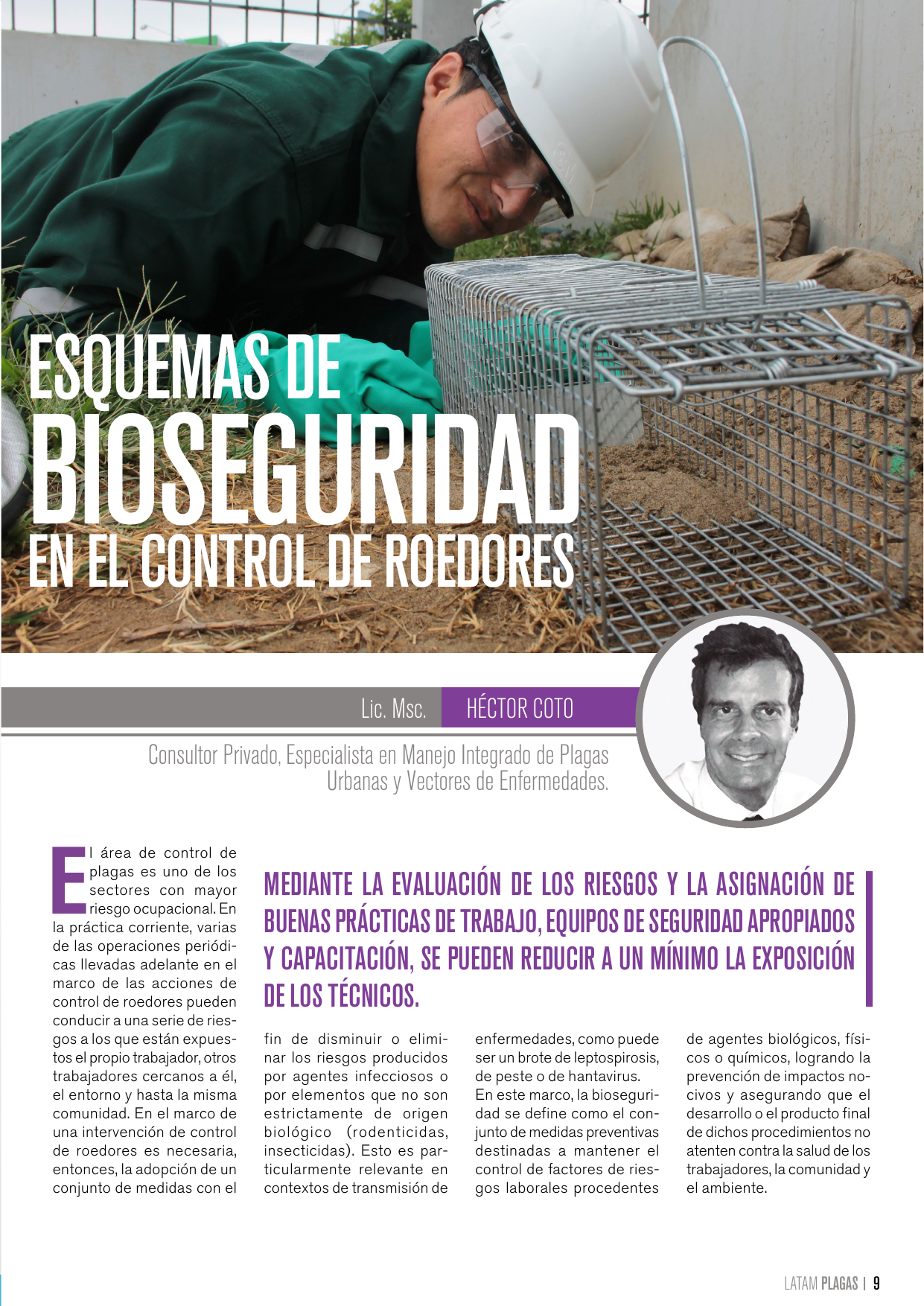
The pest control area is one of the sectors with the highest occupational risk. In current practice, several of the periodic operations carried out within the framework of rodent control actions can lead to a series of risks to which the worker himself, other workers close to him, the environment and even the community itself are exposed.
Within the framework of a rodent control intervention, it is therefore necessary to adopt a set of measures in order to reduce or eliminate the risks produced by infectious agents or by elements that are not strictly of biological origin, such as rodenticides and insecticides. This is particularly relevant in contexts of disease transmission, such as an outbreak of leptospirosis, plague or hantavirus.
In this framework, biosafety is defined as the set of preventive measures aimed at maintaining control of occupational risk factors from biological, physical or chemical agents, achieving the prevention of harmful impacts and ensuring that the development or final product of said procedures do not threaten the health of workers, the community and the environment.
The purpose of this article is to provide biosafety guidelines for those people involved in rodent control, in such a way as to guarantee, on the one hand, the personal safety of those who are directly affected by the work and, on the other hand, inseparably, the safety of the environment.
Structuring a biosafety program
Permanent exposure to a variety of work-related health risks should be considered when conducting rodent studies and control. Although these activities do not involve the manipulation or deliberate use of pathogens, they can reach the worker through contact with rodents or their secretions, as well as with objects and substances contaminated by them. As mentioned, to this is added the risk represented by the use of rodenticides and insecticides to control ectoparasites.
Therefore, it is essential that institutions and companies that carry out field work that involves sampling, capture, control, manipulation, processing and/or elimination of rodents include biosafety measures for the development of all the aforementioned tasks.
The guidelines that must structure the biosafety scheme must focus on six main aspects.
A. Establishment of appropriate security rules and standards
Rules and standards will be established that must provide the necessary methodologies to reduce the risks of exposure caused by human errors, inappropriate use of equipment or bad practices in field work. It is important that these standards are prepared by personnel who have full knowledge of the activities carried out in their area of responsibility.
B. Information and training of personnel
To comply with safety standards, it is essential that workers achieve awareness through ongoing training and training. Therefore, in the first instance, theoretical and practical training must be carried out for all personnel and periodic updates that include good field work practices, general maintenance of work equipment, decontamination procedures and disposal of materials and emergency procedures.
It is important to ensure that workers receive sufficient and appropriate training and information on the potential health risks related to their work, the precautions they must take to prevent exposure to biological and chemical agents, hygiene provisions, and the use and use of personal protective clothing and equipment.
It is essential to provide all technical and auxiliary personnel with continuous training in these measures, since incorrect practices and errors can invalidate all biosafety measures. Knowledge is the most important element that a person has in order to develop the risk perception necessary to protect their health.
C. Control of the application of security rules and standards
The participation of all personnel in the control of established standards is essential since in essence each worker is obliged to take care of their own safety and that of their colleagues, reporting risky acts or conditions at work. It is important that each worker develops a critical attitude towards the established procedures in order to detect possible shortcomings.
D. Record of accidents and unsafe work situations
An accident may or may not cause a recognized injury to the worker or those around him, loss of supplies and materials, deterioration or alteration of the environment and loss of time, among other consequences. The main reason indicated by workers for not reporting an accident is that they do not consider what happened to be of sufficient importance. Accidents are a common occurrence in field work, with sharp-edged injuries being the most common.
Although it does not carry importance due to the injury itself, the potential severity in terms of the biological risk of pathogen transmission forces it to be given an adequate dimension. Every incident must be reported. It is the responsibility of all workers to report to anyone who establishes unsafe activities or working conditions that endanger people's health or may contaminate or alter the environment. A record of accidents will be kept on forms intended for that purpose and a filing system must be established.
E. Control of the health status of personnel
The objectives of this surveillance are to provide a means by which early detection of acquired infections can be carried out, as well as to measure the effectiveness of protective equipment and procedures performed. It is recommended to perform a pre-occupational examination or at the time of assignment of risk activities.
Any worker who suffers symptoms of illness associated with any of the pathogens present or suspected in the area must inform their immediate supervisor and consult the doctor, informing the doctor about the activities carried out and the possibility of becoming ill from any agent transmitted by rodents. Early recognition of an illness and appropriate care can save a worker's life. At that time, the doctor must take a serum sample from the patient and must send it along with the base serum to the corresponding health institution for the study of infectious agents.
F. Immunoprophylaxis
Among the specific measures indicated to reduce the occupational risks of employees of a rodent control program, vaccination recommendations cannot be absent. Provide exposed personnel with case-specific vaccination or chemoprophylaxis. The criteria for making decisions about which vaccines to apply to personnel must include, in addition to the vaccines recommended by national vaccination standards, tetanus vaccination and, if applicable, those against pathogenic microorganisms probably present in the work areas.