Interview with the general director of ANECPLA Spain
From your point of view, what is the importance of the Integrated Urban Pest Management (IUPM) sector in society?
Technical summary
- Focus
- From your point of view, what is the importance of the Integrated Urban Pest Management (IUPM) sector in society?
- Approach
- It brings together technical criteria linked to Edición 14, anecpla and entrevista.
- Use
- Useful for professionals who need context, diagnosis and operational decisions in urban pests.
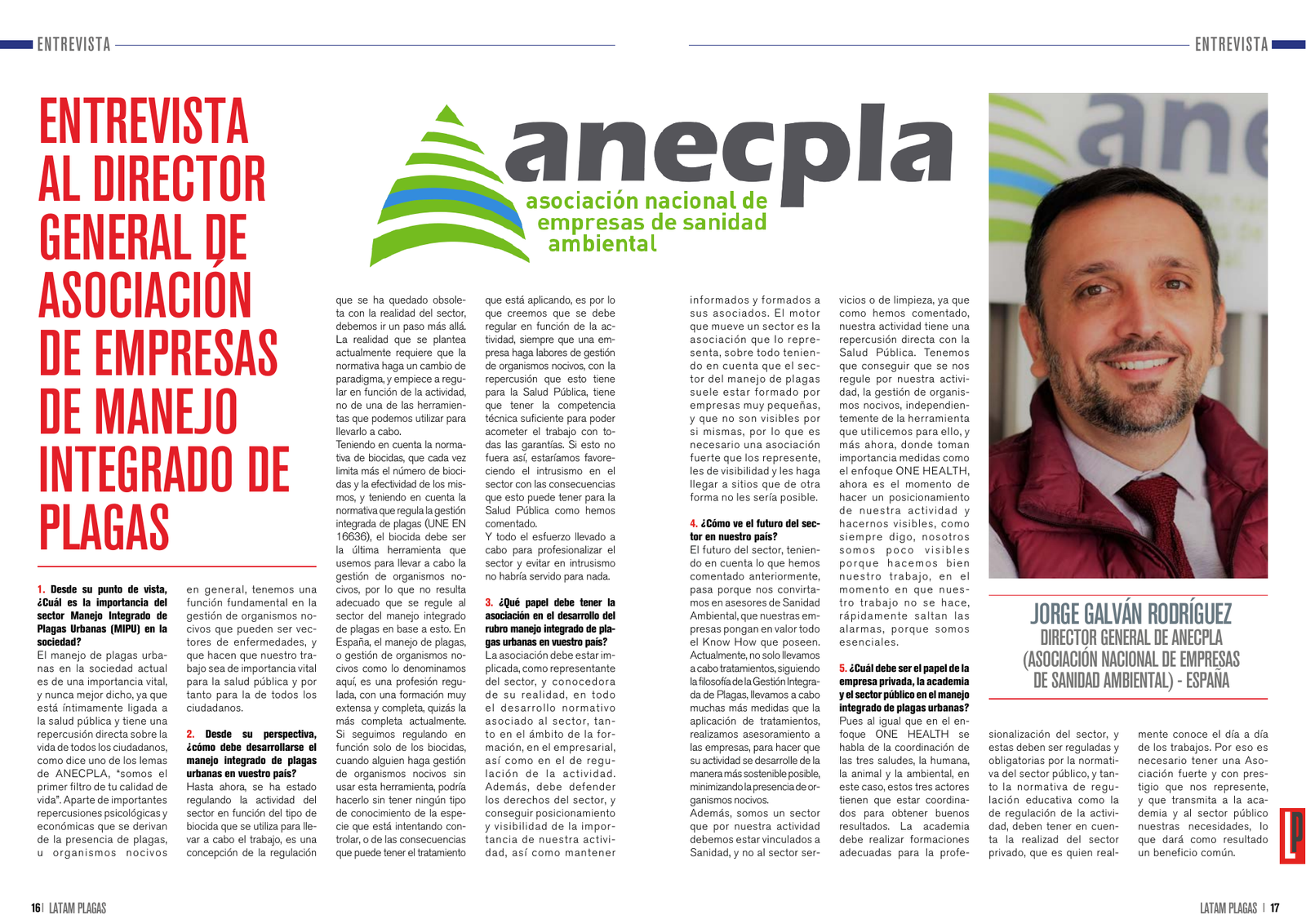
1. From your point of view, what is the importance of the Integrated Urban Pest Management (IUPM) sector in society? The management of urban pests in today's society is of vital importance, and never better said, since it is closely linked to public health and has a direct impact on the lives of all citizens, as one of ANECPLA's mottos says, "we are the first filter of your quality of life." Apart from important psychological and economic repercussions that arise from the presence of pests, or harmful organisms in general, we have a fundamental role in the management of harmful organisms that can be vectors of diseases, and that make our work of vital importance for public health and therefore for that of all citizens. 2. From your perspective, how should integrated urban pest management be developed in your country? Until now, the activity of the sector has been regulated based on the type of biocide used to carry out the work, it is a conception of regulation that has become obsolete with the reality of the sector, we must go one step further. The reality that currently arises requires that the regulations make a paradigm shift, and begin to regulate based on the activity, not on one of the tools that we can use to carry it out. Taking into account the regulations on biocides, which increasingly limit the number of biocides and their effectiveness, and taking into account the regulations that regulate integrated pest management (UNE EN 16636), the biocide should be the last tool that we use to carry out the management of harmful organisms, so it is not appropriate for the integrated pest management sector to be regulated based on this. In Spain, pest management, or management of harmful organisms as we call it here, is a regulated profession, with very extensive and complete training, perhaps the most complete currently. If we continue to regulate based only on biocides, when someone manages harmful organisms without using this tool, they could do so without having any type of knowledge of the species they are trying to control, or of the consequences that the treatment they are applying may have, which is why we believe that it should be regulated based on the activity, whenever a company manages harmful organisms, with the repercussions that this has for Public Health, it must have sufficient technical competence to be able to undertake the work with all the guarantees. If this were not the case, we would be favoring intrusion in the sector with the consequences that this may have for Public Health as we have commented. And all the effort carried out to professionalize the sector and avoid intrusion would have been of no use. 3. What role should the association play in the development of the integrated urban pest management field in your country? The association must be involved, as a representative of the sector, and aware of its reality, in all the regulatory development associated with the sector, both in the field of training, in business, as well as in the regulation of the activity. In addition, it must defend the rights of the sector, and achieve positioning and visibility of the importance of our activity, as well as keep its associates informed and trained. The engine that moves a sector is the association that represents it, especially taking into account that the pest management sector is usually made up of very small companies, and that are not visible by themselves, so a strong association is necessary that represents them, gives them visibility and makes them reach places that would not otherwise be possible. 4. How do you see the future of the sector in our country? The future of the sector, taking into account what we have commented previously, happens because we become Environmental Health advisors, so that our companies value all the Know How they possess. Currently, we not only carry out treatments, following the philosophy of Integrated Pest Management, we carry out many more measures than the application of treatments, we provide advice to companies, to ensure that their activity is carried out in the most sustainable way possible, minimizing the presence of harmful organisms. Furthermore, we are a sector that due to our activity must be linked to Health, and not to the services or cleaning sector, since as we have mentioned, our activity has a direct impact on Public Health. We have to get our activity regulated, the management of harmful organisms, regardless of the tool we use for it, and even more so now, where measures such as the ONE HEALTH approach become important, now is the time to position our activity and make ourselves visible, as I always say, we are not very visible because we do our job well, the moment our work is not done, the alarms quickly go off, because we are essential. 5. What should be the role of private companies, academia and the public sector in integrated urban pest management? Well, just as in the ONE HEALTH approach we talk about the coordination of the three healths, human, animal and environmental, in this case, these three actors have to be coordinated to obtain good results. The academy must carry out appropriate training for the professional JORGE GALVÁN RODRÍGUEZ GENERAL DIRECTOR OF ANECPLA (NATIONAL ASSOCIATION OF ENVIRONMENTAL HEALTH COMPANIES) - SPAIN sionalization of the sector, and these must be regulated and mandatory by public sector regulations, and both the educational regulation regulations and the activity regulation regulations must take into account the performance of the private sector, which is the one who really knows the day-to-day life of the jobs. That is why it is necessary to have a strong and prestigious Association that represents us, and that transmits our needs to the academy and the public sector, which will result in a common benefit.