
In search of quality
Some people assume that the pest control business is a very simple thing after all.
Technical summary
- Focus
- Some people assume that the pest control business is a very simple thing after all.
- Approach
- It brings together technical criteria linked to Edición 5, calidad and gestión.
- Use
- Useful for professionals who need context, diagnosis and operational decisions in edición 5.
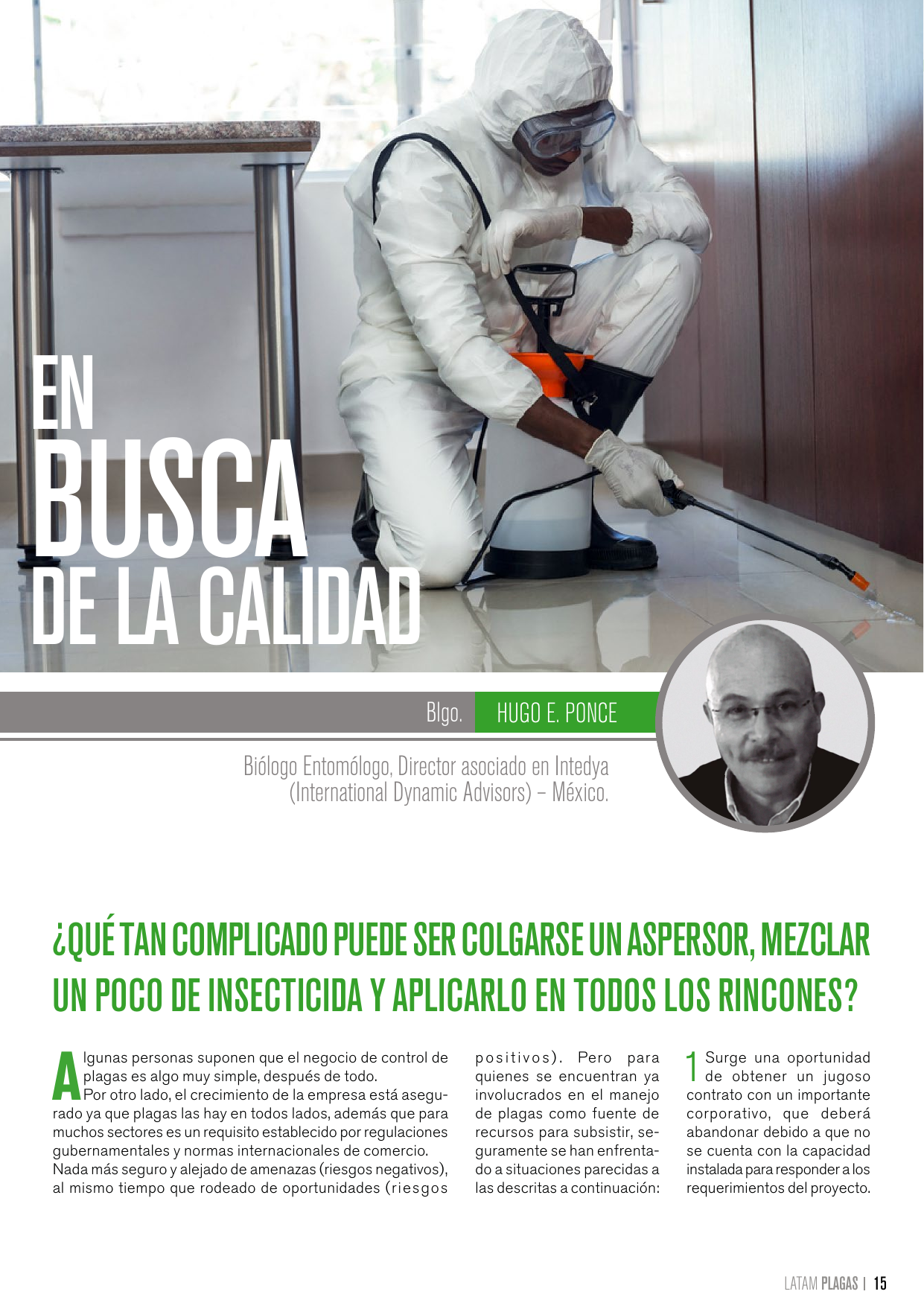
Some people assume that the pest control business is a very simple thing after all. On the other hand, the growth of the company is assured since pests exist everywhere, and for many sectors it is a requirement established by government regulations and international trade standards. Nothing is safer and away from threats, negative risks, while surrounded by opportunities, positive risks.
But for those who are already involved in pest management as a source of resources to survive, they have surely faced situations similar to the following: losing a contract due to not having installed capacity, facing claims for health problems, detecting shortages of pesticides in inventory, delaying certifications due to non-conformities, receiving complaints due to service inefficiency, facing adverse audits, having claims for damage to pets or for insecticide residues in exports, and even explaining reports that the client perceives as insufficient.
It could possibly be stated that these and other cases are part of the job, that it is impossible to anticipate and that the best management of the business is to know how to respond to each one at the time. After all, the company has operated this way for 10, 15 or 20 years and continues to make money. However, it is also notable that more and more competitors are emerging, and not all of them comply with the minimum legal requirements that the country demands for their operation.
If there is something that is not easy to accept, it is change, in business models, in pest control methods, in the demands of clients and authorities, in the available supplies, in the mentality of employees, in regulations or in the competitive environment of the sector. If change is not accepted, much less can it be prevented. Resistance that prevents realizing that it is possible to adapt and even adopt change for the benefit of the business.
For many years, on many occasions and in various talks to Pest Management Professionals, the question arose as to whether ISO 9000 certification was convenient or at least recommended. In the question and comments, the certification was perceived as many of the “medals” that the companies displayed in their advertising along with logos of important pesticide manufacturing companies or organizations from which courses were taken but presented as “certifications.”
For many, the acronym ISO represents paperwork, procedures or hard audits, but in reality ISO, for International Organization for Standardization, seeks to standardize various existing standards and guides. They are believed to be applicable only to large corporations or serial maquiladoras, but not necessarily to small and medium-sized businesses, to which most pest control companies belong.
It is also thought that one should wait for the best moment in the development of the company to think about getting certified or that they are only necessary when requested by a client. The certification is only evidence of said concern, which provides its clients with greater security in the way in which they will receive services in the management of those insects, arachnids or rodents that cause them economic losses, damage to their reputation, health risks or claims.
The implementation of ISO standards allows for better adaptation to innovation and better management of its resources. It is said that the most stable table is one that is built with three legs. Arguably the same is true of the ISO standards and the three basic standards: ISO 9001:2015, ISO 14001:2015 and ISO 45000:2018.
The ISO 9000 family of standards focuses on aspects of quality management in company processes and its consequent reflection in product quality and, since 2000, also applicable to services, improving this aspect in its new 2015 version, changing from “product realization” to “operations”, focusing on risk management. The implementation of ISO 9001:2015 in the company allows better management of its human resources, attention to claims, contract management and other aspects common to many companies.
The development of pest control plans and their monitoring are considerably benefited by this standard, facilitating their monitoring, risk management and trend analysis, for the benefit of compliance with the most demanding requirements that may affect the company itself and its clients. This, in combination with the adoption of IPM methods, favors competitiveness with savings in the use of pesticides, without detriment, and even improves the results of the pest control programs and increases the prestige and recommendation of the company's services.
Certification to ISO 14001:2015 allows the Pest Management Professional to comply with environmental regulations at the local and international level. In the sector it is clear that a company that uses substances classified as potential pollutants, even the slightest ones, by reducing the impact of its work on the environment is always a benefit in the eyes of customers. This includes the best management from programming, rotation and volume of use, expiration management, life cycle, and waste management, including empty containers.
At this point it is worth mentioning the fiscal and economic advantages that contributions to environmental protection are widespread in world markets.
Most urban fumigation companies have in mind the famous periodic acetylcholinesterase test for their technicians, which should indicate the level of affectation to those by the application and exposure to pesticides that directly affect this enzyme involved in nerve transmission, such as organophosphates or carbamates, but not that caused by others that are used with increasing frequency, equally with risk.
To facilitate, address and prevent occupational risks, ISO 45000:2018, which will replace OHSAS 18001, is now more compatible with management systems, making it easier to implement in favor of reducing risks for staff and other interested parties, improving performance and improving the health and safety of applicators and all company employees.
Monitoring the health and safety of workers brings important benefits to the company, from ethics by creating an increasingly safer work environment, to economics by reducing treatment costs and social security payments, in addition to disabilities and absenteeism that impact the capacity of personnel to provide services. On the other hand, compliance with labor laws classified under criminal law and civil law.
Of course, there are other equally applicable standards such as ISO 37000, or anti-bribery standard, particularly valuable for those who work for government entities, but equally applicable for private ones; ISO 19600, which allows the management of regulatory compliance; ISO/IEC 27001, which allows the management and control of personal data of its clients; or ISO 22301, for business continuity management in the event of crises or high-impact incidents.
The review of ISO standards has allowed some of them to be compatible and therefore be susceptible to being managed as an Integrated Management System. This allows for a simpler and more economical implementation, since by sharing the orientation towards the satisfaction of interested parties, the continuous improvement or PDCA cycle and the approach based on processes and risks, in addition to similar structures and analogous requirements.
Also, in the case of opting for certification, it is advisable to make a good selection of the entity that grants it with optimal rigor and costs. Much is said about the search for recognition of the importance of comprehensive pest management and the professionals dedicated to it, which can be achieved until it is demonstrated with facts that the union invests in the improvement of its processes, in conjunction with its environmental and social commitment. Evolve or disappear.