
Editorial: second edition of Latam Plagas
In this second issue of LATAMPLAGAS we intend to sustain the scientific and technical contribution of the main leaders in the region..
Technical summary
- Focus
- In this second issue of LATAMPLAGAS we intend to sustain the scientific and technical contribution of the main leaders in the region.
- Approach
- It brings together technical criteria linked to Edición 2, editorial and latam plagas.
- Use
- Useful for professionals who need context, diagnosis and operational decisions in urban pests.
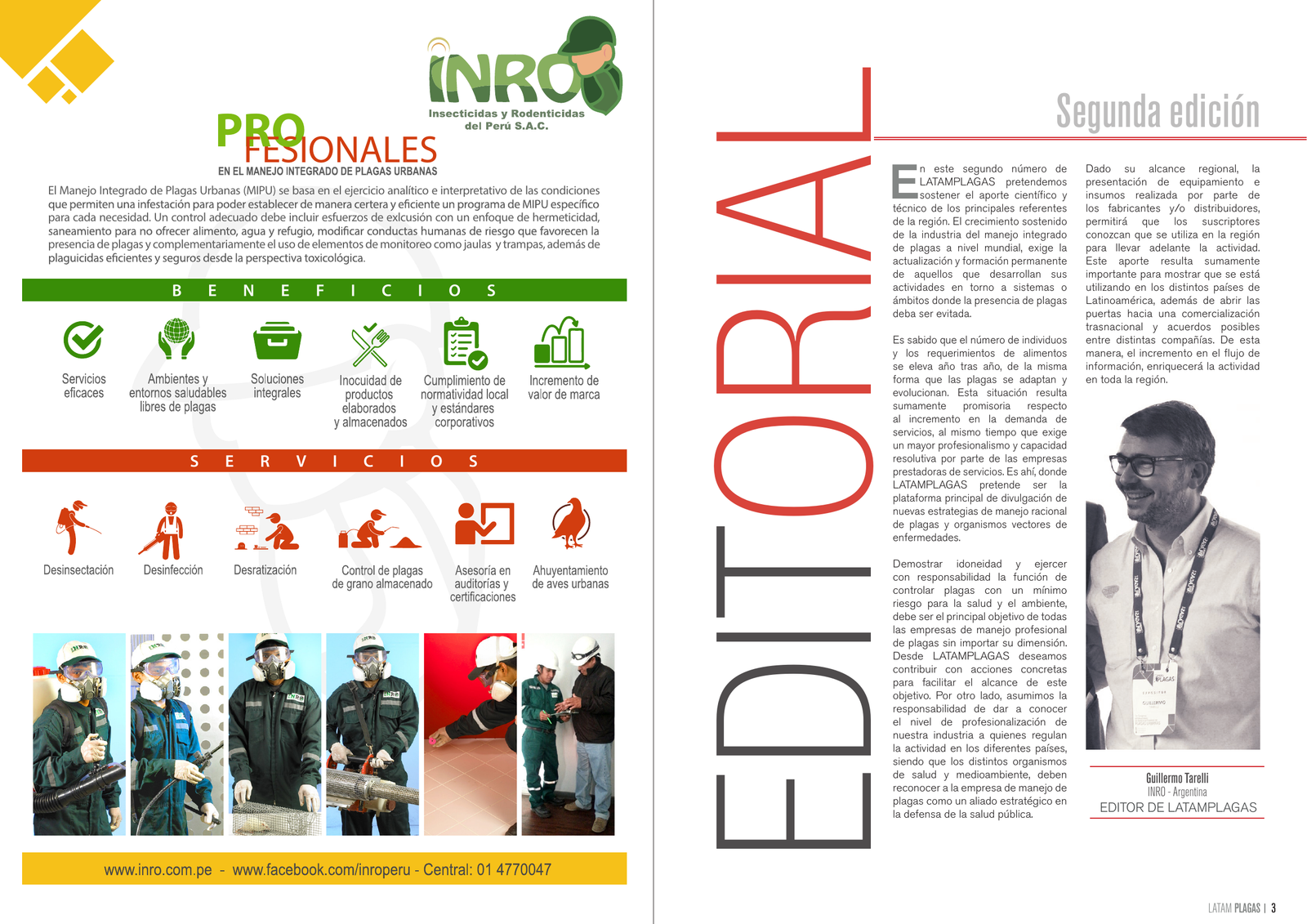
In this second issue of LATAMPLAGAS we intend to sustain the scientific and technical contribution of the main leaders in the region.
The sustained growth of the integrated pest management industry worldwide requires updating and ongoing training of those who carry out their activities around systems or areas where the presence of pests must be avoided.
It is known that the number of individuals and food requirements increases year after year, in the same way that pests adapt and evolve. This situation is extremely promising with respect to the increase in demand for services, at the same time that it requires greater professionalism and problem-solving capacity on the part of service-providing companies. This is where LATAMPLAGAS aims to be the main platform for disseminating new strategies for the rational management of pests and disease vector organisms.
Demonstrating suitability and responsibly carrying out the function of controlling pests with minimal risk to health and the environment should be the main objective of all professional pest management companies regardless of their size. From LATAMPLAGAS we wish to contribute with concrete actions to facilitate the achievement of this objective.
On the other hand, we assume the responsibility of making known the level of professionalization of our industry to those who regulate the activity in different countries, and the different health and environmental organizations must recognize the pest management company as a strategic ally in the defense of public health.
Given its regional scope, the presentation of equipment and supplies made by manufacturers and/or distributors will allow subscribers to know what is used in the region to carry out the activity. This contribution is extremely important to show what is being used in the different Latin American countries, in addition to opening the doors to transnational marketing and possible agreements between different companies.
In this way, the increase in the flow of information will enrich activity throughout the region.