
Editorial: thirteenth edition of Latam Plagas
Proud of having been socially recognized during the pandemic, comprehensive pest management professionals raised their heads and moved forward.
Technical summary
- Focus
- Proud of having been socially recognized during the pandemic, comprehensive pest management professionals raised their heads and moved forward.
- Approach
- It brings together technical criteria linked to Edición 13, editorial and latam plagas.
- Use
- Useful for professionals who need context, diagnosis and operational decisions in integrated management.
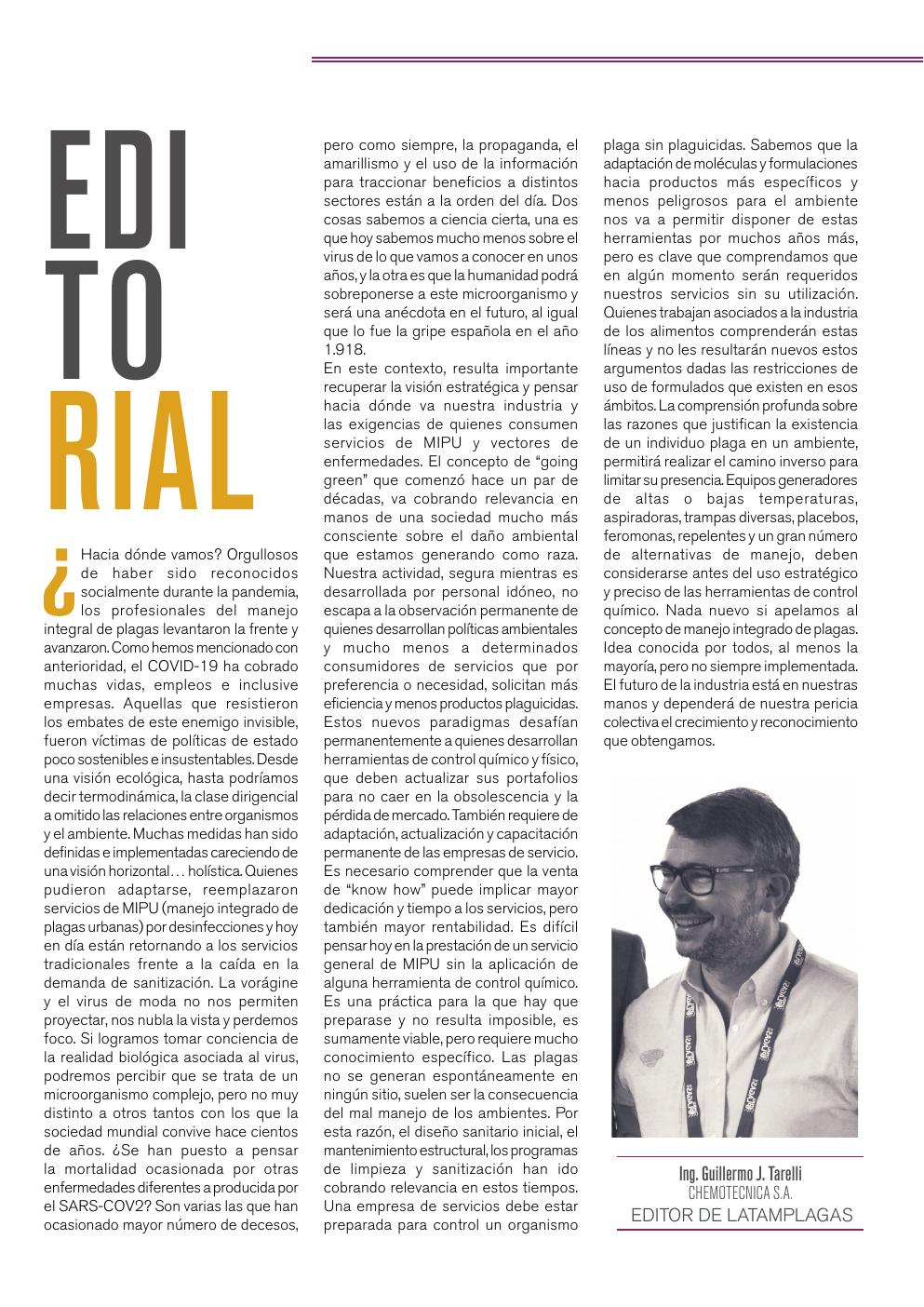
Where are we going? Proud of having been socially recognized during the pandemic, comprehensive pest management professionals raised their heads and moved forward. As we have mentioned previously, COVID-19 has claimed many lives, jobs and even businesses. Those who resisted the attacks of this invisible enemy were victims of unsustainable and unsustainable state policies. From an ecological vision, we could even say thermodynamics, the ruling class has omitted the relationships between organisms and the environment. Many measures have been defined and implemented lacking a horizontal… holistic vision. Those who were able to adapt replaced IUPM (integrated urban pest management) services with disinfections and are now returning to traditional services in the face of the drop in demand for sanitation. The maelstrom and the virus of fashion do not allow us to project, it clouds our vision and we lose focus. If we manage to become aware of the biological reality associated with the virus, we will be able to perceive that it is a complex microorganism, but not very different from many others with which global society has lived for hundreds of years. Have you stopped to think about the mortality caused by diseases other than those caused by SARS-COV2? There are several that have caused the greatest number of deaths, but as always, propaganda, sensationalism and the use of information to attract benefits to different sectors are the order of the day. We know two things for sure, one is that today we know much less about the virus than we will know in a few years, and the other is that humanity will be able to overcome this microorganism and it will be an anecdote in the future, just as the Spanish flu was in the year 1918. In this context, it is important to recover the strategic vision and think about where our industry is going and the demands of those who consume IUPM services and disease vectors. The concept of “going green,” which began a couple of decades ago, is gaining relevance in the hands of a society that is much more aware of the environmental damage we are generating as a race. Our activity, safe as long as it is carried out by qualified personnel, does not escape the permanent observation of those who develop environmental policies and much less certain consumers of services who, out of preference or necessity, request more efficiency and fewer pesticide products. These new paradigms permanently challenge those who develop chemical and physical control tools, who must update their portfolios to avoid falling into obsolescence and market loss. It also requires adaptation, updating and permanent training of service companies. It is necessary to understand that the sale of “know how” can imply greater dedication and time to the services, but also greater profitability. It is difficult to think today about providing a general IUPM service without the application of some chemical control tool. It is a practice for which you have to prepare and it is not impossible, it is extremely viable, but it requires a lot of specific knowledge. Pests do not generate spontaneously anywhere, they are usually the consequence of poor management of the environment. For this reason, the initial sanitary design, structural maintenance, cleaning and sanitation programs have been gaining relevance in these times. A service company must be prepared to control a pest organism without pesticides. We know that the adaptation of molecules and formulations towards more specific and less dangerous products for the environment will allow us to have these tools for many years to come, but it is key that we understand that at some point our services will be required without their use. Those who work associated with the food industry will understand these lines and these arguments will not be new to them given the restrictions on the use of formulations that exist in these areas. A deep understanding of the reasons that justify the existence of a pest individual in an environment will allow us to do the opposite to limit its presence. High or low temperature generating equipment, vacuum cleaners, various traps, placebos, pheromones, repellents and a large number of management alternatives must be considered before the strategic and precise use of chemical control tools. Nothing new if we appeal to the concept of integrated pest management. Idea known to everyone, at least the majority, but not always implemented. The future of the industry is in our hands and the growth and recognition we obtain will depend on our collective expertise. Ing. Guillermo J. Tarelli CHEMOTECNICA S. A. EDITOR OF LATAMPLAGAS