
Editorial: seventeenth edition of Latam Plagas
New issue of LATAMPLAGAS… keeping the flame lit. Although not as frequently as we should, we continue to try to bring you relevant technical material.
Technical summary
- Focus
- Although not as frequently as we should, we continue to try to bring you relevant technical material.
- Approach
- The article structures the analysis around EDITOR OF LATAMPLAGAS.
- Use
- Useful for professionals who need context, diagnosis and operational decisions in integrated management.
New issue of LATAMPLAGAS… keeping the flame lit. Although not as frequently as we should, we continue to try to bring you relevant technical material. In the world, the services offered for the management of healthy environments are becoming essential. From food safety to vector-borne diseases, they require specialized technicians and professionals. Understanding the ecological, behavioral and biological bases of the various synanthropic organisms that can become “pests” is a priority and essential to design and implement comprehensive and sustainable programs to manage them. The world is evolving, the population is growing, environmental awareness is modifying processes in all areas, and human beings are distancing themselves from those habits or practices that could put our lives or those of our loved ones at risk. Our activity is in a process of permanent adaptation. New technologies, digitalization, chemicals of natural origin and a great diversity of pest monitoring and physical control tools are part of the portfolio that challenges knowledge and demands high levels of knowledge. More and more companies offer “ecological” services, where they reinforce the idea of controlling organisms harmful to health without using pesticides of any kind. The formula industry is looking for alternatives that allow it to sustain profitable businesses, offering differentiated products that meet the needs of companies.
We could say that the use of pesticides begins to be inversely proportional to the professionalism of those who design and implement pest management programs. It remains key to understand that pests are a consequence of poor environmental management. There are no pests in those places where we do not allow their entry or introduce them mechanically. Only in vector control campaigns, the weather and the limitations when it comes to profoundly modifying the environment mean that the use of larvicidal and adulticidal formulations remains in force. The same thing happens in the control of vinchucas and other disease-transmitting insects. From LATAMPLAGAS we will continue to contribute to our industry with current material generated by the main references in the world, launches of chemical and physical control tools, promotion of various international events and academic training offers. Together we must raise service standards, making our professionalism known to the different users and consumers of what we offer.
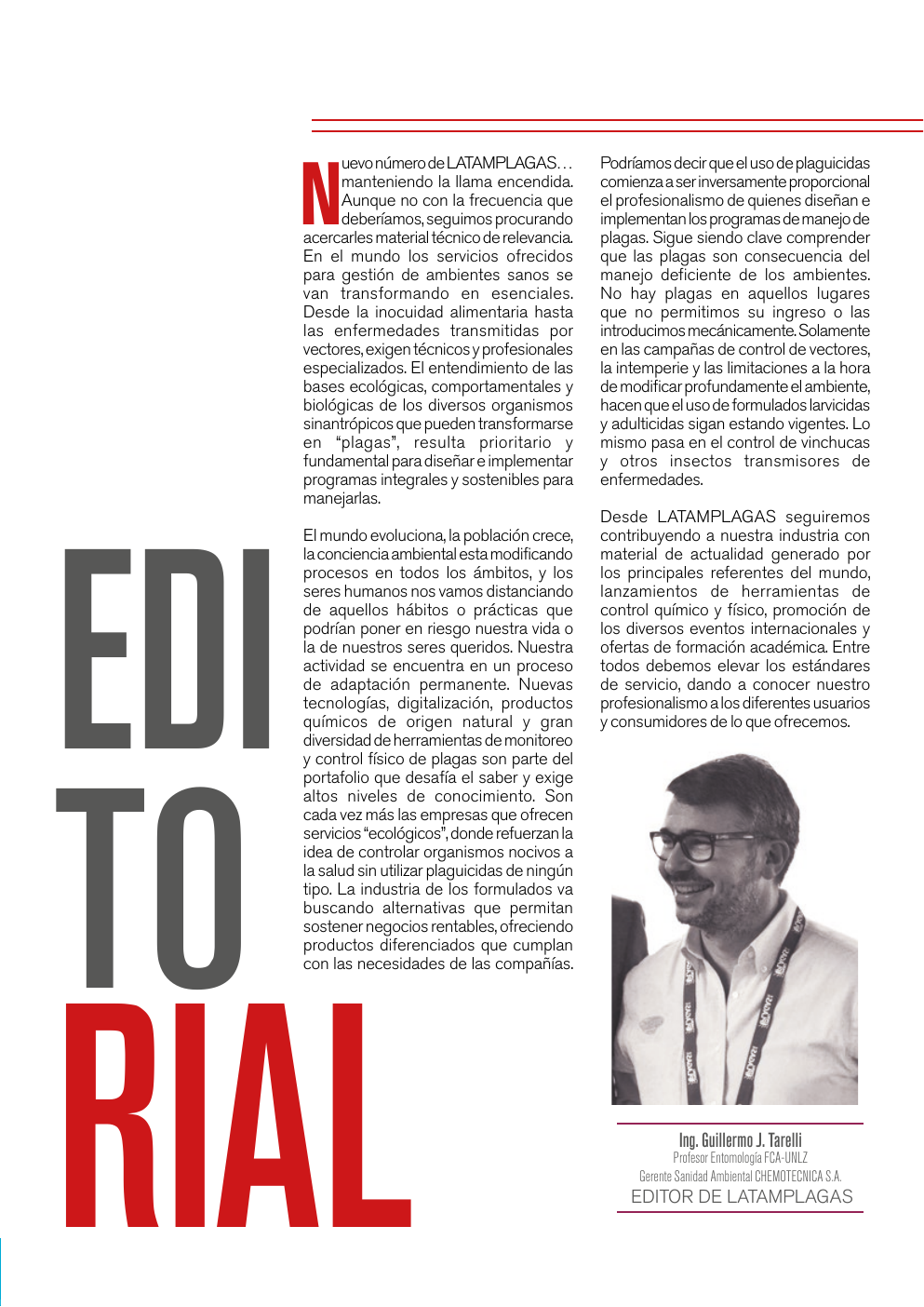
Ing. Guillermo J. Tarelli
Professor Entomology FCA-UNLZ Environmental Health Manager CHEMOTECNICA S.A.