
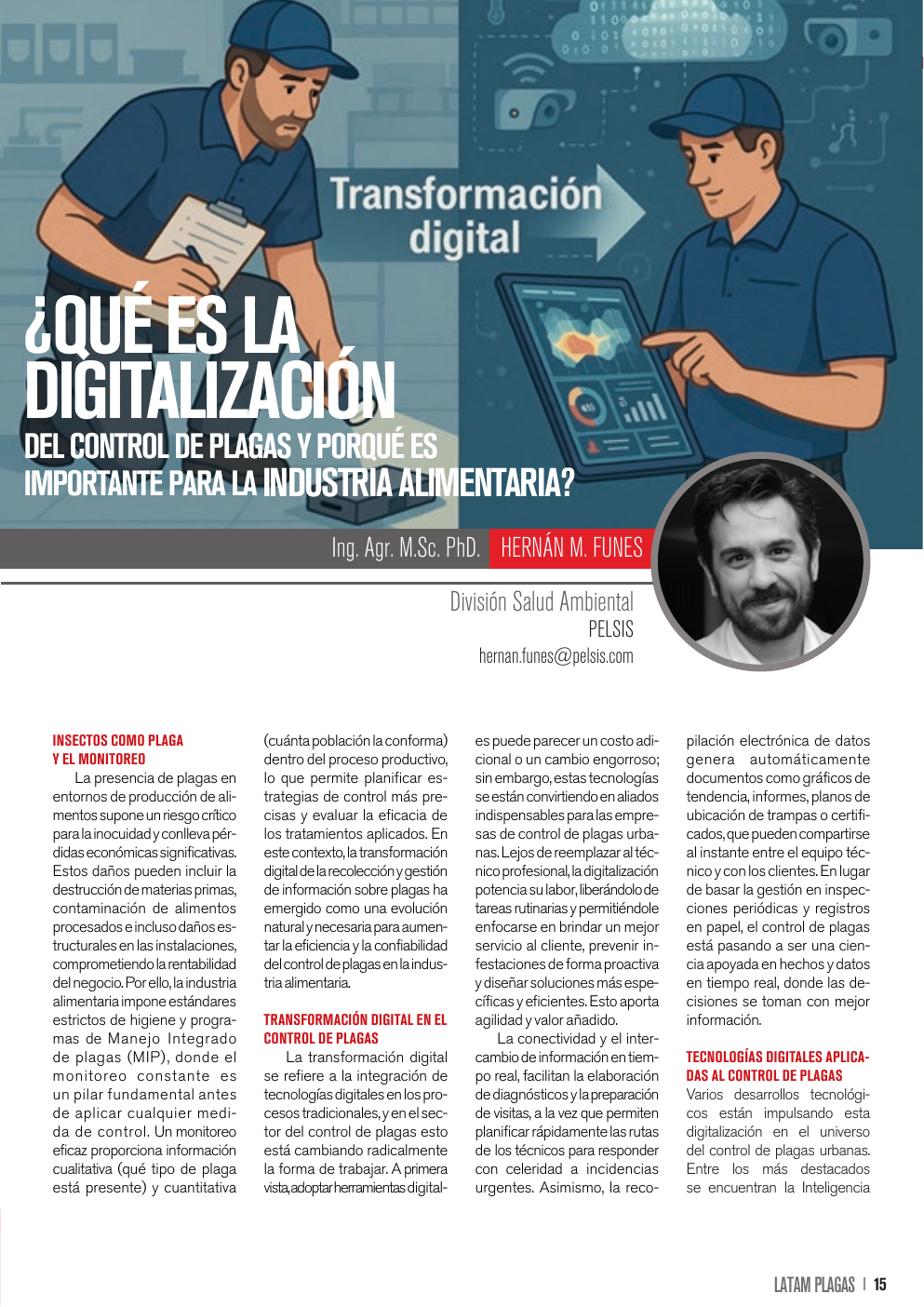
What is the digitalization of pest control and why is it important for the food industry?
Insects as pests and monitoring. The presence of pests in food production environments poses a critical safety risk and leads to significant economic losses.
Technical summary
- Focus
- Insects as pests and monitoring The presence of pests in food production environments poses a critical safety risk and leads to significant economic losses.
- Approach
- The article structures the analysis around Insects as pests and monitoring, Digital transformation in pest control and Digital technologies applied to pest control.
- Use
- Useful for professionals who need context, diagnosis and operational decisions in integrated management.
Index
Insects as pests and monitoring
The presence of pests in food production environments poses a critical safety risk and leads to significant economic losses. These damages can include the destruction of raw materials, contamination of processed foods and even structural damage to the facilities, compromising the profitability of the business. For this reason, the food industry imposes strict hygiene standards and Integrated Pest Management (IPM) programs, where constant monitoring is a fundamental pillar before applying any control measure. Effective monitoring provides qualitative (what type of pest is present) and quantitative information
(how much population it comprises) within the production process, which allows planning more precise control strategies and evaluating the effectiveness of the treatments applied. In this context, the digital transformation of pest information collection and management has emerged as a natural and necessary evolution to increase the efficiency and reliability of pest control in the food industry.
Digital transformation in pest control
Digital transformation refers to the integration of digital technologies into traditional processes, and in the pest control sector this is radically changing the way of working. At first glance, adopting digital tools may seem like an added cost or cumbersome change; However, these technologies are becoming indispensable allies for urban pest control companies. Far from replacing the professional technician, digitalization enhances their work, freeing them from routine tasks and allowing them to focus on providing better customer service, proactively preventing infestations and designing more specific and efficient solutions. This provides agility and added value. Connectivity and the exchange of information in real time facilitate the preparation of diagnoses and the preparation of visits, while allowing technicians' routes to be quickly planned to respond quickly to urgent incidents. In addition, electronic data collection automatically generates documents such as trend graphs, reports, trap location plans or certificates, which can be shared instantly between the technical team and with clients. Instead of basing management on periodic inspections and paper records, pest control is becoming a science supported by facts and real-time data, where decisions are made with better information.
Digital technologies applied to pest control
Several technological developments are driving this digitalization in the universe of urban pest control. Among the most notable are Intelligence
Artificial Intelligence (AI), which in recent years has gained ground due to the need for more efficient and sustainable solutions. Below are the main digital tools and their application in the sector, with emphasis on food environments: Remote monitoring: Conventional light traps evolve into smart traps equipped with sensors (motion, contact, pressure) and even cameras connected to the Internet. This equipment allows you to monitor pest activity in real time and receive immediate alerts when a capture occurs or movement is detected. For example, there are already electronic rodent traps that automatically notify each capture, avoiding having to manually check empty stations. Similarly, smart light traps for insects can detect the presence of a target species (e.g. plodia, musca domestica or drosophila) and provide early warning of its appearance. Environmental temperature and humidity sensors are even used to anticipate conditions conducive to infestations, integrating prevention into the system. A practical case of this technology is the equipment for capturing flying insects with cameras that photograph the adhesive plates and transmit the images via mobile network to a central platform. These systems allow daily monitoring of captured populations and store associated environmental data, facilitating rapid, evidence-based decision making. The connection guarantees 24/7 surveillance, even when the facilities are closed, detecting activity in hidden or difficult-to-access areas where a technician
It would be difficult to check frequently. Management platforms and software: Along with connected traps, companies have digital platforms (accessible via web or mobile apps) where all monitoring data is concentrated. These platforms record the location of each trap on maps or plans, generating control panels (dashboards) with key indicators: number of captures per day/week, activity levels per area, seasonal trends, etc. Centralized information not only speeds up the preparation of reports for audits, but also improves communication with the client, who can access updated reports on the status of their installation at any time. It should be noted that many of these applications include databases on pests and biocidal products (technical sheets, doses, safety measures), so that technicians have updated knowledge at hand that optimizes their decisions in the field. In the case of the food industry, where safety audits (IFS, BRC, etc.) demand exhaustive documentation, having traceable digital records of each inspection, capture and treatment applied is a crucial added value to demonstrate compliance and diligence. Data analysis and Artificial Intelligence: The large amount of data collected by devices opens the door to applying AI algorithms to obtain valuable insights. On the one hand, using artificial vision techniques, it is now possible to automate the identification of pest species from images. Similarly, in industrial environments
could differentiate between a house fly and a moth (Plodia for example) in a trap, guiding the technician on the probable origin of the infestation. On the other hand, AI applied to historical data series can predict in advance when and where pest problems are most likely to occur. Using models that correlate environmental, seasonal factors and activity patterns, you can anticipate, for example, a peak of rodents in a certain area before it happens, allowing for preventive action. These advanced analysis capabilities make pest control more proactive, optimizing the selection of times and places to intervene (for example, planning targeted applications of biocide only where and when it is really needed). In summary, data and AI turn them into actionable knowledge, promoting a cycle of continuous improvement in control strategies.
Advantages in the food industry
The digitization of information and the incorporation of intelligent tools provide multiple specific benefits in food industry facilities, where tolerance to the presence of pests is zero. The most relevant advantages are summarized below: Continuous monitoring and early detection: Unlike periodic inspections, digital surveillance is permanent. Connected devices allow constant 24/7 monitoring of critical areas and notify you as soon as they detect unusual activity. This early detection enables immediate interventions, preventing an isolated introduction from becoming an established infestation. In environments where a single pest can contaminate an entire production line, that quick reaction makes the difference. Operational efficiency and cost reduction: Smart traps optimize the work of the technician, who no longer needs to check each trap manually for captures. Instead of spending time checking empty devices, you can focus your efforts on areas where sensors have indicated activity. For example, if traditionally checking 20 light traps in a factory took several hours, with a digital system the technician receives a summary of which ones have high insect captures or levels and can go directly to them. This smarter use of time translates into fewer hours of routine inspection and more time for prevention efforts, root cause analysis of infestations, and customer communication. In fact, field studies have shown that remote monitoring saves up to hours of work per visit in large facilities by eliminating repetitive tasks. As a result, the pest control company can serve more clients or devote more specialized attention without increasing personnel costs. Improved accuracy and traceability: Digital systems automatically record each event (capture, sensor activation, etc.) with date, time and exact location, eliminating possible transcription errors in manual records. Real-time information reaches the technician and the customer with greater accuracy, and is stored to generate reliable histories. This makes it easier to meet audit requirements in the food industry, since graphs, heat maps and detailed reports can be presented that demonstrate compliance with reviews and the evolution of pest populations in the plant. Complete traceability of the pest control program provides confidence for food safety certifications. Rational use of pesticides and sustainability: A key benefit of digitalization is that it allows for more sustainable IPM. By knowing exactly where and when intervention is required, the use of biocides can be reduced to the minimum necessary. This minimizes the chemical load in the productive environment and reduces the risk of residues in food, aligning with the increasing regulatory demands for sustainability. In fact, the recent 2022 update of the IFS Food Guide highlights both sustainability and rapid digitalization as essential elements for integrated and responsible pest control in the food industry. In addition, travel efficiency (fewer routine inspection visits) leads to fuel and emissions savings, contributing to the program's positive environmental footprint. Added value and customer service: Implementing digital monitoring solutions also improves the value proposition of pest control companies towards their industrial clients. Customers can access transparent information about the status of their facilities, receive real-time alerts and check the actions taken, which builds trust. The service becomes more proactive:
Instead of waiting to find a pest in a monthly inspection, the client knows that their facilities are constantly monitored. This is especially appreciated in the food industry, where consumer protection and brand reputation are at stake. In short, digitalization allows us to offer a more agile, precise service adapted to the critical needs of the food sector, distinguishing the supplier company as technologically innovative.
Implementation challenges and considerations
Although the advantages are numerous, the adoption of digital technologies in pest control also entails challenges to consider: Initial investment and costs: The implementation of devices with this type of technologies, cameras and specialized software requires a notable financial investment at the beginning, as well as technical training of personnel. It is important to evaluate return on investment (ROI) in terms of efficiency and customer retention, especially for small pest service businesses. Infrastructure and maintenance: These solutions depend on a reliable technological infrastructure. Connectivity problems (e.g. poor Wi-Fi coverage in certain areas of the plant) or device failures can leave areas temporarily unmonitored. A preventive maintenance plan, technical support and redundancies are needed to guarantee continuity. Data management and cybersecurity: When centralizing sensitive data (such as facility plans, incident histories, etc.) it is crucial
protect the security and privacy of information. Platforms must have encryption and good computer security practices, since connected devices can be targets of attacks if they are not adequately protected. In addition, current data protection regulations must be complied with, especially when sharing reports with clients. Cultural adaptation: The transition to a digital model may face resistance to change from technicians accustomed to traditional methods and from some clients. It is essential to accompany the implementation with training, demonstrations of results and an adaptation period in which traditional and digital systems coexist until full confidence in the new tool is achieved. Communicating that technology comes to complement, not replace human labor, helps with acceptance.
Conclusions
The digitalization of information in urban pest control represents a paradigm shift that fits perfectly with the needs of the modern food industry. We are faced with modern and innovative pest control, where the combination of sensors, connectivity and data analysis transforms a traditional service into intelligent, preventive and documented management in real time. Companies in the sector that have embraced these innovations have managed to turn quarterly or monthly reviews into continuous data-based surveillance, detecting pests before even physically seeing them. This results in safer facilities, contamination-free food, and ultimately in greater protection of public health. The trend is unstoppable: international standards and end customers are raising their expectations, valuing the transparency, effectiveness and sustainability that digital solutions offer. Far from being a fad, digital transformation aligns with the principles of integrated pest management and the chemical reduction targets set by global initiatives such as the European Green Deal. In a sector as sensitive as the food industry, having a robust digital pest control system not only facilitates regulatory compliance, but also provides peace of mind to all those involved in the production chain. In summary, digitalization in urban pest control has ceased to be optional and has become a new quality standard. Those disinfection and pest control service companies that successfully integrate these technological tools will be better positioned to offer a more precise, faster and reliable service, helping to protect food safety in a more effective and sustainable way. The era of carrying a logbook in one hand and a flashlight in the other is giving way to the era of cloud data and intelligent monitoring, where information flows instantly and guides concrete actions. This technical and professional leap forward portends a future in which we will keep pests at bay in our factories and food warehouses with never-before-seen efficiency, backed by data science and technological innovation.