
German cockroach: Blattella germanica
Among all insects, the most common is the cockroach. The fossils found are evidence that cockroaches have existed for more than 300 million years.
Technical summary
- Focus
- The fossils found are evidence that cockroaches have existed for more than 300 million years.
- Approach
- The article structures the analysis around Habitat and behavior, If cockroaches are present during the day it could be due to three reasons: and Life cycle.
- Use
- Useful for professionals who need context, diagnosis and operational decisions in edición 4.
Index
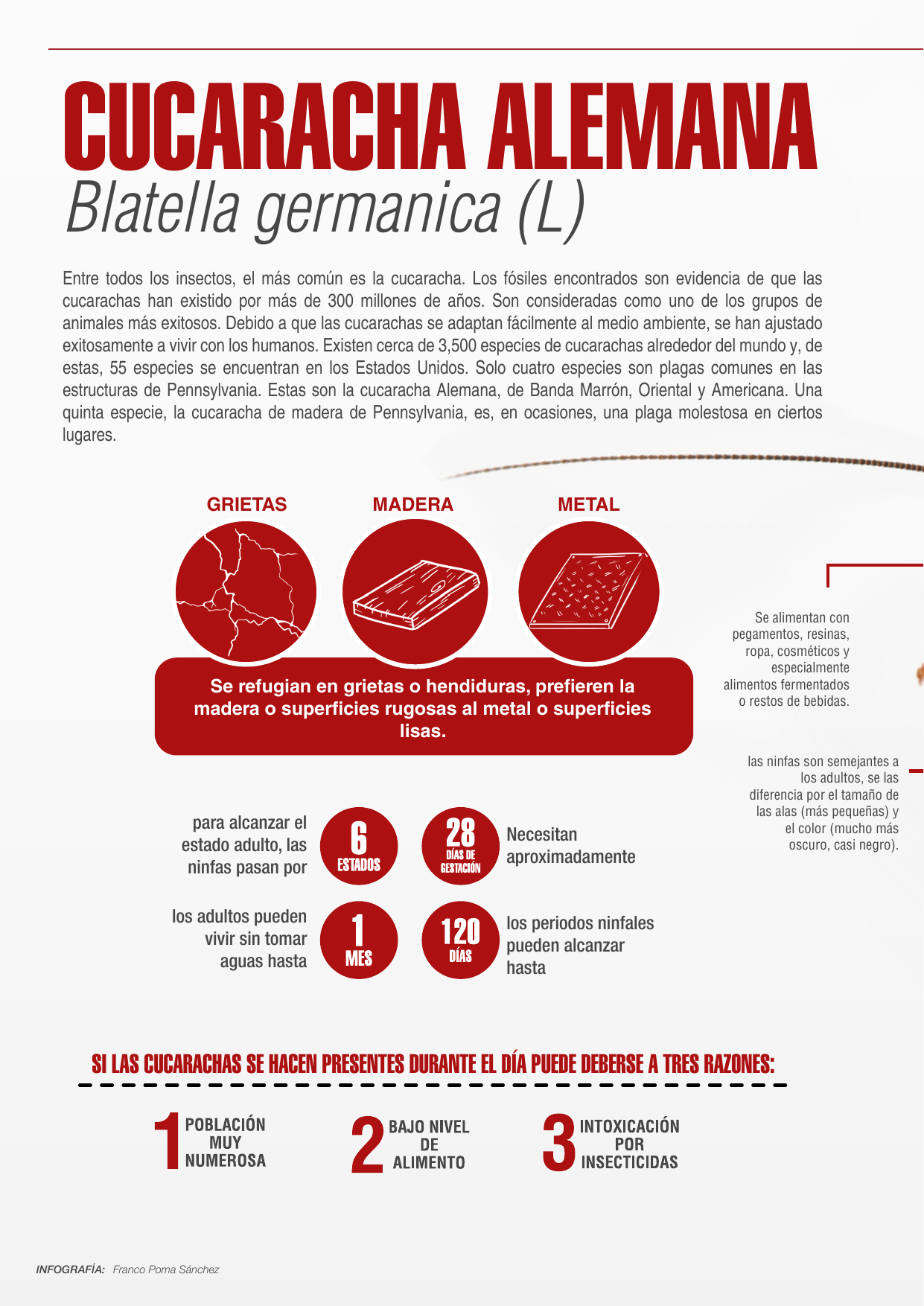
Among all insects, the most common is the cockroach. The fossils found are evidence that cockroaches have existed for more than 300 million years. They are considered one of the most successful groups of animals. Because cockroaches adapt easily to the environment, they have successfully adjusted to living with humans. There are about 3,500 species of cockroaches around the world, and of these, 55 species are found in the United States.
Only four species are common pests of Pennsylvania structures. These are the German, brown-banded, oriental and American cockroach. A fifth species, the Pennsylvania wood cockroach, is sometimes a nuisance pest in certain locations.
Habitat and behavior
They take refuge in cracks or crevices. They prefer wood or rough surfaces to metal or smooth surfaces.
They feed on glues, resins, clothing, cosmetics and especially fermented foods or leftover drinks.
The nymphs are similar to the adults. They are differentiated by the size of the wings, which are smaller, and the color, which is much darker, almost black.
To reach the adult stage, the nymphs go through 6 stadiums. They need approximately 28 days of gestation.
Adults can live without drinking water until 1 month and the nymphal periods can reach up to 120 days.
If cockroaches are present during the day it could be due to three reasons:
- Very large population.
- Low level of food.
- Insecticide poisoning.
Life cycle
The ootheca measures 7 to 9 mm.
Nymph 1 measures 2 to 3 mm; nymph 2, 2.5 to 5 mm; nymph 3, 4 to 7 mm; nymph 4, 6.5 to 9 mm; and nymph 5, from 8 to 11 mm.
In their adult period they are light brown in color and measure up to 2.5 cm. The adult measures 10 to 15 mm.
Females produce up to eight oothecae in which 30 to 48 eggs are housed.
The female places the eggs inside an ootheca that she carries throughout the entire gestation period.
The nymphs come out of the ootheca even when the female is carrying it or when they deposit it in some place where they have food and adequate temperatures.
If the ootheca is detached from the female prematurely, it is very likely that all its members will die.
Source: https://www.ento.psu.edu/extension/factsheets/es/es-german-cockroaches