Synanthropic rodent control and MIR concept
Rodents have been classified as a pest with a very high level of adaptability, resistance to adverse conditions and reproductive rate.
Technical summary
- Focus
- Rodents have been classified as a pest with a very high level of adaptability, resistance to adverse conditions and reproductive rate.
- Approach
- The article structures the analysis around IMPORTANCE OF ACTIVE INGREDIENTS AND FORMULATIONS and CONCEPT OF INTEGRATED RODENTS MANAGEMENT (MIR).
- Use
- Useful for professionals who need context, diagnosis and operational decisions in rodents.
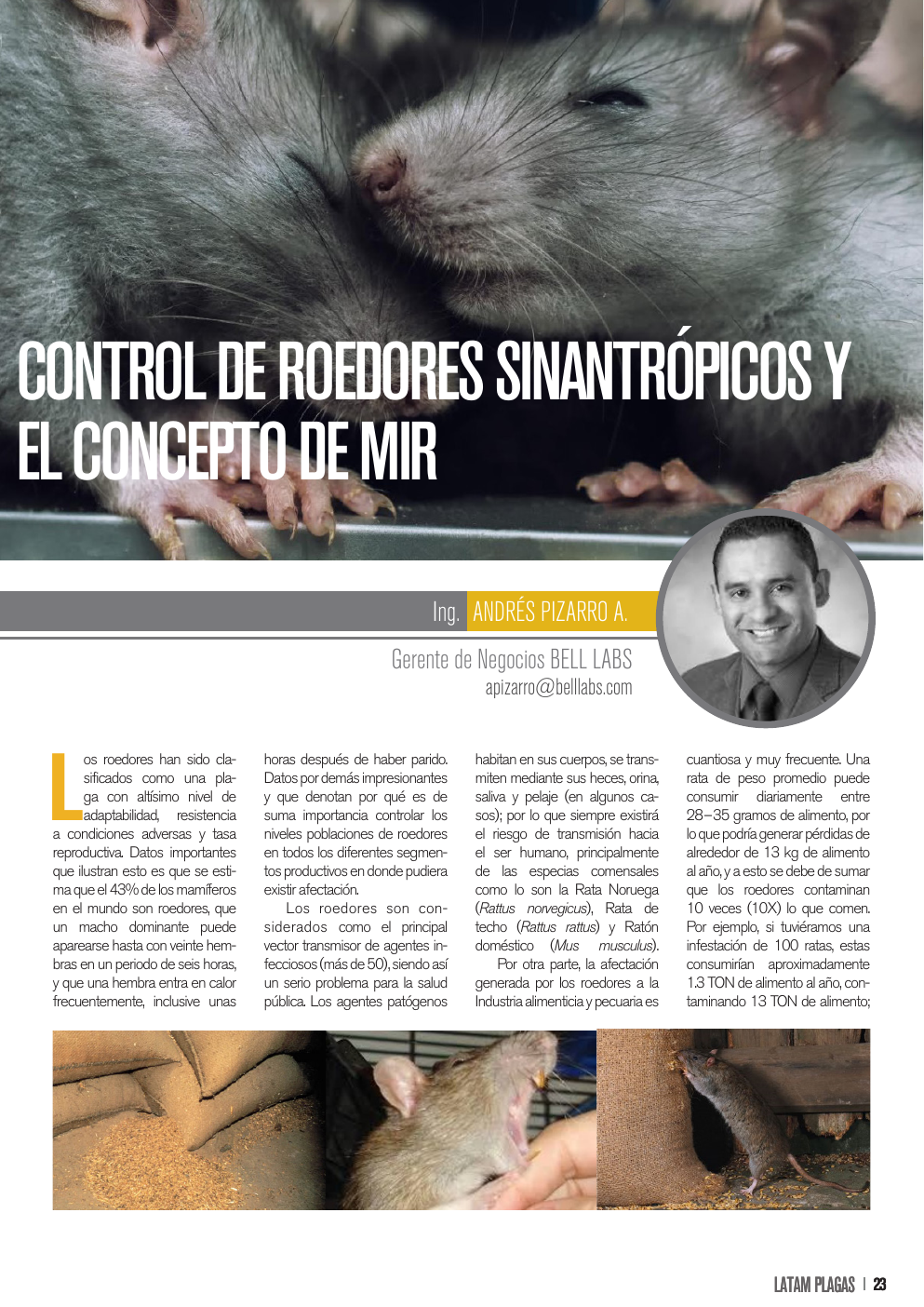
Rodents have been classified as a pest with a very high level of adaptability, resistance to adverse conditions and reproductive rate. Important data that illustrate this is that it is estimated that 43% of the mammals in the world are rodents, that a dominant male can mate with up to twenty females in a period of six hours, and that a female comes into heat frequently, even a few
hours after giving birth. These data are impressive and show why it is extremely important to control rodent population levels in all the different productive segments where there could be an impact. Rodents are considered the main transmitting vector of infectious agents (more than 50), thus being a serious problem for public health. Pathogens
They live in their bodies, they are transmitted through their feces, urine, saliva and fur (in some cases); Therefore, there will always be the risk of transmission to humans, mainly from commensal species such as the Norway Rat (Rattus norvegicus), Roof Rat (Rattus rattus) and House Mouse (Mus musculus). On the other hand, the impact generated by rodents on the food and livestock industry is
large and very frequent. A rat of average weight can consume between 28–35 grams of food daily, so it could generate losses of around 13 kg of food per year, and to this we must add that rodents contaminate 10 times (10X) what they eat. For example, if we had an infestation of 100 rats, they would consume approximately 1.3 TON of food per year, contaminating 13 TON of food;
These are undoubtedly data that should be of concern and generate immediate actions to follow to control the pest. Starting from relevant facts such as those mentioned above, it is imperative to know in detail which species of rodent is generating a certain infestation, its routes of passage, its behavior and then generate solutions according to the available tools, to achieve the objective of reducing the population of the colony.
IMPORTANCE OF ACTIVE INGREDIENTS AND FORMULATIONS
The vast majority of rodenticides today have as an ingredient
activate some anticoagulant molecule. Its mechanism of action is to block the Vitamin K cycle, preventing blood clotting and therefore generating internal bleeding in the rodent. There are first generation anticoagulants, in which the rodent needs to eat them repeatedly to obtain the lethal dose, and its subsequent death will be after 10-15 days. On the other hand, second generation anticoagulants require a single ingestion to obtain the lethal dose, causing death 3-5 days later. The latter are the most used in the Industry, with Brodifacoum being the most powerful (most toxic) anticoagulant currently available. To talk about the history of anticoagulant rodenticides we must go back to the 1920s, in the state of Wisconsin, USA.
In that decade, many dairy producers suffered losses due to the death of their cattle due to ingesting sweet clover hay, which had become contaminated with mold. In the 1930s, one of these producers decided to take his dead animals to the University of Wisconsin (Madison), where Professor Karl Link discovered that the molecule causing the poisoning was Dicoumarol. Later, in the 1940s, the same Professor Link continued experimenting with Dicoumarol derivatives, discovering that molecule #42 was highly toxic; Later this molecule was known as Warfarin and patented in 1948. Warfarin is then known as the first anticoagulant created in the industry, and its therapeutic effects are still known for certain treatments in humans today. Then other compounds emerged such as Difacinone, which is widely used as a rodenticide (first generation); Later, in the 1970s, second-generation anticoagulants emerged, the most used being Brodifacoum and Bromadiolone.
As for the different formulations, there are very varied and of varying quality on the market. A key aspect when deciding which rodenticide bait to use is undoubtedly being clear about its degree of palatability, acceptance, ingredients present in the formulation (if possible), and resistance to all types of environmental conditions. In particular, the baits from the BELL LABS company are formulated with 16-21 top quality ingredients or raw materials (human food grade), which makes them recognized as the most palatable baits in the industry. On the other hand, their bait blocks have sharp edges, which allows the rodent to follow its gnawing nature, making these baits widely accepted. Likewise, their bait blocks are manufactured with the highest standard of quality and resistance to extreme humidity and temperature conditions. The FINAL BLOX product brings together all the benefits of the most powerful anticoagulant molecule available in the Industry (Brodifacoum), together with the 45 years of leadership in research and development of BELL LABS, for the creation of a rodenticide bait with extremely high effectiveness and palatability, proven resistance to adverse conditions and a unique combination of top quality ingredients. These characteristics have placed this product as number 1 in preference for pest control professionals and livestock producers in the USA, and in Latin America more and more people have decided to use this rodenticide as part of their rodent control programs.
CONCEPT OF INTEGRATED RODENTS MANAGEMENT (MIR)
Success in being able to have adequate control of the rodent infestation lies in knowing very well the behavior of the pest rodent(s) and how to apply the acquired knowledge and tools in an articulated way to achieve the objectives. From a practical perspective, the concept of Integrated Rodent Management should be a basic manual to follow to achieve this goal. The most important points of the MIR concept and a brief explanation of each of them are presented below: 1.INSPECTION. It is still possible to find cases where rodent control programs are established without having previously carried out an adequate inspection. This is the first step, since you must identify which species of rodent is causing the problem, its route of passage, the points of greatest infestation and, if possible,
Identify the burrows. It is extremely important to use all the tools available for the inspection, but above all the communication that we can establish with the person in charge, and that everything is well documented. One aspect that I always like to affirm is the importance of carrying out inspections both at ground level and at high points (roofs, ceilings, etc.), since the infestation problem could be anywhere.
- EXCLUSION. Exclusion methods are all those that will prevent the rodent from entering the facilities. Of course we could only establish these mechanisms by carrying out an exhaustive inspection. Examples of this are: eliminating invasive vegetation in the surroundings and between structures, properly closing ducts or vents, correcting damage to structures such as sidewalks, walls and roofs, among many others.
- BAITING AND TRAPPING. This important step is in which we are going to use all the tools and mechanisms available to reduce the rodent population. I always recommend that rodenticide baits should be used and, in addition, non-toxic methods that are available. Examples of the latter are bait stations, multiple capture traps, snap traps (such as the market leader, the TRAPPER T-REX) and glue traps (for both rats and mice). By using toxic products together with non-toxic ones, we will be carrying out a complete program and we will always have more possibilities of winning the game against rodents.
- REDUCTION AND CONTROL. If a good baiting and trapping program is established (previous point) the infestation will be reduced, which will cause fewer rodent sightings in the short term. This is a good sign, but you must be strict in controlling and monitoring the bait points to prevent the infestation from growing again. It should never be forgotten that rodents are highly prolific animals, so they will soon cause us problems again.
- MAINTENANCE AND MONITORING. It goes without saying that within an MIR the maintenance of our program
It must be done ALL year round. Constant monitoring of the baiting points and the placement of non-toxic products will determine the success that can be obtained at the infestation site. You should always ensure that the bait you place is fresh, so that it is attractive and palatable to the rodent. For this, it is advisable not to leave a bait unreplaced for more than 15 days as a general rule, although there are always variations. Rodents are truly fascinating animals and every day they impress more and more all of us who have seen their evolution over time. However, if we can use observation, ingenuity, the tools that the Industry gives us, and a lot of patience, it is possible to control the pest, but not eliminate it. Rodents are here to stay and will continue to be close to humans as long as we provide them with shelter, food and water sources, so control must be increasingly strict.