
Pest control in museums and objects of heritage importance I: the use of inert gases
Over the centuries, one of the most important causes of loss of cultural property and museum collections has been due to insect damage.
Technical summary
- Focus
- Over the centuries, one of the most important causes of loss of cultural property and museum collections has been due to insect damage.
- Approach
- The article structures the analysis around REDUCED OXYGEN ATMOSPHERES.
- Use
- Useful for professionals who need context, diagnosis and operational decisions in edición 6.
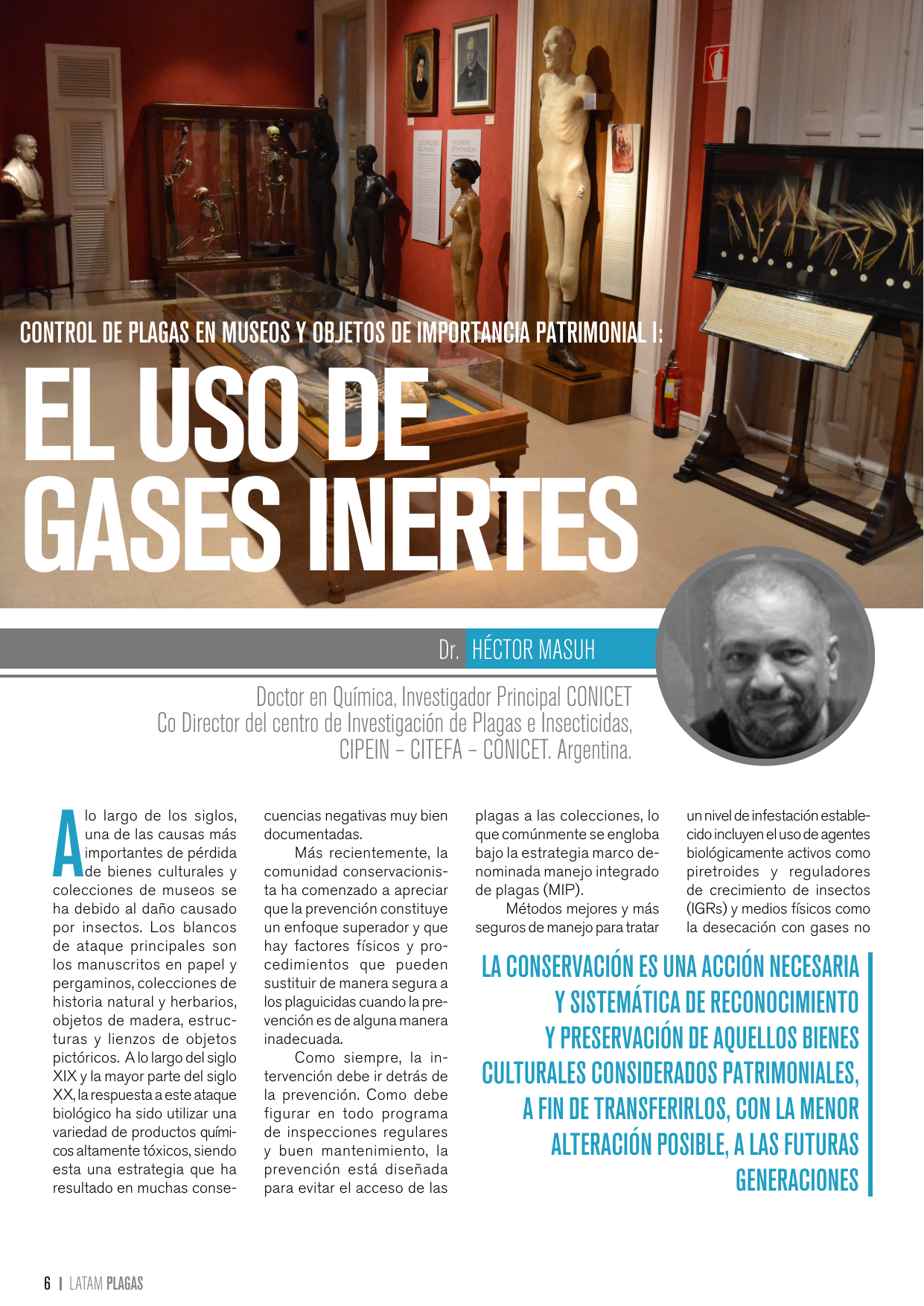
Over the centuries, one of the most important causes of loss of cultural property and museum collections has been due to insect damage. The main targets of attack are paper and parchment manuscripts, natural history collections and herbaria, wooden objects, structures and canvases of pictorial objects. Throughout the 19th century and most of the 20th century, the response to this biological attack has been to use a variety of highly toxic chemicals, a strategy that has resulted in many well-documented negative consequences.
More recently, the conservation community has begun to appreciate that prevention is a superior approach and that there are physical factors and procedures that can safely substitute pesticides when prevention is somehow inadequate. As always, intervention must follow prevention. As should be included in any program of regular inspections and good maintenance, prevention is designed to prevent pests from accessing collections, which is commonly included under the framework strategy called integrated pest management (IPM).
Better and safer management methods to treat an established level of infestation include the use of biologically active agents such as pyrethroids and insect growth regulators (IGRs) and physical means such as desiccation with non-toxic gases, heat treatments, cryogenics and irradiation methods. The level of difficulty is enormous: not only must we control a pest by knowing its taxonomy and behavior, preserving other non-target organisms, and in places with high exposure to humans; We must also consider the physical support that is the target of the pest's attack so that it remains unchanged. We consider here only an approach to conventional treatment that includes oxygen atmosphere reduction methods. In future installments we will talk about other physical and chemical treatments.
Conservation is a necessary and systematic action of recognition and preservation of those cultural assets considered heritage, in order to transfer them, with the least possible alteration, to future generations.
REDUCED OXYGEN ATMOSPHERES
Low oxygen atmospheres can be produced by recirculating a storage system with nitrogen or argon, or by using an oxygen scavenger to remove oxygen from a closed system. Numerous studies have been conducted to determine optimal treatment times for particular insect pests, but as yet no rigid rules have been developed as there are many factors to consider.
In any institution or collection, a carefully designed program must be established as a preventive measure, being a fundamental requirement in institutions that protect great heritage value.
However, some general principles do apply: shorter treatment times will be effective if higher temperatures, lower relative humidity levels and lower oxygen concentrations are used, and if argon is used instead of nitrogen as the inert gas. To be most effective against insect pests, the oxygen concentration should be maintained in the range of 0.1 – 0.3%, a value that should be recorded continuously. A typical treatment would take approximately 4 weeks if the temperature is 25° C, much less at 30° C with an oxygen content of less than 0.1%.
Eliminating insects using oxygen-poor atmospheres is a useful and non-polluting alternative for objects that cannot be treated by other physical methods, for example freezing.
The method of reducing the oxygen concentration will be determined by the size of the object to be treated and the availability and cost of appropriate equipment and experience. Methods that can be used to treat infested objects include flowing an inert gas, for example nitrogen or argon, into a bag until the oxygen concentration is less than 0.1% and then adjusting the gas flow to maintain the low oxygen level; flow into a bag as described above and seal it after an appropriate amount of an oxygen scavenger has been added; or add a calculated number of sachets of the oxygen scavenger to a bag and seal it.
The principle behind this technique is based on the dehydration of the insect by increasing its respiratory rate due to the condition of anoxia.
In all cases, the bags where the artifacts to be treated are placed must be made of a material with a very low gas permeability. Suitable bags are typically multilaminates based on a number of different polymers including polychlorotrifluoroethylene, polyvinylidene chloride (PVDC), polyethylene terephthalate (PET) and ethylene vinyl acetate and ethylene vinyl alcohol (EVOH) copolymers. These products are sold under a wide variety of trade names. It is necessary to achieve the lowest possible OTR (oxygen transmission rate). Additionally, the film is required to be resistant to handling and thermofusion sealable.
The first two oxygen reduction methods, which are best suited for treating large objects, should be left to professionals. Specialized equipment is needed and careful control must be exercised over the relative humidity of the gas used to flush the system to avoid desiccation of sensitive objects. The oxygen concentration, temperature and humidity parameters must be recorded continuously. The gases used can be carbon dioxide, nitrogen or argon. Each one has advantages and disadvantages, which are considered according to the complexity of the piece to be treated.
The panorama that opens up by professionally using this alternative is enormous: it is an approach to pest management in complex scenarios, using systems that, despite requiring a technological base and experience, use non-toxic and highly effective elements in highly sensitive environments. This strategy is not only functional in the control of pieces of heritage value, but can also be used to control pests in packaged foods. But that is a topic for the next article.
The penetration is excellent, making this methodology very useful in the treatment of xylophagous insects and pests of grains and processed foods.